
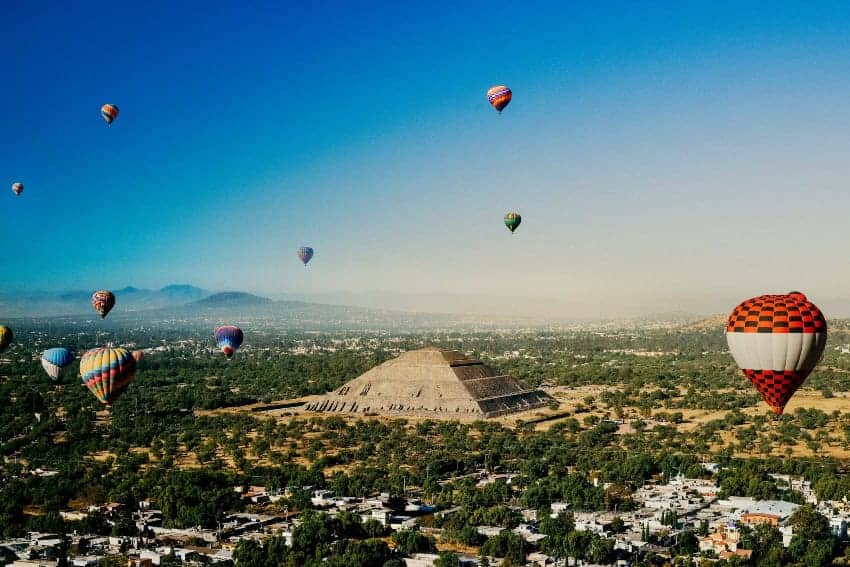
Anybody who has traveled out to Teotihuacán in the early morning will have been delighted at the sight of dozens of hot air balloons rising into the sky. Mexico’s hot air balloon tourist industry carries about 60,000 passengers annually and generates US $25 million in revenue. Business has not yet peaked, with annual growth predicted at around 7%. While the vast majority of tourists fly over the Sun and Moon pyramids, there are companies offering flights in other places, most notably San Miguel de Allende. Indeed, the real home of Mexican ballooning might be said to be León, where the Festival Internacional del Globo is the largest balloon festival in Latin America, featuring 200 hot air balloons and attracting 400,000 spectators. It is a remarkable comeback for an activity that nearly died out at the beginning of the 20th century. The early flight of José María Alfaro Guiles The man credited as the pioneer of ballooning in Mexico, and the first Mexican to take to the air, was José María Alfaro Guiles. His flight occurred, if it did, just six months after the Montgolfier brothers captured the world’s imagination by soaring over Paris. Guiles had no direct contact with the French pioneers and only learned of their achievement thanks to a brief report in an international newspaper. Having some engineering skills, he decided to try ballooning for himself. Guiles started by constructing small paper balloons with little more than a nightlight to lift them. His models increased in size until on May 18, 1784, a crowd gathered in the city of Xalapa to watch him climb into the basket and successfully ascend into the sky. According to the commonly accepted account, he piloted the craft across the countryside for about 9 kilometers (5.6 miles), reaching heights of around 800 meters (2,600 feet). This historic achievement was recorded in the Gazeta de México, then a new publication that had been founded only a few months before. The report came out June 2 and was brief: “Xalapa. There has been manufactured in this town a hot air balloon, similar to those described in the latest Gazetas from Madrid, crafted by Don Josef María Alfaro: it measures approximately 18 Castilian varas, and it is believed it will have the desired effect, given the precision and care with which it has been built, of which the public will be notified.” (A Castilian vara is a traditional Spanish unit of length equal to approximately 33 inches or 0.84 meters). 1889: When the world discovered Mexico Debating the evidence behind Mexico’s first flight However, whether José María Alfaro Guiles actually flew in his balloon is open to debate. Careful readers will note that this report is not of the flight of the balloon but of its construction, and no evidence is offered that the designer took his life in his hands and climbed into a paper balloon heated by an open fire. Pictures of the flight clearly show Guiles in a basket beneath the soaring balloon, but none of this artwork was created at the time. The first illustrations appeared many years later and were based on drawings of balloons in Europe. The next written account of the flight was by Manuel Rivera Cambas in his “History of Xalapa,” published in 1869. Here he confirms that Guiles made a successful manned flight of nearly 9 kilometers. Rivera Cambas is said to have researched the story by accessing local municipality archives and collecting oral accounts. However, we have no details of what papers he actually read in the archives, while oral histories are notoriously unreliable, especially if collected years after the event. One major reason to argue against a successful manned flight at this early date is that there were numerous balloons built in Mexico over the next 50 years, but none were big enough to carry a passenger. Early ballooning in Veracruz It was Veracruz that became the first center of ballooning in Mexico. While it was noted that altitude would make ballooning more difficult in Mexico City, the emergence of Veracruz was probably a coincidence. A local merchant, Antonio María Fernández, after reading of Guiles’ design, constructed a sizable balloon and watched it ascend into the sky on Feb. 6, 1785. This captured the local imagination and led others to copy his experiment. While some of the balloons crashed and burned, a few rose and dramatically disappeared into the night sky. There was an interesting discussion about what farmers would make of a balloon if it landed close to a village. After all, peasants in France had attacked one of Montgolfier’s balloons with pitchforks. Hot air balloons captured the fancy of Mexico, with the golden age for flights occurring during the 19th century. (Public Domain) Ballooning in Puebla By the summer of 1785, Puebla had become another center of ballooning, and it is here that we find the first authentic attempt at a manned flight. There were two problems to overcome with a manned balloon: First, a balloon had to be a considerable size to carry a man’s weight; second, the man had to be brave enough to fly in a contraption that, based on the experience of smaller models, had a habit of bursting into flames. The Puebla balloon was large, about 10 meters (33 feet) in height and 20 meters (66 feet) in circumference, and quite sophisticated for the time, with the skin encased in a net and a basket attached for the passenger. However, the bigger the balloon, the more difficult it was to handle on the ground, and this happened to be a windy day. The balloon might well have lifted a few meters, but it was already being thrown around by the wind. It banged against a wall, the gondola broke and the attempt was abandoned. Foreign aeronauts introduce hydrogen technology By this point, Mexico was being left behind by the balloon revolution. In Europe, balloonists had already progressed from heating the air with an open flame to using lighter-than-air hydrogen, a gas not readily available in Mexico. Progress in ballooning was therefore made by foreigners who brought all the necessary skills and equipment with them. General Manuel de la Barrera, a prominent businessman who owned the San Pablo Bullring, was a pioneer of ballooning in the 1830s, and he persuaded aeronaut Adolfo Theodore to bring his balloon to Mexico. Despite his reputation for having made a successful flight in Cuba, Theodore’s visit was a disaster. The paying crowd was furious when his flight in May 1833 was canceled because of the weather, while the government halted a second attempt in October over safety concerns. Étienne-Gaspard Robert, a French aeronaut better known as Robertson, was far more successful. On Feb. 12, 1835, he lifted off in a balloon from the Plaza de Toros de San Pablo in central Mexico City and disappeared into the distance. He did not find his way back to Mexico City until Feb. 14, having traveled approximately 100 kilometers (62 miles). After this, he performed a series of exhibition flights, but he caught yellow fever in Veracruz and died in 1838. Spectacular exhibitions and national pioneers Ballooning was entering its golden period, and Fanny Calderón de la Barca, wife of the Spanish ambassador, left an account of an attempted flight in Mexico City in 1841. She noted the attendance of the rich and finely dressed, who were entertained by two bands. As for the balloon itself, it “swayed up and down in the midst of the plaza like a living thing.” On this occasion, the attempt to take off was abandoned after a hole was discovered in the fabric: “The people bore their disappointment very good-humouredly, although it was conjectured that the air traveller had merely proposed to himself to get their money without the slightest intention of performing.” It was Robertson’s flights that inspired the first generation of successful Mexican balloonists, led by Benito León Acosta. Born in Guanajuato in 1819, he entered the School of Mines in Mexico City and made his first ascent on April 3, 1842. His balloon remained airborne for a little over half an hour, and in an act of showmanship, he waved the Mexican flag to the crowd below. President Antonio López de Santa Anna was among the witnesses and sponsored many of Acosta’s later flights. The hero toured Mexico, but after an accident in Morelia where he fell from the basket, he concentrated on his career as an educator. 19th century Mexico through the eyes of an American aristocrat The legacy of Joaquín de la Cantolla y Rico Joaquín de la Cantolla y Rico was 10 years younger than Acosta, having been born in Mexico City in 1829. He entered the Military College and helped defend Chapultepec Castle during the American invasion. Starting in 1863, he built and piloted his own hot air balloons, capturing the public’s imagination with both his flying and his showmanship, often ascending while dressed in a formal frock coat and top hat. He received gifts from presidents and emperors and is featured in Diego Rivera’s murals. Even today, the small balloons flown at village festivals are known as globos de Cantoya. For all the enthusiasm, plans to find a practical use for balloons ran up against the great stumbling block that they could not be steered. Cantolla had the idea of encasing several of them into a more streamlined shape and adding an engine — creating an airship — but lacked the resources for such an ambitious scheme. Aeronauts already suspected that winds at high altitudes always blew west to east and wondered if this might be exploited to carry goods across the Atlantic, but this idea came to nothing. The one organization that might have made use of balloons was the army, as a tethered balloon makes a good lookout point. However, wars in Mexico were most likely to be fought in remote areas where transporting the heavy equipment required for balloons would be impractical. And so the great age of the balloon faded out with the arrival of ever more powerful and reliable airplanes. Who could have predicted that balloons would make a US $25 million comeback flying tourists over the pyramids of Teotihuacán? Bob Pateman lived in Mexico for six years. He is a librarian and teacher with a Master’s Degree in History.
The surprisingly long history of hot air ballooning in Mexico
Full Article
Original Source
Read the full article at Mexiconewsdaily →KhanList aggregates and links to publicly available news content. We do not host full articles from third-party sources. Always verify important information with original sources.