
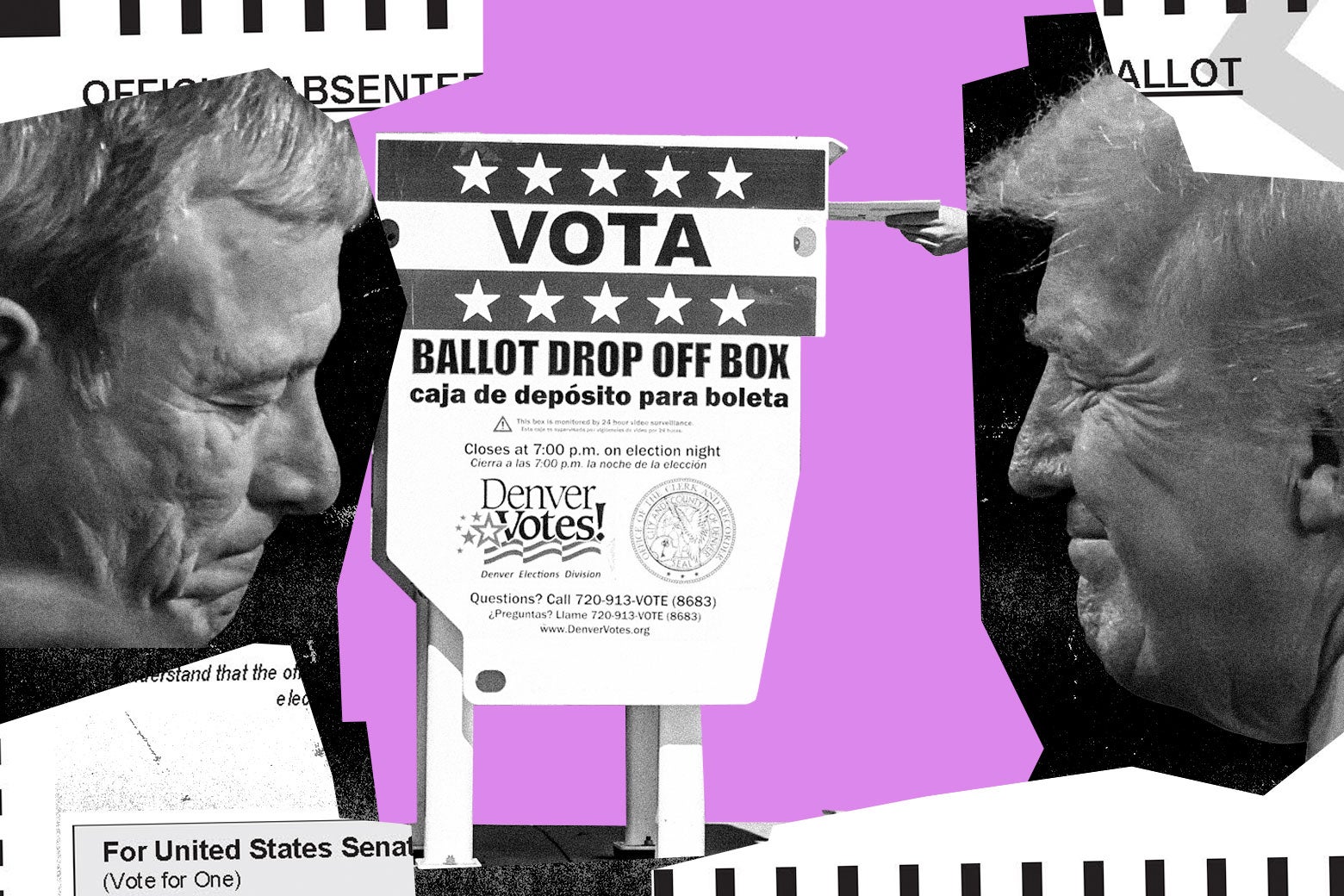
Jurisprudence By Enter your email to receive alerts for this author. Sign in or create an account to better manage your email preferences. Unsubscribe from email alerts Are you sure you want to unsubscribe from email alerts for Shirin Ali? Sept 25, 20265:38 PM He surely wouldn’t instigate an unlawful voter purge, would he? Photo illustration by Slate. Photos by Michael Ciaglo/Getty Images and Andrew Caballero-Reynolds/AFP via Getty Images. Sign up for Executive Dysfunction, a weekly newsletter that highlights one under-the-radar story about how Trump is changing the law—or how the law is pushing back—and keeps you posted on the latest from Slate’s Jurisprudence team. With one of the most consequential midterm election cycles ever just about five weeks away, the U.S. Supreme Court on Friday decided now would be as good a time as any to issue a bombshell decision granting the Trump administration permission to aggressively vet states’ voter rolls for noncitizen voting. The 6–3 decision allows the use of an expanded federal database that combines immigration status with Social Security data in order to identify potential noncitizen voting in states’ voter rolls, despite this system having a long history of falsely identifying voter fraud. Though the justices attempt to limit the application of this system to only individualized voter inquiries rather than mass voter roll purges ahead of the midterms, since federal law bans any systematic changes to voting processes 90 days ahead of an election, their decision hinges on the Trump administration and GOP-led states actually following the law. The Supreme Court’s conservative majority concluded that the federal government has an overriding right to assist states and local governments in safeguarding U.S. elections against noncitizen voting, over the objections from voting rights groups who argued the Trump administration’s approach violates federal privacy laws. Solicitor General John Sauer, in defending the Trump administration’s position before SCOTUS, claimed the database in question doesn’t disqualify voters but “merely notifies the States whether the federal government can confirm citizenship.” However, plaintiffs pushed back by noting that Congress never authorized the federal government to create a master database of all U.S. citizens, and what the Trump administration is attempting to do here is creating an “error-laden master citizenship database that endangers millions of Americans’ privacy and voting rights.” The database at the heart of this case is known as SAVE, Systematic Alien Verification for Entitlements, and it’s been in use since 1986. It was initially created to help state and local governments determine residents’ eligibility for social services like food stamps, meant to bridge the gap between state benefit administrators and federal immigration data—notably, not to identify U.S. citizens. This process began to pretty drastically change last year when President Donald Trump signed an executive order that instructed the Department of Homeland Security, the Social Security Administration, and the now-defunct Department of Government Efficiency to review states’ voter rolls and establish an expanded SAVE database that would allow states and local officials to verify citizenship or immigration status of people trying to register to vote. It quickly drew numerous lawsuits and parts of the order were blocked, but ultimately it still triggered an overhaul of the old SAVE system that’s essentially now up and running. Before SCOTUS’s decision this week, it was clear there were serious ramifications to the Trump administration’s overhaul of the SAVE database. In Nevada, Homeland Security told local election officials that they had a list of nearly 16,000 individuals who were suspected to be noncitizens. But, according to the New York Times, after meeting with Nevada election officials about it, Kimberley Vogt, a DHS official, admitted her agency had not had “a full manual review of each one”—exactly what SCOTUS now says is the only application of the expanded SAVE database that the federal government could appropriately apply ahead of the midterms. Following that meeting, Vogot then told Nevada officials that DHS had in fact manually reviewed some of the 16,000 or so suspected noncitizens and “confirmed 185 are not U.S. Citizens.” On Thursday, one day before SCOTUS’s decision, Nevada Deputy Attorney General Greg D. Ott wrote to DHS that every single person of the 185 identified by DHS was, in fact, a lawful U.S. citizen. Oh, and DHS had still not shared their list of nearly 16,000 individuals the agency claimed might be noncitizens. As if this was not disturbing enough, alarm bells have been ringing for months around the Trump administration’s efforts to expand SAVE. Back in January, the New York Times uncovered that DHS ran close to 50 million voter files through its expanded SAVE program and seemingly identified about 10,000 voters as potential noncitizens. Even if every single one of those voters were in fact noncitizens, it would represent just 0.02 percent of the total number of registered voters within the voter files searched, a reasonably low error rate. In June, the Brennan Center for Justice also explained how large-scale data matching programs always carry the risk of false positives, so any registered voters flagged by a mass voter database need to be investigated and given a chance to clear up mistakes before being removed from rolls. There’s also no evidence that any of the potential noncitizens on this list actually voted. This is a point Justice Ketanji Brown Jackson similarly impressed upon in her dissent of SCOTUS’s Friday decision, writing that “the harm caused by burdening or disenfranchising even a few lawful voters outweighs the nonexistent harm that the Government experiences when it is prevented from taking an action that it likely lacks the authority to take.” She also noted a case in Texas, where a woman saw her voter registration revoked without her knowledge, an occurrence the conservative majority simply did not address. It’s also worth noting that U.S. District Judge Sparkle Sooknanan of D.C., whose stay SCOTUS overturned, previously concluded that the way in which the Trump administration was going about expanding SAVE “flunked compliance” with the Social Security Act, the Privacy Act, and the Administrative Procedure Act by “haphazardly” combining and repurposing “the private information of millions of Americans, including citizenship data that they knew to be unreliable.” There are plenty of unaddressed questions coming out of SCOTUS’s decision, like is there any mechanism for voters to track their ballots to ensure they do in fact get counted? What about voters who already cast their ballots, does the high court’s ruling apply retroactively? All Americans can do now is hope the Trump administration does in fact only investigate noncitizen voting on an individual basis and that their local election officials stand by them, instead of falling under the pressure of a vindictive president. Donald Trump Jurisprudence Republicans Supreme Court Voting Voting Rights Ketanji Brown Jackson
The Supreme Court Bets That Trump and GOP States Will Follow the Law on Voter Purges. Uh-Oh.
Full Article
Original Source
Read the full article at Slate →KhanList aggregates and links to publicly available news content. We do not host full articles from third-party sources. Always verify important information with original sources.