
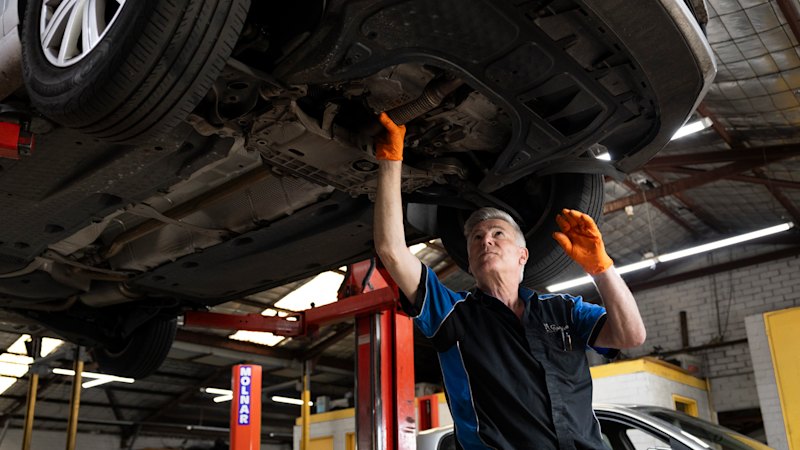
September 7, 2026 — 6:00pmEasily repairable cars are increasingly being written off after minor accidents due to delays in sourcing replacement parts from vehicle manufacturers, Australia’s peak mechanics body says, as insurers concede that the barriers to repair are inflating premiums for all motorists.Frustration at carmakers has flared up since average repair times blew out from 38.57 days in 2019 to 61.25 days in 2024, according to data from the Insurance Council of Australia (ICA). It’s been identified as a key contributor to rising motor insurance premiums, which the corporate regulator found have risen about 50 per cent in six years.Tom Horne of Castle Automotive in Artarmon, Sydney, says dealing with manufacturers has become a growing headache.Janie BarrettStubborn delays for replacement parts have persisted since Australia’s car manufacturing sector shuttered last decade, exacerbated by the proliferation of new brands now imported into the country and more electric componentry and sensors that make modern repairs more complex.Electric vehicle uptake has also complicated the repairs ecosystem, with traditional mechanics needing to undergo electrical training to de-power and repower batteries before and after working on such cars.Insurer policy changes over the past decade, including an industry-wide shift to allow repairs using refurbished parts not sourced from the original manufacturer, have helped to reduce delays for some tasks, but shortages remain a key problem for mechanics and insurers.Difficulty sourcing parts from manufacturers who are keen to steer customers to their in-house branded dealerships for repairs has become so severe that independent mechanics sourcing parts as simple as replacement panels can exceed four months, said Motor Trades Association of Australia (MTAA) executive director Bruce Billson.As a result, where policyholders are entitled to a replacement vehicle while waiting for a repair, insurers must weigh up the cost of a rental car for that period, and whether it is cheaper than writing off the customer’s vehicle at its agreed value.“We are aware of insurance companies writing off vehicles because of an inability to access parts in a timely way,” said Billson, a minister for small business under the former Abbott government.“For some vehicles, you’re waiting 22 weeks for a part, and you might get a car written off because it’s uneconomic to repair,” he said. “The cost of the rental car becomes a critical part of whether your insurance will write it off.”As a result, relatively new cars that should have years left on the road are being sold at auction, in some cases to be dismantled for their increasingly lucrative spare parts, Billson said.“You may have clipped your bumper from running over your kid’s bike, but if your comprehensive policy includes a rental car hire while you wait for a repair, you may just find your car gets written off instead,” he said.Since 2022, carmakers have been required to share diagnostic and repair data with independent mechanics, known as the “right to repair”. Billson said that while these were well intentioned, there should also be a “right to timely access to parts for repairs”.MTAA executive director Bruce Billson.Natalie BoogThe result of otherwise repairable cars being written off prematurely is unnecessarily adding to insurers’ costs, and inflating the size of the pool of money they need to raise from customers’ premiums across the board to be in a position to fulfil policyholders’ claims.An insurance council spokeswoman echoed the MTAA’s concerns and said that “delays in the supply of parts are a real and growing problem”.“When a vehicle sits waiting months for a part, repairs take longer, costs rise, and more cars end up being written off rather than repaired, and those pressures ultimately flow through to premiums,” she said.The council also wants the right-to-repair laws strengthened to include parts access.”Insurers and repairers both want parts available when a vehicle needs them, and we are asking government to require manufacturers to supply them in a timely manner,” the council spokeswoman said.Tom Horne, owner and head mechanic of Castle Automotive in Sydney’s Artarmon, said that dealing with manufacturers has become a growing headache in his 35 years in the trade.He recalled a recent repair of a small car, where the wait for a replacement brake hose stretched more than a month. “The car just sat there. It’s stuck here waiting.”Manufacturers are also charging more for parts, he said. “It can now cost $3000 for a smashed headlight because it’s an LED and you can’t just replace the globe. The car may only be worth $3000, so you may just scrap it,” he said.Car design is also turning what were previously easy fixes into cumbersome, prolonged tasks. On some new cars, Horne’s hand doesn’t fit in the gap where he needs to access a headlight for replacement. “They make it so hard,” he said.Merle Rogers, Castle Automotive’s workshop manager, said that manufacturers were deliberately throwing repair obstacles at independent mechanics.In the past year, several large car brands have begun blocking access to car diagnostics and dashboard control, requiring third part mechanics to pay for virtual tokens to be able to switch off service alerts, despite cars being fully repaired and roadworthy.“We serviced a car, rang up the manufacturer, asked how to turn the service light off, and they said you’ll have to service it again for us to turn the light off. We told them we’d just serviced it, but they said that didn’t matter,” Rogers said.Other manufacturers outright refuse to sell parts to independent operators. Horne does try to source secondhand parts to avoid manufacturers’ long wait times and high prices, but said that the used market is unreliable. “You spend hours on the phone trying to track down the right part,” he said.These barriers mean that the right to repair isn’t always a reality, the MTAA said.Assistant Minister for Competition Andrew Leigh said the government’s consumer law changes coming into effect from mid-next year would introduce stronger penalties for companies that fail to comply with the consumer guarantees framework, which includes a right to repair.However, he did not address specific changes to the motor vehicle-specific “right to repair” laws that the MTAA and insurance council have been calling for.“It’s clear that delays in accessing parts can cause real frustration and cost,” Leigh said. “Where businesses fail to meet their obligations, consumers need confidence that the law has real teeth.”The Business Briefing newsletter delivers major stories, exclusive coverage and expert opinion. Sign up to get it every weekday morning.Elias Visontay is a National Consumer Affairs Reporter at The Sydney Morning Herald and The Age.Connect via email.From our partners
The supply crunch writing off cars early and jacking up insurance premiums
Full Article
Original Source
Read the full article at Smh →KhanList aggregates and links to publicly available news content. We do not host full articles from third-party sources. Always verify important information with original sources.