
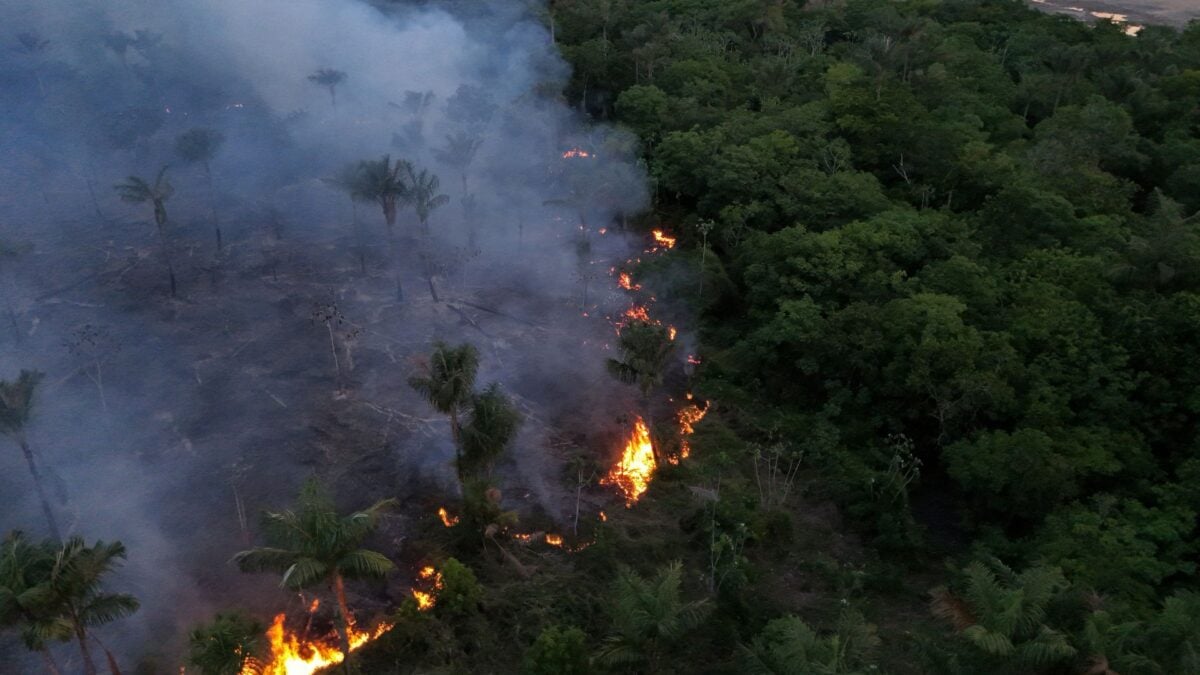
As the strongest El Niño on record continues to intensify, its effects are already being felt around the world. In the Amazon Rainforest, wildfire season is off to a brutal start. In September, satellites detected a sharp rise in fire activity and smoke emissions in the central and eastern Amazon, according to NASA. The burning region stretches from forests surrounding the Brazilian cities of Manaus and Santarém to the mouth of the Amazon River. Data from Brazil’s Amazon surveillance system shows that there were 1,679 fires in Brazil’s Amazonas state in the first two weeks of October, a 253% surge compared to the same period last year, Reuters reports. On October 12, NASA’s Aqua satellite captured images of smoke billowing from fires on both sides of the river and blanketing Manaus, the capital of Amazonas state. The MODIS (Moderate Resolution Imaging Spectroradiometer) on NASA’s Aqua satellite captured this image of smoke from fires on both sides of the Amazon River on October 12, 2026. © NASA Earth Observatory images by Lauren Dauphin, using MODIS data from NASA EOSDIS LANCE and GIBS/Worldview City officials reported extremely poor air quality that day, with fine particulate matter (PM2.5) values above 135 micrograms per cubic meter. The hazardous conditions have forced residents to wear face masks, schools to close, and municipal administrative offices to suspend in-person work. According to Douglas Morton, an Earth system scientist at NASA’s Goddard Space Flight Center, the burning around Santarém and Manaus is part of a “cascade” of fire in the tropics that accompanies El Niño’s effects on rainfall patterns. Indeed, many of the same forests that burned during the El Niños of 2023 and 2015 are now burning again. “It’s so striking—and frustrating—that this is happening all over again,” Morton said in a statement. “Given the intensity of this El Niño, this really is the year for people to avoid burning at all costs.” El Niño delays the Amazon’s rains Morton’s research has shown that El Niño drives a pan-tropical wildfire pattern that begins along the equator with drought and peat fires in Indonesia, followed by heightened fire activity in the central and eastern Amazon. That’s exactly what has played out this year. Indonesia has been battling drought, fire, and smoke since August, according to NASA. “Now, in the Amazon, we’re seeing the second domino in the cascade fall,” Morton said. The Amazon’s annual dry season, which typically peaks in August and September, consistently corresponds with an uptick in wildfire activity because the landscape is primed for ignition. In a typical year, rains bring relief by October. But El Niño often delays the onset of the rainy season and thus exacerbates wildfire damage, as we’re seeing now. Morton expects the fires around Manaus and Santarém to keep burning until the rainy season finally arrives in December or January. Brazil’s meteorological agency predicted a delayed rainy season in early August and urged governments to prepare, but there are other factors besides El Niño potentially contributing to the current crisis. The role of human activity Today, the AP reports that Brazilian authorities are investigating whether some of the recent fires were intentionally set. “The indications are that there has been a premeditated effort” to start the fires, Environment Minister João Paulo Capobianco told the AP. Who might have started the fires, and why, remains unclear. But when Capobianco flew over burned areas with environmental enforcement officials earlier this week, they saw fires in protected forest areas arranged in a geometric pattern, suggesting they were deliberately set. “Nearly all ignitions in the region are caused by human activity, mainly to renew pastures or clear land,” Ane Alencar, science director at Brazil’s nonprofit Amazon Environmental Research Institute, told the AP. “During very dry periods, those fires can escape.” According to Shane Coffield, a University of Maryland assistant research scientist at NASA Goddard, an analysis of satellite observations indicates there are 50 to 70 uncontrolled fires burning in the Santarém region alone. Human activity has also exacerbated wildfire in the Amazon through climate change. Last year, researchers found evidence to suggest that the rainforest is morphing into a “hypertropical” climate, with unprecedented extreme heat and drought conditions. By 2100, the rainforest could experience up to 150 days of hot drought conditions each year, potentially leading to mass tree die-offs, they predicted. As this record-strong El Niño unfolds against the backdrop of human-driven warming, we could get a glimpse of the Amazon’s climate future.
The Super El Niño Hasn’t Even Peaked, and It’s Already Burning Up the Amazon
Full Article
Original Source
Read the full article at Gizmodo →KhanList aggregates and links to publicly available news content. We do not host full articles from third-party sources. Always verify important information with original sources.