
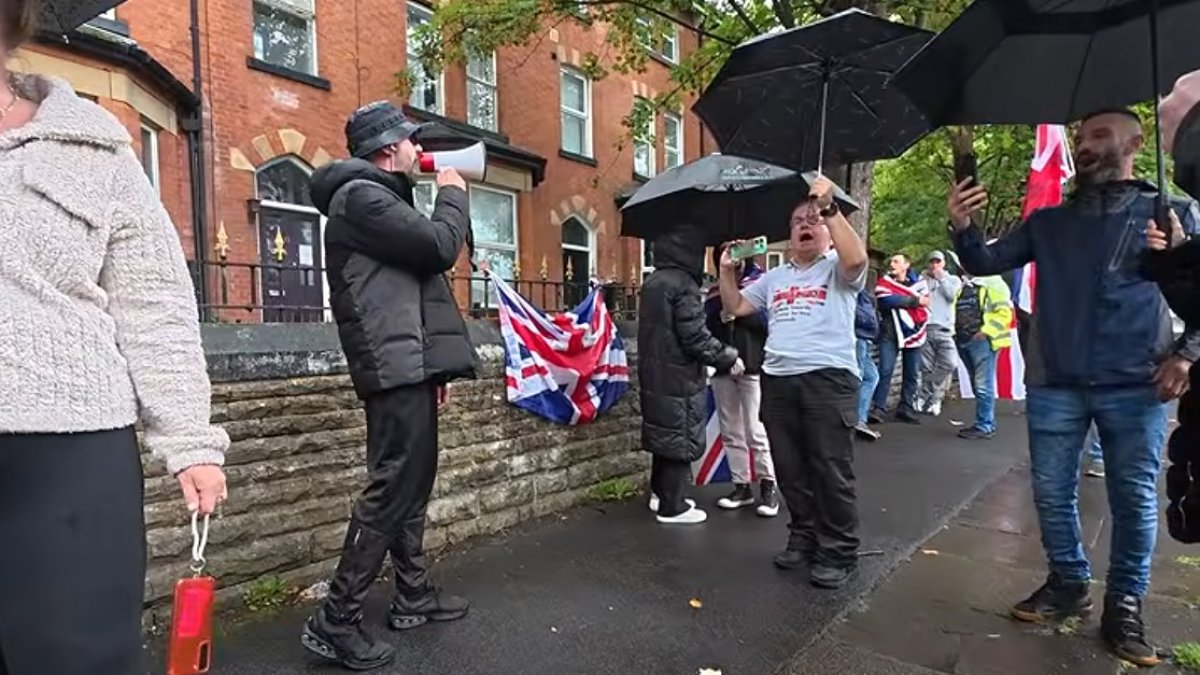
On a rainy Saturday afternoon, a man with a loudspeaker stood on a street in Tameside, Greater Manchester, and led a crowd in a chant of “Don’t unpack, you’re going back”. The unpleasant remarks were aimed at the people living in the buildings behind him, whom they believed to be asylum seekers. They made this assumption after local councillor Jake Frater, elected for Reform UK in May, shared details of the council’s HMO (Houses in Multiple Occupation) register on his Facebook page. Shorts It showed that there are 207 HMO licences held in Tameside. On this one street, no less than seven are held by Serco, the firm which has a 10-year contract with the Home Office to supply asylum seeker accommodation worth more than £1bn. The i Paper is not identifying the road, due to security concerns, but it is a quiet residential street with around 30 properties. At the end of the road is a school. “Residents deserve answers, and I intend to get them,” Frater wrote on Facebook in August. More than a month later, Frater says he still does not know for certain if any asylum seekers are indeed living in the HMOs. “There’s a lack of transparency,” he complained. ‘Your children are not going outside’ But that didn’t stop the protest going ahead. A crowd of people turned up, many draped in Union Jacks and England flags, and engaged in chants such as “deport the f**king lot” and “we want our country back”. Most of those attending were filming themselves, and everyone else around them, in what became an increasingly toxic atmosphere. Some members of the crowd even knocked on the front door to see if they could get inside. At one stage, a heated argument began with an Asian man who confronted the protesters. Police officers, who had been watching carefully nearby, intervened to maintain order. But thanks to Manchester’s wet weather and a lack of any real flashpoint, the protest eventually dissipated without further incident. But residents who live on the street have been left rattled. One woman in her seventies described the protest as “frightening”. A young mum added: “It was intimidating, we could hear it from my house [a few streets away], it was scary.” Another Muslim woman said her white neighbours had told her not to leave the house when they became aware of the protest, fearing she would be targeted simply because of her ethnicity. “They said ‘your children are not going outside’ because the situation is not good,” she said. “The police came and protected us.” None of the residents The i Paper spoke to were supportive of the protest. They had no issues with those living in the HMO buildings. Several expressed concern that there are women and children inside who would have been terrified by what happened. “I get more mither from the girls screaming on the way into school,” said one man who has lived on the street for several decades. “I didn’t recognise anyone [at the protest]… They made it sound as if it is a right rough hole round here and it’s not.” How HMOs became immigration powder keg The tense scenes in Tameside demonstrate the powder keg atmosphere that is building in a number of towns and cities across the UK. Nigel Farage’s Reform party has cranked up its anti-immigration rhetoric in the past 12 months, pledging to set up “detention centres” and carry out “mass deportations”. Despite the rioting of summer 2024, fuelled by immigration misinformation, Reform has also been supportive of protests organised by far-right groups. And as the Labour Party has gradually reduced the use of hotels for housing asylum seekers, HMOs have become new targets. The number of HMOs has been rising rapidly in many parts of Britain for several years. Experts believe this is primarily a response driven by the housing market – as the cost of living continues to bite, more people are interested in cheaper, shared living arrangements. But because HMOs are also used by the government to house asylum seekers, they have become a byword for illegal immigration. This narrative has been inflamed further by many councils announcing what is often described as a “crackdown” on HMOs by tightening up planning rules. Into the mix, Andy Burnham’s Government has also said that it is time for more middle-class areas to “play their part” when it comes to asylum seeker accommodation. This line was repeated by one of his ministers, Lisa Nandy, when villagers in Piddington, Oxfordshire, voted to “leave the UK” in a referendum sparked by Government plans to house asylum seekers nearby. Labour says it is getting a grip on the issue more broadly by reducing the backlog of people awaiting an initial decision on their asylum application. The backlog fell to 32,400 in June, from a peak of 134,000 in 2023. But the reality is that the government is still dealing with around 100,000 people who are still somewhere in the asylum system. The ‘North-South HMO divide’ Analysis by The i Paper shows around 70,000 of those people were living in “dispersal accommodation” as of June, which usually means HMOs. Glasgow, Belfast and Coventry are the areas with the most. And there are huge differences. Wigan, for example, has 1,183 asylum seekers in HMOs – one for every 278 of the borough’s 330,000 residents. By comparison, there are only 240 in Surrey where 1.2 million people live – one for every 5,000 residents. Frater says the “North-South divide” is just one aspect of the HMOs in Tameside he is concerned about. He also claims HMOs bring increased reports of antisocial behaviour, littering and parking problems and crime. He draws a direct link between government housing asylum seekers and the large numbers of people waiting for housing in Tameside. “I’m dealing with residents at the minute that have been on waiting lists for years already, bidding for properties,” said Frater. “There shouldn’t be, in my view, any people that are able to come out of area [and] into this area when we are so behind on our current housing stock and have such high waiting lists.” Asked if he would support further protests outside the HMOs, Frater said: “If people want to protest on a street, by my account, people are well within their rights to do so. “If things are being forced upon the residents in those areas, they do have the right to protest.” ‘We are putting other people first’ Frater also insisted there is not a racist narrative to complaints about HMOs. “That is not what people have a problem with, just because somebody’s of a different colour,” he said. “The problem is people coming into the country illegally, taking properties like these where we’ve got people that have lived in the area, [and] through no fault of their own they end up on the streets… “They’ve paid into the system, all of their working lives, and they’re looking for support, and there’s no support available to them because we are putting other people first. “That, to me, is the most shameful thing that’s happening across the country.” The i Paper understands the properties which attracted the protest in Tameside have been managed by Serco for more than a decade. A Serco spokesperson said: “We work under the direction of the Home Office, who decide where people are placed, based on overall national demand.” A Home Office spokesperson said: “The concerns of communities are central to our immigration reforms. “We are working to fairly house asylum seekers across the country, engaging with local authorities to reduce the impact on communities, and we have saved taxpayers over £1bn on asylum support costs since the election.”
The street with seven HMOs on the front line of Reform’s asylum housing war
Full Article
Original Source
Read the full article at Inews →KhanList aggregates and links to publicly available news content. We do not host full articles from third-party sources. Always verify important information with original sources.