
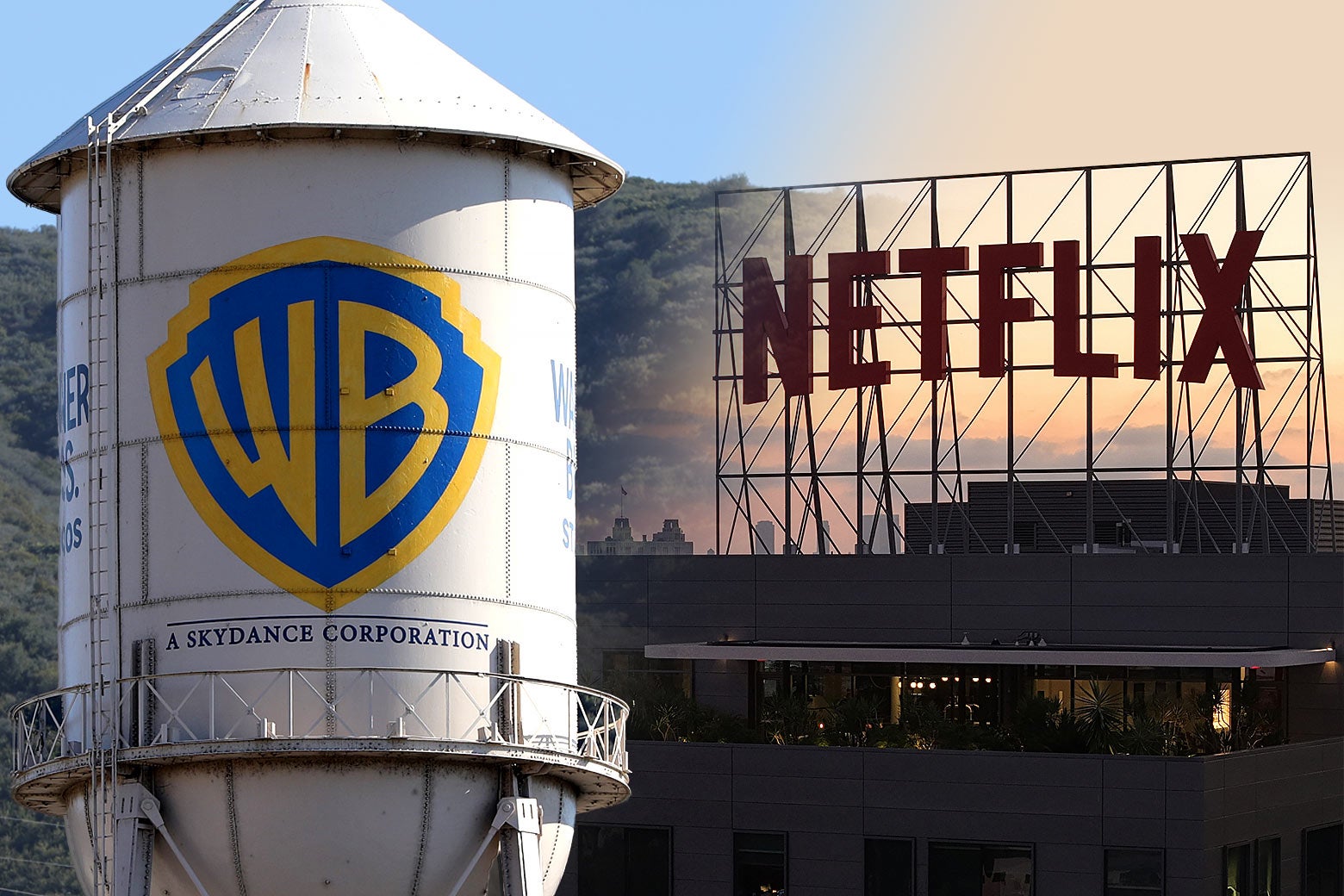
The Media Netflix and Disney Are Scrambling to Survive Stranger things have happened—but this partnership paints a grim picture of the state of streaming. By Enter your email to receive alerts for this author. Sign in or create an account to better manage your email preferences. Unsubscribe from email alerts Are you sure you want to unsubscribe from email alerts for Nitish Pahwa? Oct 16, 20263:32 PM Photo illustration by Slate. Photos by Zeng Hui/Xinhua via Getty Images and Mario Tama/Getty Images. Sign up for the Slatest to get the most insightful analysis, criticism, and advice out there, delivered to your inbox daily. In the near future, we may look at fall 2026 as one of those decisive seasons where the entertainment industry entered a new moment of transition—one where the final corporate giants left standing began making drastic moves in order to survive. The three main players in this saga are Disney, Netflix, and Skydance Corporation. The latter assumed its final hydra-esque form this month, when Paramount Skydance closed its acquisition of Warner Bros. Discovery, roping in a multibillion-dollar corpus of film-and-TV studios, streaming services, newsrooms, movie theaters, and book imprints under the aegis of one man, nepo baby David Ellison. Among his first goals is to “outspend” both of his primary competitors, Disney and Netflix—even as his media empire faces down a multibillion-dollar debt load and a cratering stock price. What may help Ellison there is that Netflix isn’t looking so red-hot lately. Once the leader of and undisputed standard-bearer for the TV-to-digital shift, the streaming pioneer has had to publicly contend with various moments of weakness throughout this year. First, the ultimately failed bid to acquire major bits of Warner Bros. Discovery. Second, the persistent woes of lower ratings, lagging engagement metrics, and subscription drop-offs within the United States, which have drawn concerns from shareholders and even pushed CEO Ted Sarandos to admit that “we’re not growing as fast as I want us to.” Plus, a massive round of layoffs and leadership shake-ups took place this week, affecting about 6 percent of Netflix’s staff—its deepest workforce cut in four years. Even more significantly, it’s now teaming with the very company Ellison had posited as Skydance’s other rival: Disney, which will break from its once-ironclad exclusivity mantra to allow certain titles, including Plus Originals, to stream on Netflix for varying lengths of time. Really, Netflix seems to be rethinking everything. The mass layoffs included top-level staff who oversaw what the app puts out to begin with: the chief content officer, along with the directors and managers of specific divisions (film, Originals, unscripted) and genres (drama, animation). It’s no doubt a concession to the intensifying public narrative that no one likes what Netflix has to offer these days. But it’s also an epiphany that Netflix is making serious changes to adjust and remain viable in the environment it helped construct—one that caused a lot of traditional TV shops to weaken and consolidate into the Skydance behemoth that Netflix and Disney are up against. The unprecedented Netflix partnership is only one of the major changes Disney’s made in recent months. Under the direction of new CEO Josh D’Amaro, the company is embarking on a path toward becoming a “more efficient” and “much smaller organization,” leaning on further internal consolidation and more external deals. More job cuts and A.I. demands are expected, and the wholesale absorption of Hulu’s app into the Disney+ interface is still happening. Bit by bit, Disney is continuing to shape itself into something more like its former nemesis, Netflix, including by diving more into the vertical-video and A.I. future while licensing visual podcasts as TV shows. (All steps that Netflix took first.) Sure, that’s in part to maintain a competitive edge in an ever-techified entertainment industry. But there’s also a recognition here that the way through that inflection point will involve some inconvenient alliances in the face of powerful business threats. It’s not just Skydance Corporation whom Disney and Netflix will have to work against. They’re up against the entire apparatus that allowed Skydance to become what it is now. It took only two years for Ellison’s Skydance Media to grow from stand-alone production house to owner of multiple Hollywood studios, and that would not have happened without the help of a friendly administration. Through the leadership of President Donald Trump and agency head Brendan Carr, the Federal Communications Commission allowed the Paramount acquisition to go through (following a couple political concessions, like a settlement with and donation to Trump) and bothered little with the Warner Bros. Discovery swallow-up, a purchase that was cheered on by some White House officials. There has been no such glad-handing with Skydance’s competitors. When Netflix announced its own deal to procure certain WBD properties, myriad Republican lawmakers expressed their concerns over potential antitrust violations and adverse ideological influences. (They stayed mum, naturally, when Paramount Skydance made its bid for all of WBD.) The streamer has also come under persistent attack from MAGA trolls over some of its pro-LGBTQ+ shows and movies, even though the service also hosts and produces standup specials and sitcoms from several right-wingers. Disney, meanwhile, has been locked in near-constant battle with the Trump presidency over Jimmy Kimmel’s jokes, The View’s roster of guests, and ABC News’ reportage. Having been subjected to multiple FCC probes of ABC’s programming, the corporation has pushed back in court against Carr, in what has already amounted to a drawn-out and expensive legal tussle. It goes beyond which brand Trump or Carr favors; it’s about who is in those brands’ corners. David Ellison’s father, Larry, is a good friend of Trump’s who’s also taken it upon himself to bankroll much of the staggering cost involved in realizing the Skydance juggernaut. He also has plenty of other deals with the president: for federal use of applications from his software company, Oracle; for easing the data center buildouts meant to power Oracle’s A.I. ambitions; and for his major stake in TikTok’s “Americanized” app. Also backing a good chunk of the Ellison octopus: the managers of Saudi and Emirati investment funds, who have both chummy and financial relationships with this administration. Skydance hasn’t escaped all government scrutiny. Its networks CBS and CNN are co-defendants with ABC (and, incidentally, Fox News) in a lawsuit from the Justice Department accusing the broadcasters of violating antitrust laws by pursuing a collective boycott of the White House TV pool. Still, it’s nowhere near the level of persecution that Trump and his cohort have visited upon Netflix and Disney—and, in the latter’s case, are keeping up. Obviously, Disney’s and Netflix’s corporate pivots are not just a joint response to the feds; there are very real business and culture adjustments that both companies need to make to survive in this period of technological flux. But they both realize they have to make these changes while under the eye, and without the help, of anyone in the Trump White House—and against a competitor who has a lot of friends up top. For Disney, that looks like mimicking some of Skydance’s most tech-focused goals (incorporating more A.I. firms and functions, melding its streaming services into one app). For Netflix, that means looking outside of its once-unimpeachable red walls and embracing more reluctant partnerships with rivals, while cutting costs and overhauling old practices wherever possible. Maybe strategies will shift after Trump leaves office. But with his administration tilting the field as it is, they’ll for once have to play the game as they see it right now, not as what they’d prefer for it to be. Disney Movies Netflix TV
The Streaming Wars Just Created the Most Bizarre Allies
Full Article
Original Source
Read the full article at Slate →KhanList aggregates and links to publicly available news content. We do not host full articles from third-party sources. Always verify important information with original sources.