
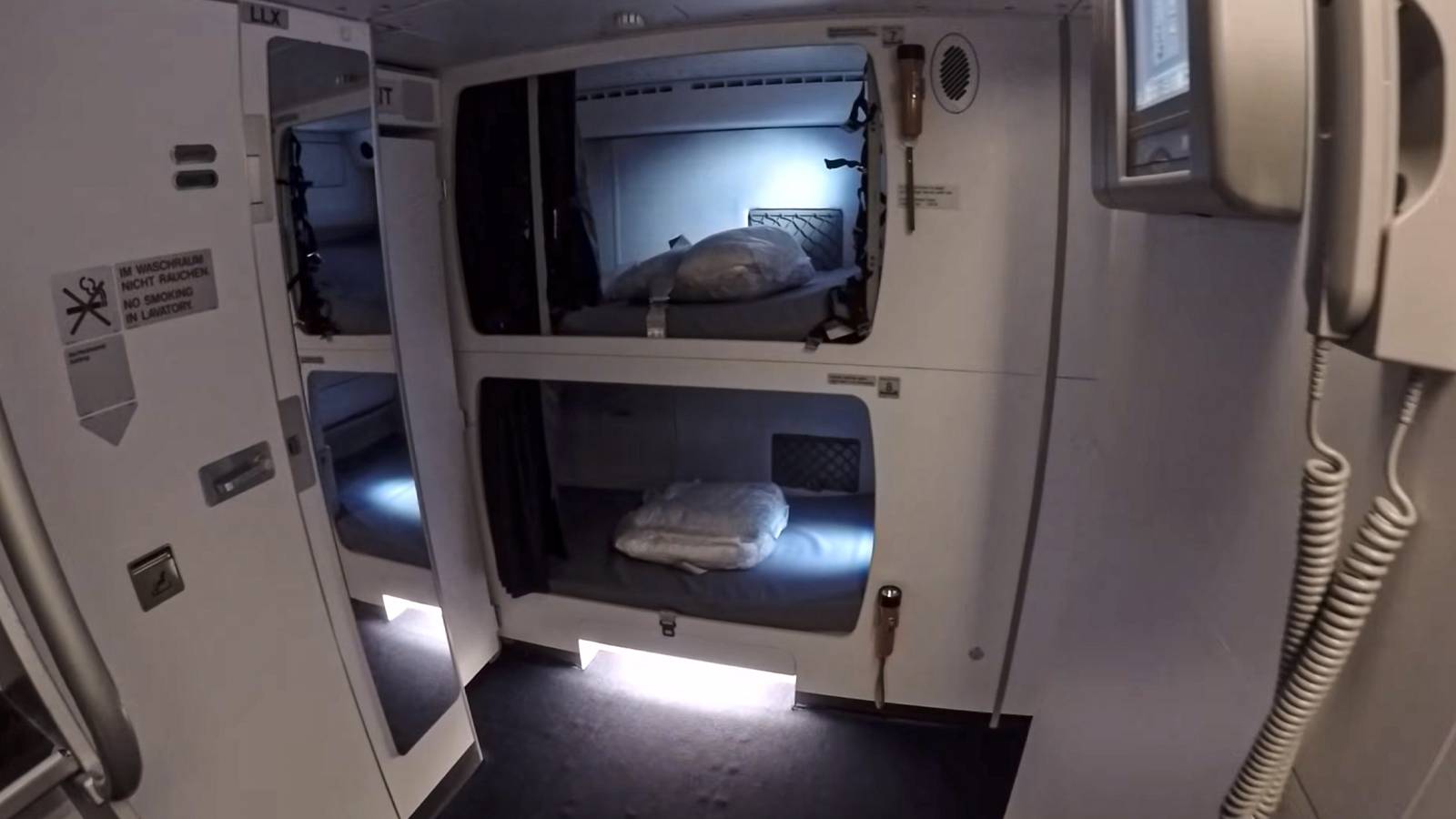
Published Oct 2, 2026, 10:00 AM EDT Prachi is a London-based journalist with extensive experience in the aviation industry. She has worked for several leading industry publications, covering a broad range of topics. Her expertise lies in aircraft maintenance, emerging technologies, and advanced air mobility. She is currently pursuing a PhD in Journalism, focusing on data journalism and its potential to transform conventional aviation reporting. Most of us have probably wondered at least once where the crew sleeps on a long-haul flight. Some journeys can last more than ten hours, and the cabin crew working those flights obviously can't spend all that time on their feet. They need time to rest too, so airlines carefully schedule crew shifts to make sure some members can take a break while others continue looking after passengers and handling safety responsibilities in the cabin. Where that break happens is something passengers never see. Most widebody aircraft have dedicated crew rest compartments, often located above or below the passenger cabin. The Airbus A380 has some particularly spacious areas set aside for its crew. So, where exactly are these sleeping quarters, and what are they like? What Are Crew Rest Areas Like On The Aircraft? Credit: Cathay Pacific Most widebody aircraft have separate rest areas for cabin crew and flight crew, each fitted with bunks where crew members can get some sleep during their scheduled rest periods. The flight crew area is generally close to the cockpit, whereas the cabin crew area is positioned elsewhere in the aircraft. The entrance is often through a small door that passengers may never notice. A short staircase or ladder-style steps can lead to the compartment when it is located above or below the passenger cabin. Of course, access is restricted to crew members only; some aircraft even use a passcode for additional security. The layout depends on the aircraft, but the principle is the same: the crew needs a private space away from the passenger cabin. Inside, the bunks are fairly simple. Each one has a mattress, a pillow, and a blanket, plus a curtain that can be closed when a crew member is sleeping. There is usually a personal light and an air vent at each berth, and some aircraft provide power outlets or a small area for personal belongings. A hook can also be provided for hanging a uniform. Additionally, each berth has a seatbelt, and oxygen masks are available in the event of a loss of cabin pressure. You can also find emergency lighting, an intercom for communication with the cabin and flight deck, and a fire extinguisher in the crew rest area. How Are Crew Rest Compartments Arranged On The A380? Credit: Matheus Obst | Shutterstock So, what are crew rest areas like on the double-decker? The A380 is one of the largest passenger aircraft ever built, so it has more room to work with than most other widebody jets. Airbus has given airlines several options for installing crew rest compartments, which means their exact locations can vary depending on the aircraft configuration. One common arrangement includes a 12-bunk cabin crew rest compartment on the lower deck. The compartment is installed in the aft cargo area and takes up space that could otherwise be used for cargo. Access to it is usually provided from the main deck through a dedicated staircase, so the crew can move between the passenger cabin and the rest area without going through a passenger seating area. This indeed is one of the more unusual features of the double-decker. Passengers are used to thinking of the aircraft as having two decks, but a lower-deck crew rest compartment adds another level, almost creating a third deck of sorts. The A380 can also have a cabin crew rest compartment on the upper deck. In fact, one of Airbus' 2006 training documents shows an upper-deck arrangement with 13 bunks. This means there is no single layout that applies to every A380. The airline can choose how to use the available space based on its aircraft configuration and operational requirements. We will look at some examples from individual airlines in the next few sections to see how these arrangements can differ. The flight crew also has a separate rest area, although it is located close to the flight deck rather than in the main cabin crew rest compartment. This gives pilots their own dedicated space to rest on long-haul flights and keeps them close to the cockpit when they need to return to their operating positions. How Qantas And Emirates Arrange Crew Rest On Their A380s Credit: Qantas Let's take a look at how the crew rest areas are arranged on some A380s, starting with Qantas. According to ch-aviation, the Australian airline currently operates a fleet of ten A380s and uses the aircraft on some of its longest scheduled routes, including Sydney to Dallas/Fort Worth, Melbourne to Los Angeles and Sydney to Los Angeles. Some of these flights take more than 12 hours, so the crew needs a place to rest during the journey. Qantas' A380s are typically configured with 485 seats, and the airline rosters around 20 crew members on these aircraft. The cabin crew has access to a restricted rest area located underneath the economy cabin. It sits behind a discreet door near the mid-cabin lavatories that reads as a service panel, with a narrow staircase leading down into the compartment. Inside the rest area, up to 12 crew members can lie down on individual bunks. The pilots have their own rest area near the cockpit. Emirates, which is by far the largest operator of the A380, has used different crew rest arrangements across its aircraft. On some A380s, the cabin crew rest area is located on the same deck as the economy cabin, while on others it is located beneath the main passenger deck. The layout can look a little like a Japanese capsule hotel, with a series of individual sleeping spaces arranged next to each other. Each bunk is roughly the length of a full-size bed and is wide enough for one person to turn over comfortably. Every berth has a mattress, pillow, and duvet, while a small control panel at the head of the bed provides a reading light and personal air vent. Some aircraft also have a USB or power outlet, so crew members can charge their personal devices during their rest period. How Other Long-Haul Aircraft Provide Rest Areas For Crew Credit: Maxene Huiyu | Shutterstock Now that we have established how crew rest areas are arranged on the A380, what about other aircraft? The same idea is used across many long-haul widebodies, although the available space is much more limited. On some aircraft, the crew rest area is hidden above the passenger cabin, behind a door that most passengers would never realize leads to another part of the aircraft. On some 777s, for instance, the cabin crew rest area is located above the rear of the passenger cabin and is reached through a security-locked door at the back of the aircraft. A narrow staircase leads upstairs to the rest area, which can contain several rows of bunks. Some layouts have between eight and ten bunks on each side. The compartment can also have a shared wardrobe for crew belongings and its own temperature controls. On Cathay Pacific’s Boeing 777-300ERs, for example, the entrance to the crew rest area is designed to look like a lavatory door, but it actually leads upstairs to a compartment above the rear section of economy. The rest area has eight bunks arranged in two rows of four, with a small aisle between them. There are partition walls and curtains that separate the individual berths. Furthermore, the Boeing 787 Dreamliner also has crew rest areas above the passenger cabin. Boeing designed the pilot rest area at the front of the aircraft, directly behind the cockpit, while the cabin crew rest area is located towards the rear. The Airbus A350 uses a similar approach, with separate upstairs rest areas for pilots and cabin crew. The pilot compartment at the front has two berths, while the cabin crew area at the rear has six. Passengers can sometimes spot the crew rest area by looking at the overhead bins. Some airlines replace the bins with solid panels above part of the cabin where the rest compartment sits. Qatar Airways' A350-900, for example, has solid panels above the last few rows of economy where the overhead bins would normally be. The Safety Requirements For Crew Rest Areas Credit: Jordan Tan | Shutterstock Furthermore, crew rest areas are not merely a lounge. They may look like simple sleeping compartments, but they are still part of the aircraft's certified interior and have to meet specific safety requirements. The European Union Aviation Safety Agency (EASA), for example, sets requirements for how these spaces can be used and what they must have in place for emergencies. For the A380, EASA specifies that the crew rest compartment cannot be occupied during taxi, takeoff, or landing. The number of people inside during the flight is limited to the number of approved seats and bunks, and the area cannot be used to store cargo or passenger baggage. The compartment also needs emergency lighting, firefighting equipment, and two-way communication with the flight deck and relevant cabin crew stations. There are also requirements for emergency alarms, seat restraints, and other equipment inside the compartment. Another requirement concerns emergency evacuation. The crew rest compartment needs at least two evacuation routes that allow occupants to reach the passenger decks. These routes have to be separated so one incident does not block both ways out. The doors also need to be designed so nobody can become trapped inside. If a lock is fitted, it must be possible to open it from outside without special tools, while someone inside must always be able to open the door. Crew Rest Is Essential On Long-Haul Flights Credit: MC MEDIASTUDIO | Shutterstock To conclude, crew rest is an important part of any long-haul flight. Some of the longest routes can take around 15 hours, and that does not include the time crew members spend preparing before passengers board. They therefore need proper time to sleep and take a break during the journey. Depending on the flight time and operating schedule, crew members typically get around one and a half to three hours. There are specific areas on the aircraft where they can do this. The Federal Aviation Administration (FAA) divides crew rest areas into three classes. Class 1 is a dedicated sleeping area with bunks or flat sleeping surfaces in the upper or lower fuselage, accessed through a hidden door. Class 2 is a lie-flat seat separated from other passengers by a curtain, while Class 3 is a reclining seat with foot support, also curtained off. Which type is used depends on the airline, aircraft, and cabin configuration. The A380 has enough space for some particularly large dedicated crew compartments, but the same principle applies across long-haul aircraft. These areas are located where intrusive noise, odors, and vibration have the least effect on sleep.
The Spacious Sleeping Quarters Airbus A380 Crew Members Escape To On Long-Haul Flights
Full Article
Original Source
Read the full article at Simpleflying →KhanList aggregates and links to publicly available news content. We do not host full articles from third-party sources. Always verify important information with original sources.