
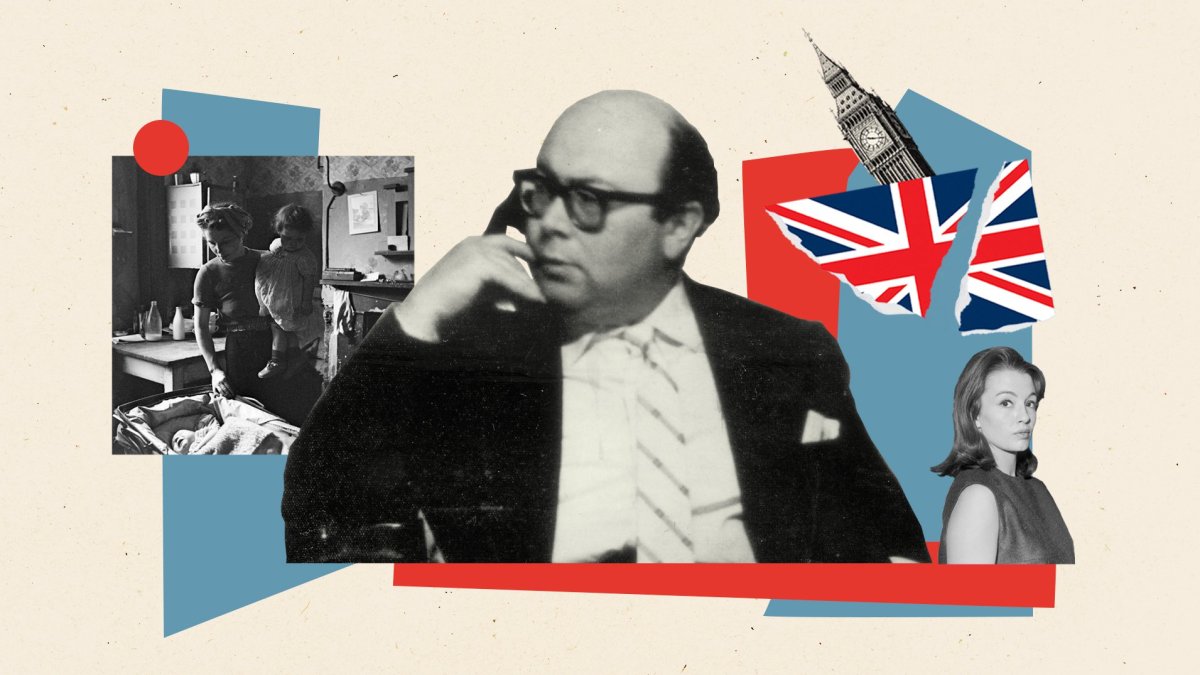
Who broke Britain? Welcome to The i Paper’s opinion series in which experts and writers debate the issues that concern them about modern Britain. • Martin Lewis: the money-saving expert… who accidentally cost Britons billions• The American woman who ripped the heart out of Cadbury• The beer “punk” who became a British hate figure The thuggish slumlord Peter Rachman died too soon in 1962, which was a shame because he missed the Profumo affair, in which he was shortly to acquire a lurid walk-on part. He also missed the great house-price boom from Thatcher to Cameron, Kirstie and Phil, and buy-to-let, which transformed his central wheeze into a respectable occupation for accountants, dentists, and other bourgeois Brits with £40,000 knocking about. He also failed to live long enough to see himself achieve the rarer distinction of entering the dictionary. “Rachmanism” became the name for a rather noisome sort of property racket, which turned on buying cheap houses containing protected tenants, persuading them to clear off on pain of violence, then hoicking up the rent, packing in poorer people, and, finally, pocketing the difference on a sale. Rinse, repeat – and buy a Rolls-Royce. In Rachman’s hands, the business came with raffish additions of bruisers and Alsatians, prostitutes and basement clubs. But the underlying proposition was simple enough: namely, that the pesky notion that houses were meant for people to live in often got in the way of the more lucrative fact of their financial value. He was born Perec Rachman in Lwów, then in Poland (now Lviv in western Ukraine), in 1919, and had already been put through rather more history than most men before reaching London. His parents disappeared in the Holocaust. The Nazis put Perec on a road-building chain gang. Later, the Russians captured and starved him. He arrived in Britain stateless at the end of the war and washed dishes at Bloom’s kosher restaurant in Whitechapel before turning to property. By the 1950s, he had managed to put together a minor empire in Paddington and North Kensington. In this, he was helped along by a useful kink in the 1957 Rent Act. Plenty of sitting tenants were paying controlled rents that were often well below market levels, and those protections disappeared once they left. As a result, a house with an old lady still living in it was worth considerably less than the same house once the old lady had been got out. Rachman applied himself to getting them out with some ingenuity. In his properties, electricity and water developed an unfortunate habit of going off. Furniture was smashed. Floorboards came up. Doors somehow parted company with their hinges. Thugs were deployed with an almost ecumenical nastiness: white gangsters to frighten black tenants, black ones to frighten whites. Once a house had been cleared, it could be “sweated” – crammed with impecunious Caribbean tenants – or let at fantastic rents to clubs and brothels. A house bought for £1,500 typically fetched him £10,000 a year in rent. This was villainy with naff flourishes. Rachman wore silk shirts and crocodile shoes, and travelled by a pair of red and blue Rolls-Royces. A gold bracelet, locked to his wrist, bore the numbers of his Swiss bank accounts and the combinations to his safes. He took several baths a day in gallons of Dettol. Less quirkily, he relived old wartime terrors by hoarding bread crusts under his bed. Then there was his “satyriasis,” as the historian Richard Davenport-Hines puts it, which he “relieved by a daily routine of mistresses”. Among them was Christine Keeler, the showgirl whose simultaneous entanglements with war secretary John Profumo and Soviet naval attaché Yevgeny Ivanov killed Harold Macmillan’s government. “Sex to Peter Rachman was like cleaning his teeth,” Keeler later recalled, “and I was the toothpaste.” Rachman died of a coronary thrombosis in November 1962, just months before Keeler’s other liaison brought down Profumo. Rachman’s own part in the affair extended chiefly to having slept with Keeler and her friend Mandy Rice-Davies, and moving in the same raffish circle as his tenant Stephen Ward, the fashionable osteopath and social fixer who had introduced Keeler to Profumo. The scandal sent the papers rummaging through Rachman’s extortionate, slumlordly past. Britain duly recoiled. “Rachmanism” entered the language, and both Labour and the Conservatives hurried to put several pews between themselves and the private landlord. No doubt there was a certain convenience in the public disgust, which was entirely deposited upon one deceased, Jewish foreigner, although his methods were hardly unique. For a short minute, Rachman posthumously helped make rent control politically irresistible. Ben Parkin, the Labour MP who had done much to expose the abuses, argued for housing to be brought properly within the welfare state. Now, with the sophistication of hindsight, it is easy to see that while Britain repudiated Rachman, we have nevertheless embraced his central proposition. To be sure, the dogs and hooligans disappeared. But houses have become, increasingly, assets expected to appreciate, and policy obligingly helped it along: Right to Buy, dwindling council stock, and, from 1996, the buy-to-let mortgage. Household wealth rose from about three times GDP in the late 1980s to nearly eight times GDP before the pandemic. British capitalism has drifted from productive investment towards extracting returns from existing assets, housing foremost among them. England now has some 4.7 million privately renting households and millions of landlords. Rachmanism democratised, and, indeed, deodorised, with perfectly “decent” people battening on tenant labour. Even Westminster has joined the game. Today, 85 MPs are landlords; the biggest among them is the Labour MP for Ilford South, Jas Athwal, owner of 15 rental properties, some of them boasting black mould and ant infestations (Athwal said he had been unaware of this and that he was “profoundly sorry” for their condition). Calling such genteel exploitation “Rachmanism” is perhaps unfair. Nobody is wrenching lavatory doors from their hinges. Yet Rachman grasped unusually early what his compatriots later learned en masse: in a country of scarce housing, the pesky people living in a property are secondary to its financial value. He died a national disgrace, but had he lived 60 years later, he might have found Britain a surprisingly familiar, even congenial, place. There was a time when serious thinkers could imagine escaping the logic of landlordism altogether. John Stuart Mill could contemplate the state as “universal landlord”. Alfred Russel Wallace – between discovering natural selection and corresponding with Darwin – went further, calling explicitly for the abolition of landlordism and the nationalisation of the land. Such quaint ambitions have now gone the way of brutalism. A few indignant souls continue to denounce landlordism as a parasitical interest, but larger questions of land redistribution have receded from respectable politics. We live in Rachman’s world.
The slum king who showed British landlords how to get rich without working
Full Article
Original Source
Read the full article at Inews →KhanList aggregates and links to publicly available news content. We do not host full articles from third-party sources. Always verify important information with original sources.