
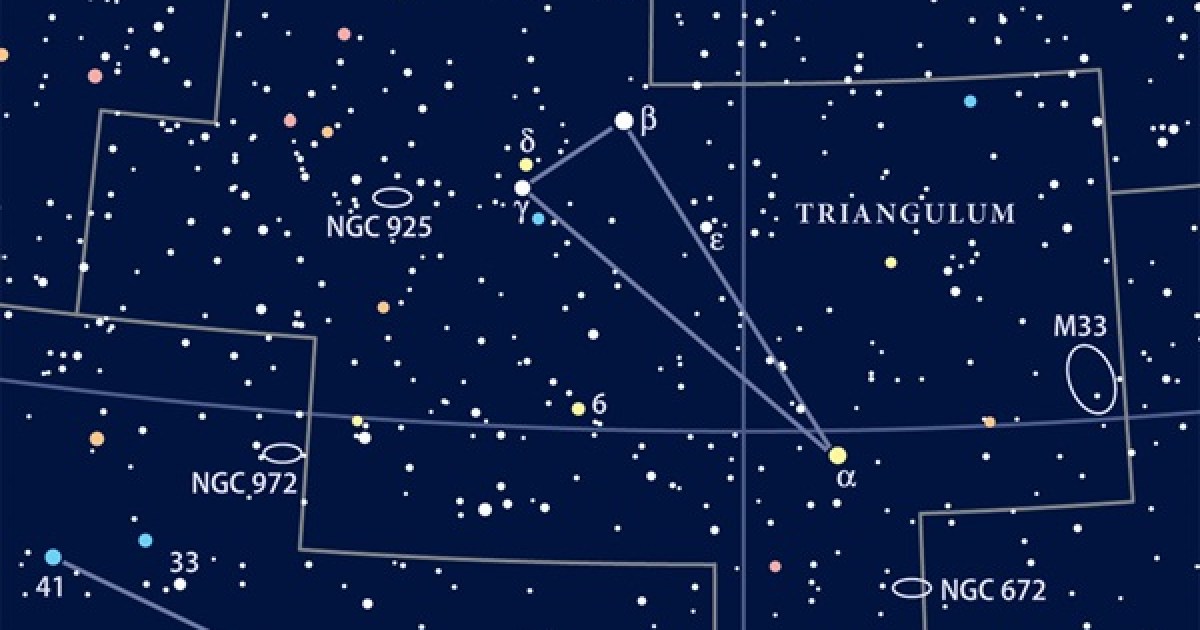
Triangulum is a small but easy-to-spot constellation in the evening and morning sky, hosting one of the closest galaxies to our own. | Published: September 16, 2026 The tiny constellation Triangulum has four bright stars and several galaxies, the most famous of which is M33. Credit: Astronomy: Roen Kelly Looking for a sky event this week? Check out our full Sky This Week column. September 15: View the false dawn Rising around sunset and highest in the early-morning hours before sunrise is the constellation Triangulum. This tiny triangular star pattern is perfect for evening or morning observers: Around 10 P.M. local daylight time, it’s high enough (25°) in the east to observe easily, and is also still high in the west (60° or more) in the hour or two before sunrise, so early birds can catch it, too. In the evening sky, you’ll find it sandwiched between the constellations Perseus and Pisces as they rise. Triangulum is very small, just 78th (out of 88) in size among the official constellations astronomers use to chart the sky. In total, it covers an area of about 132 square degrees. It (predictably) has three bright stars that make up its namesake shape: Alpha (α), Beta (β), and Gamma (γ) Trianguli. These shine at magnitude 3.4, 3.0, and 4.0, respectively, making Beta the brightest star despite its secondary designation. A fourth relatively bright star, Delta (δ) Tri, shines at magnitude 4.8 just northwest of Gamma. Only eight other stars in this constellation shine brighter than magnitude 5.5, and all are fainter than these, so the shape of the constellation is pretty easy to pick out by eye. The most famous deep-sky object in Triangulum is M33, also called the Triangulum Galaxy. This 6th-magnitude spiral lies in far western Triangulum, about 4.3° west-northwest of Alpha Tri, and should be readily visible with any telescope tonight, especially with no Moon for most of the dark hours overnight. Sunrise: 6:42 A.M.Sunset: 7:07 P.M.Moonrise: 12:40 P.M.Moonset: 9:46 P.M.Moon Phase: Waxing crescent (34%)*Times for sunrise, sunset, moonrise, and moonset are given in local time from 40° N 90° W. The Moon’s illumination is given at 10 P.M. local time from the same location. Alison Klesman is senior editor of Astronomy magazine. She holds a Ph.D. in astronomy and has studied a variety of topics, from minor planets to supermassive black holes.
The Sky Today on Wednesday, September 16: Triangle in the sky
Full Article
Original Source
Read the full article at Astronomy →KhanList aggregates and links to publicly available news content. We do not host full articles from third-party sources. Always verify important information with original sources.