
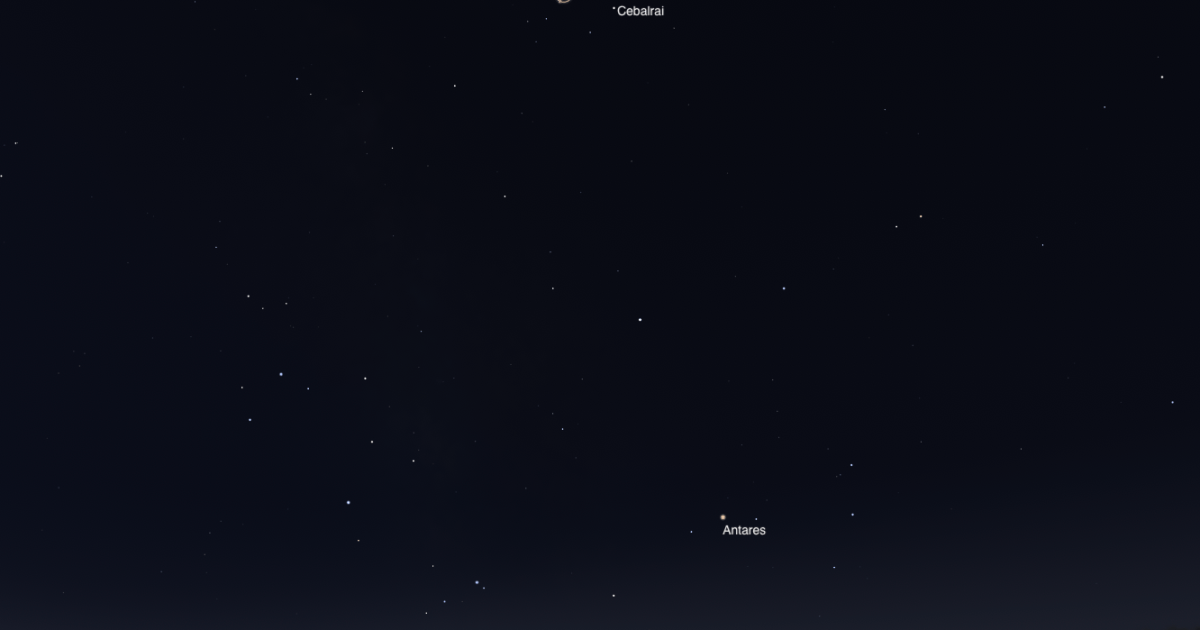
This dim star is nonetheless one of the most famous suns in our sky, possessing a huge proper motion as it skims through space. | Published: August 26, 2026 Circled is the location of Barnard’s star, high in the sky around 10 P.M. local daylight time. It is not visible to the naked eye, but any optical aid should reveal it. Credit: Stellarium Looking for a sky event this week? Check out our full Sky This Week column. August 25: Messier 73 One of the most famous stars in the sky lies in Ophiuchus the Serpent-bearer, still high in the west and southwest (it’s a big constellation) two hours after sunset. In its northeastern corner is Barnard’s star — although you’ll need some optical aid to observe it, as it’s too faint to see with the unaided eye. Binoculars or any small scope will show it. To find Barnard’s star, look 3.6° east of Cebalrai (Beta [β] Ophiuchi), which shines at magnitude 2.8 in Ophiuchus’ northeastern region. At magnitude 9.5, Barnard’s star won’t stand out for its brightness but for its color: a deep red. For added contrast, there’s a fainter (11th magnitude) white-hued star nearby, just 1’ east-southeast of this ruddy sun. But its color is not Barnard’s star’s actual claim to fame — that is its huge proper motion. This GIF shows the motion of Barnard’s star over the course of a decade. Snapshots show its position in July 2001, June 2004, June 2007, and June 2010. Credit: Alejandro Sanz Gómez/Wikimedia Commons (CC BY-SA 2.5 ES) Proper motion refers to a star’s apparent movement across our sky relative to more distant (and seemingly fixed) background stars. Because nearer objects appear to move faster than farther ones, this tells us Barnard’s star, which slides 10.3” each year across the sky, is quite close. That’s the greatest proper motion of any star we know. Perhaps unsurprisingly, Barnard’s star is just 6 light-years away, making it the next-farthest star after the Alpha Centauri system. Sunrise: 6:22 A.M.Sunset: 7:41 P.M.Moonrise: 7:05 P.M.Moonset: 4:37 A.M.Moon Phase: Waxing gibbous (99%)*Times for sunrise, sunset, moonrise, and moonset are given in local time from 40° N 90° W. The Moon’s illumination is given at 10 P.M. local time from the same location. Alison Klesman is senior editor of Astronomy magazine. She holds a Ph.D. in astronomy and has studied a variety of topics, from minor planets to supermassive black holes.
The Sky Today on Wednesday, August 26: Catch Barnard’s star
Full Article
Original Source
Read the full article at Astronomy →KhanList aggregates and links to publicly available news content. We do not host full articles from third-party sources. Always verify important information with original sources.