
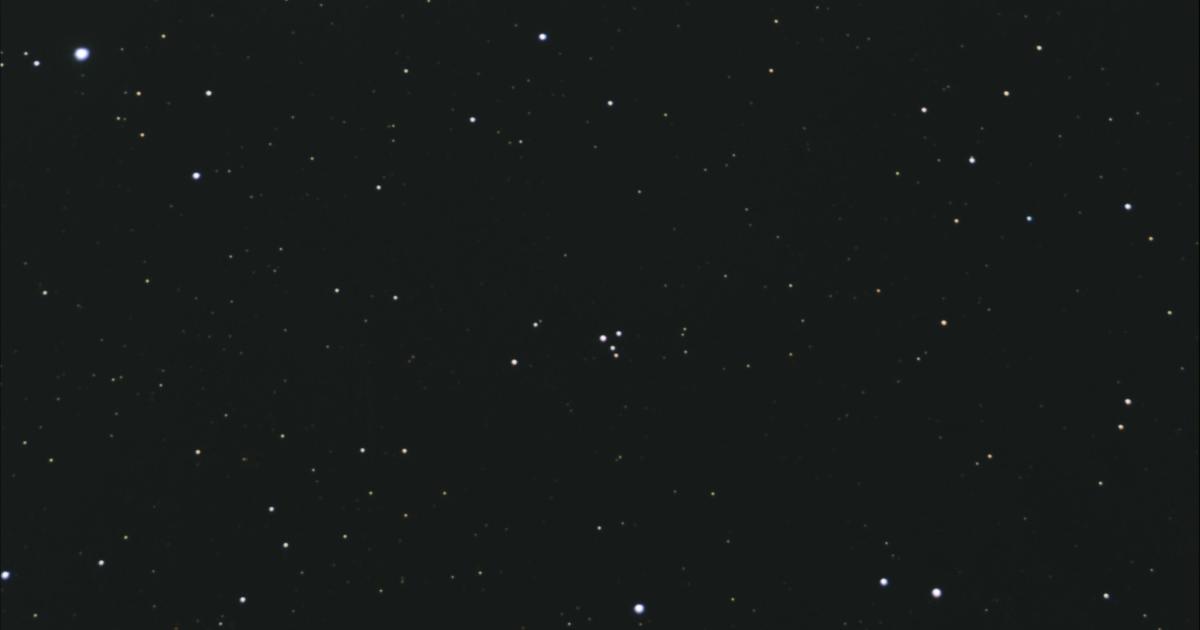
M73 is a strange entry in the comet-hunter’s list: a small group of four stars forming a triangular shape in the sky. | Published: August 25, 2026 The 73rd entry on Messier’s list is a strange one: a small group of just four stars, captured just below center in this photo. Credit: zemt-fr (Flickr, CC BY-SA 2.0) Looking for a sky event this week? Check out our full Sky This Week column. August 24: Iapetus at eastern elongation Charles Messier’s famous list of non-cometary objects largely contains star clusters, nebulae, and galaxies — faint fuzzies it could be easy to confuse for a cometary nucleus in a telescope of the type the comet-hunter was using. But M73 is a bit of an outlier, and you’ll see why when you catch it in your sights tonight. A small scope is perfect for the job. Located in Aquarius the Water-bearer, M73 is already above the horizon by sunset and in great viewing condition as soon as the sky gets dark. About 30° high in the southeast shortly before 10 P.M. local daylight time, you can find it just under 3° southwest of magnitude 4.5 Nu (ν) Aquarii. Although the bright Moon is nearby in Capricornus, you don’t have to worry about it obscuring this particular Messier object. That’s because M73 is a small group of just four stars, with three in the shape of an equilateral triangle and the fourth just to the northwest. Even with the bright background of moonlight, they should show up in your scope. Astronomers don’t believe this grouping is physically bound; instead, these suns just happen to fall close together as we look out into 3D space and see a 2D view of the sky. They are apparently only on Messier’s list because, according to the SEDS Messier Index, he charted its location at the same time as M72 — a true globular cluster of stars just 1.3° west of M73. This spherical conglomeration of old stars is definitely easier to confuse for a comet, and much more indicative of the average Messier object. But it will also be difficult to see with the Moon nearby, so wait a few days and then come back to this region to check it out. Sunrise: 6:21 A.M.Sunset: 7:42 P.M.Moonrise: 6:38 P.M.Moonset: 3:32 A.M.Moon Phase: Waxing gibbous (96%)*Times for sunrise, sunset, moonrise, and moonset are given in local time from 40° N 90° W. The Moon’s illumination is given at 10 P.M. local time from the same location. Alison Klesman is senior editor of Astronomy magazine. She holds a Ph.D. in astronomy and has studied a variety of topics, from minor planets to supermassive black holes.
The Sky Today on Tuesday, August 25: Messier 73
Full Article
Original Source
Read the full article at Astronomy →KhanList aggregates and links to publicly available news content. We do not host full articles from third-party sources. Always verify important information with original sources.