
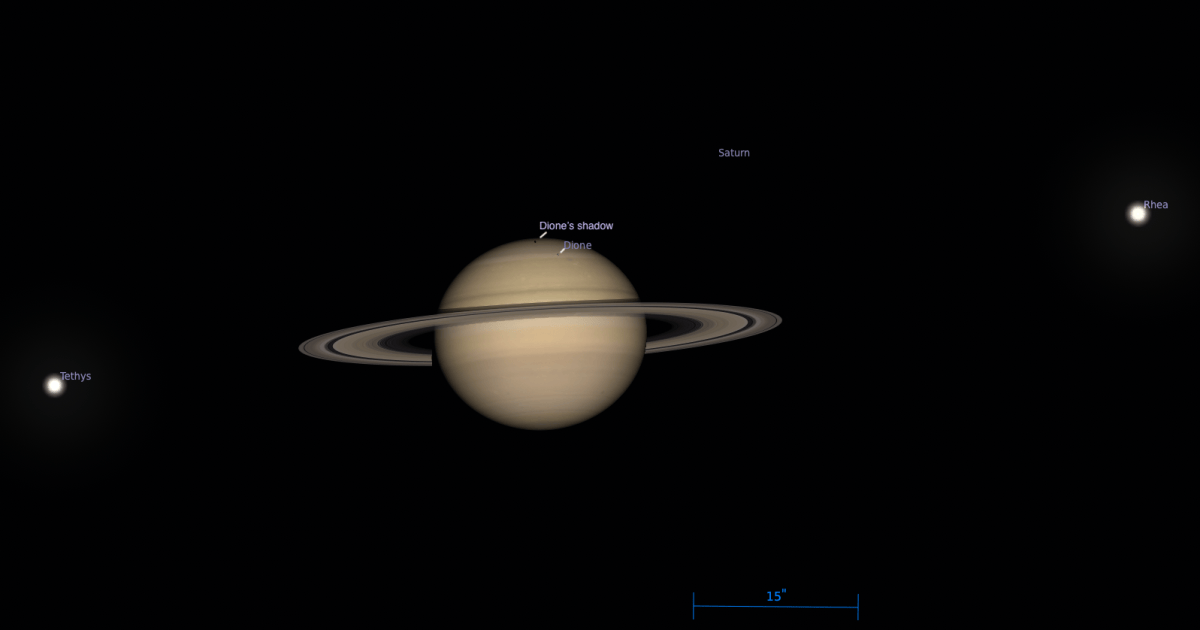
Dione and its shadow cross Saturn’s disk this evening, while several more of the ringed planet’s moons stand nearby. | Published: October 25, 2026 Dione and its tiny shadow transit Saturn early in the evening on October 25. Credit: Stellarium/Oleg Pluton Looking for a sky event this week? Check out our full Sky This Week column. October 24: Mercury stands still Saturn’s small moon Dione transits the disk this evening at 8:43 p.m. EDT, best seen from the eastern half of the U.S. However, the transit itself will be difficult to watch visually no matter your location, and will be best captured via high-speed video. Even if you aren’t an advanced photographer, however, you can watch Dione enter and exit the disk, as well as track several of Saturn’s other moons throughout the night. Around 9 P.M. EDT (8 P.M. CDT), Saturn is well above the horizon, in the east for Midwestern observers and the southeast for those along the East Coast. It’s the brightest point of light in this part of the sky and should be visible to the naked eye even with the Moon nearby. You’ll need a telescope to spot its rings and moons, however, and the larger the better to help cut through the Moon’s glare. Prior to the transit’s start, 10th-magnitude Dione is approaching the planet’s northeastern limb, with similarly bright Tethys east of the rings and Rhea to their west. Brighter Titan, which shines around magnitude 8.5, is also visible far west of Saturn all evening, about 2’ from the planet’s center. As Dione begins its transit, it will likely seem to disappear for visual observers, as its tiny disk will be difficult to pick out against Saturn’s bright cloud tops. Video capture might also nab the moon’s shadow, which will cross the far northern polar region of the planet, appearing around 9:40 P.M. EDT and disappearing roughly half an hour later, before Dione reaches the northwestern limb. The moon does this just before 10:40 P.M. EDT — now, visual observers will see it pop into view just off the limb and begin pulling away from Saturn to the west. Sunrise: 7:22 A.M.Sunset: 6:06 P.M.Moonrise: 5:33 P.M.Moonset: 6:46 A.M.Moon Phase: Full*Times for sunrise, sunset, moonrise, and moonset are given in local time from 40° N 90° W. The Moon’s illumination is given at 10 P.M. local time from the same location. Alison Klesman is senior editor of Astronomy magazine. She holds a Ph.D. in astronomy and has studied a variety of topics, from minor planets to supermassive black holes.
The Sky Today on Sunday, October 25: Dione crosses Saturn
Full Article
Original Source
Read the full article at Astronomy →KhanList aggregates and links to publicly available news content. We do not host full articles from third-party sources. Always verify important information with original sources.