
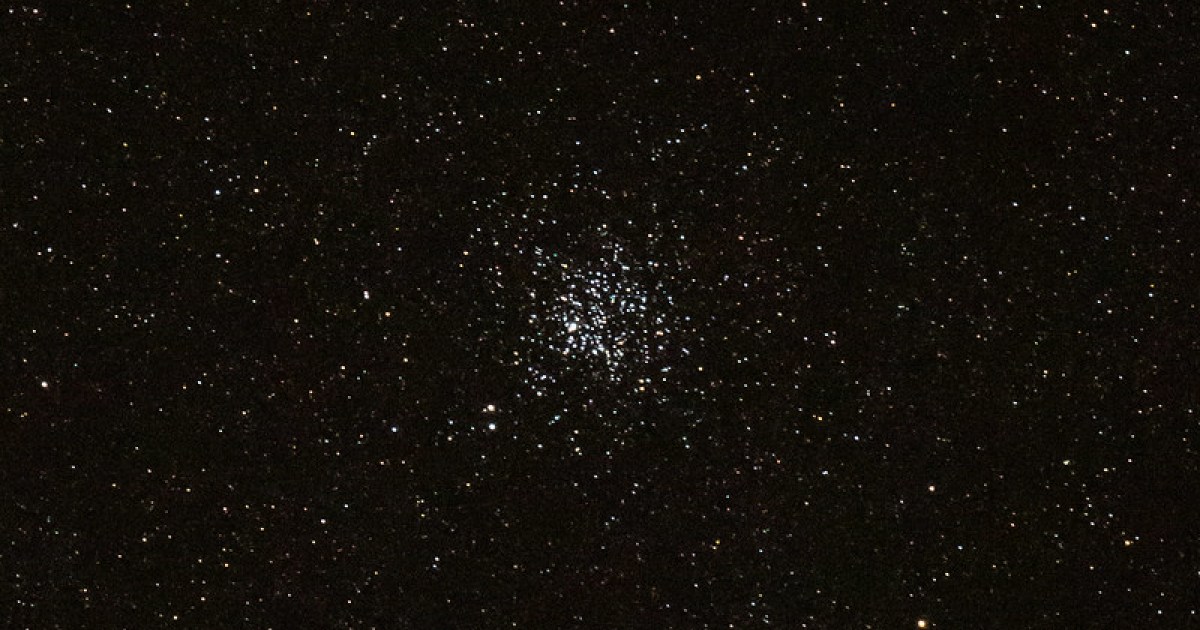
The Wild Duck Cluster is flying through the nighttime sky, a great object to check out during lengthening autumn evenings. | Published: October 17, 2026 Looking for a sky event this week? Check out our full Sky This Week column. October 16: Tethys and its shadow transit Still visible for several hours after sunset is the Wild Duck Cluster (M11), a young grouping of stars also cataloged as NGC 6705. Located in Scutum the Shield, the cluster is still 40° high in the south an hour after sunset and more than 30° high in the southwest an hour after that. Even with the bright waxing Moon nearby, M11’s stars will readily pop into view in binoculars or a telescope, thanks to their brightness: The cluster shines at magnitude 5.8. It lies near the rich, star- and dust-filled plane of our Milky Way, although the galactic plane will likely be difficult to make out in the moonlight tonight. Come back when there’s no Moon in the sky, however, and it may appear from a dark observing site. Spanning roughly 14’, M11 is a lovely grouping filled with numerous young suns — at least 500 of its stars are brighter than magnitude 14. Astronomers estimate its stars are roughly 250 million years old, and it lies 6,000 light-years away. The easiest way to find M11 is to start at the tail of Aquila the Eagle nearby, which hangs below the Eagle’s brightest star, Altair. Use the curving path created by the stars Lambda (λ) and 12 Aquilae, followed by Eta (η) Scuti, to guide your way right to M11’s location. The Wild Duck Cluster (M11) remains high enough for easy observing several hours after sunset in mid-October; on the 17th, the waxing Moon is nearby. Credit: Stellarium/USGS/Celestia/Clementine Sunrise: 7:13 A.M. Sunset: 6:17 P.M. Moonrise: 1:59 P.M. Moonset: 11:05 P.M. Moon Phase: Waxing crescent (45%) *Times for sunrise, sunset, moonrise, and moonset are given in local time from 40° N 90° W. The Moon’s illumination is given at 10 P.M. local time from the same location. Alison Klesman is senior editor of Astronomy magazine. She holds a Ph.D. in astronomy and has studied a variety of topics, from minor planets to supermassive black holes.
The Sky Today on Saturday, October 17: Watch Wild Ducks
Full Article
Original Source
Read the full article at Astronomy →KhanList aggregates and links to publicly available news content. We do not host full articles from third-party sources. Always verify important information with original sources.