
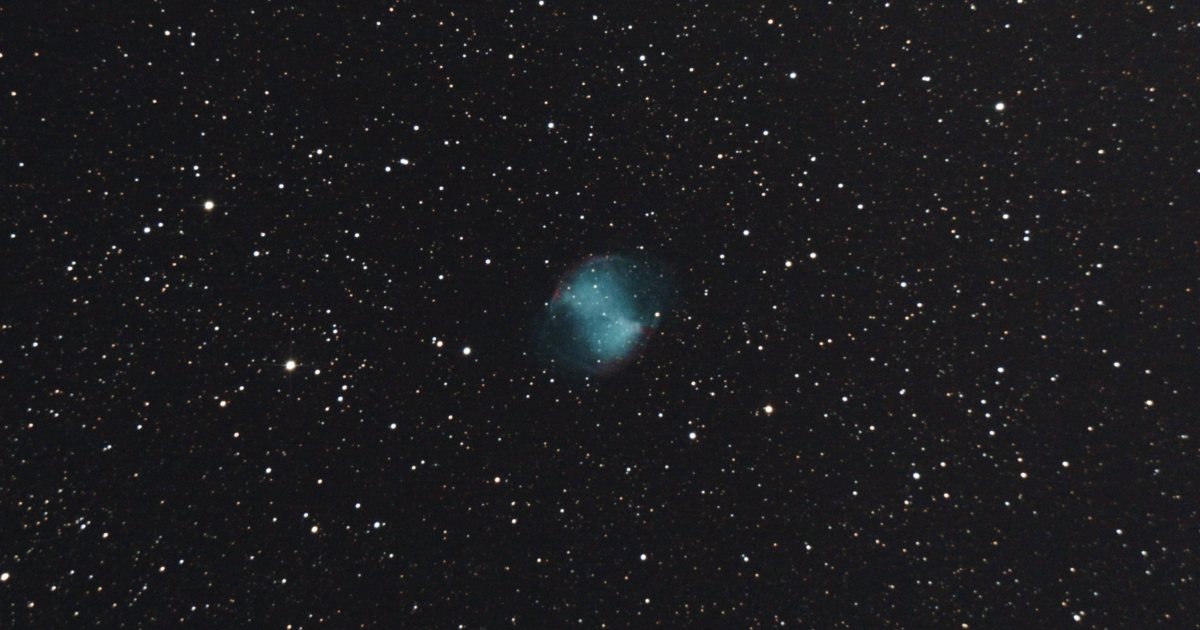
The Dumbbell Nebula in Vulpecula is a great target for any telescope under this evening’s dark, moonless skies. | Published: September 4, 2026 The Dumbbell Nebula (M27) in Vulpecula is a great deep-sky target for observers of any skill, including beginners. It appears tapered at the center and wider at the ends, like its namesake. Credit: Jeremy Stanley (Flickr, CC BY-NC-SA 2.0) Looking for a sky event this week? Check out our full Sky This Week column. September 3: The Moon in Taurus Last Quarter Moon occurs at 3:51 A.M. EDT, leaving our evening sky completely dark and perfect for searching out fainter, deep-sky targets. High in the southeastern sky two hours after sunset is the constellation Vulpecula, which sits just to the right of cross-shaped Cygnus the Swan. One of Vulpecula’s most famous inhabitants is M27, also known as the Dumbbell Nebula. This planetary nebula, created by a dying Sun-like star, is thinner in the middle and thicker on either end, giving it the appearance of a bowtie or — you guessed it — a dumbbell. The nearest bright star is actually Gamma (γ) Sagittae, which shines at magnitude 3.5. From here, the Dumbbell is just a short hop 3.2° due north. Glowing at magnitude 7.4, M27 is one of the best planetaries in the sky, especially for beginning observers. It stretches about 8’ long and nearly 6’ at its widest. Through binoculars or any small telescope, you’ll see a grayish or greenish blob; give your eyes time to adjust, or try looking out of the corner of your eye to pick up on its pinched-in-the-middle shape. Bumping up the magnification once you’ve got a scope centered on it may help as well, while a narrowband or OIII filter will further improve the view. The central star responsible for the nebula, now a white dwarf, shines at 13th magnitude. Larger scopes (10 inches or more) should allow you to spot it. Sunrise: 6:30 A.M.Sunset: 7:27 P.M.Moonrise: 11:51 P.M.Moonset: 2:59 P.M.Moon Phase: Waning crescent (41%)*Times for sunrise, sunset, moonrise, and moonset are given in local time from 40° N 90° W. The Moon’s illumination is given at 10 P.M. local time from the same location. Alison Klesman is senior editor of Astronomy magazine. She holds a Ph.D. in astronomy and has studied a variety of topics, from minor planets to supermassive black holes.
The Sky Today on Friday, September 4: Get in a workout
Full Article
Original Source
Read the full article at Astronomy →KhanList aggregates and links to publicly available news content. We do not host full articles from third-party sources. Always verify important information with original sources.