
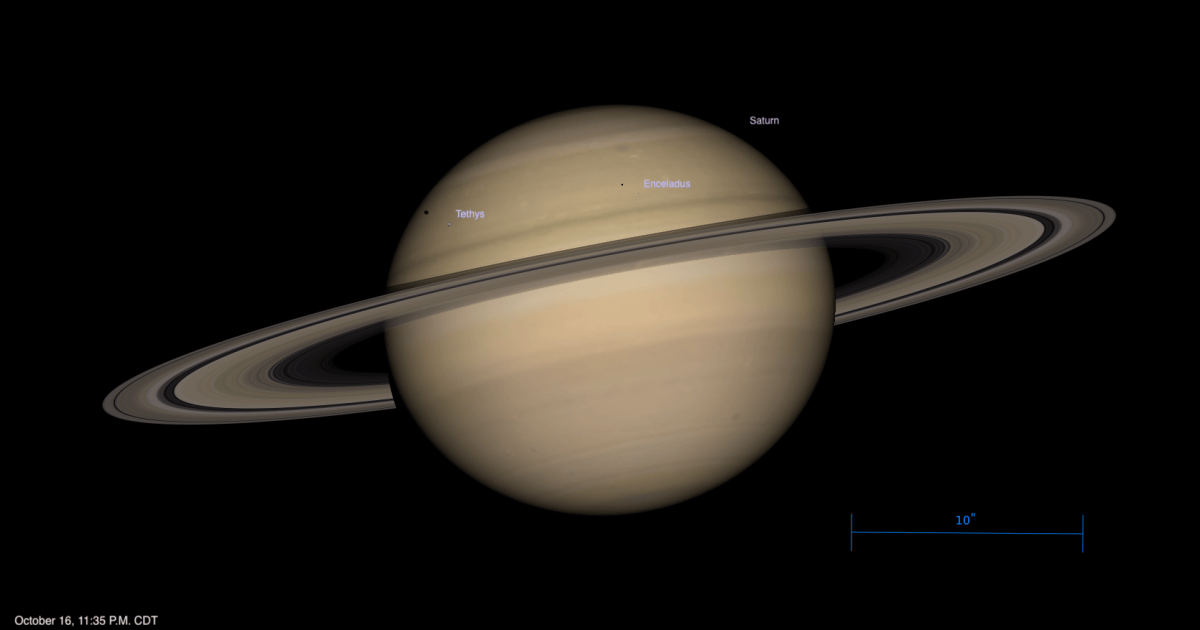
Saturn’s moon Tethys transits the disk; you may catch it via planetary imaging. Bright Titan is near the planet, visible to all observers. | Published: October 16, 2026 This close-up view shows both Tethys and Enceladus transiting Saturn late on the 16th for most of the U.S. Note that Enceladus will not be visible visually, and Tethys will be a challenge as well. Both are best caught via photography. Credit: Stellarium/Oleg Pluton Looking for a sky event this week? Check out our full Sky This Week column. October 15: Double crater Messier Late this evening for much of the U.S., Saturn’s small moon Tethys transits the ringed planet’s disk along with its shadow. It’s the best-timed such event all month for U.S. observers, beginning shortly after midnight EDT (so, early on the 17th in the Eastern time zone, and late on the 16th for all other U.S. time zones). Around midnight EDT, magnitude 0.3 Saturn is high in the south, outshining any of the stars in this region. Through a telescope, you’ll easily spot Titan, Saturn’s largest and brightest moon, roughly 1’ southeast of the ringed planet. At this time, 10th-magnitude Tethys lies just northeast of the planet’s eastern limb. Similarly bright Dione is east of the planet, just north of Titan, while Rhea is west of Saturn. The tiny, dim moon Enceladus is transiting with its shadow, but will be extremely difficult to track and require photography or high-speed video capture to catch. Watch as Tethys approaches the planet, beginning to transit around 12:17 A.M. EDT Oct. 17 (still Oct. 16 farther west). Its shadow appears just after 12:30 A.M. EDT. Again, you will likely require photography to catch the transit and shadow transit, given that Tethys is so small and faint compared to Saturn’s disk. The moon continues to make its way across the disk until the early-morning hours of the 17th; both moon and shadow slip away from Saturn’s western limb around 2:25 A.M. EDT. Sunrise: 7:12 A.M. Sunset: 6:19 P.M. Moonrise: 1:16 P.M. Moonset: 10:05 P.M. Moon Phase: Waxing crescent (36%) *Times for sunrise, sunset, moonrise, and moonset are given in local time from 40° N 90° W. The Moon’s illumination is given at 10 P.M. local time from the same location. Alison Klesman is senior editor of Astronomy magazine. She holds a Ph.D. in astronomy and has studied a variety of topics, from minor planets to supermassive black holes.
The Sky Today on Friday, October 16: Tethys and its shadow transit
Full Article
Original Source
Read the full article at Astronomy →KhanList aggregates and links to publicly available news content. We do not host full articles from third-party sources. Always verify important information with original sources.