
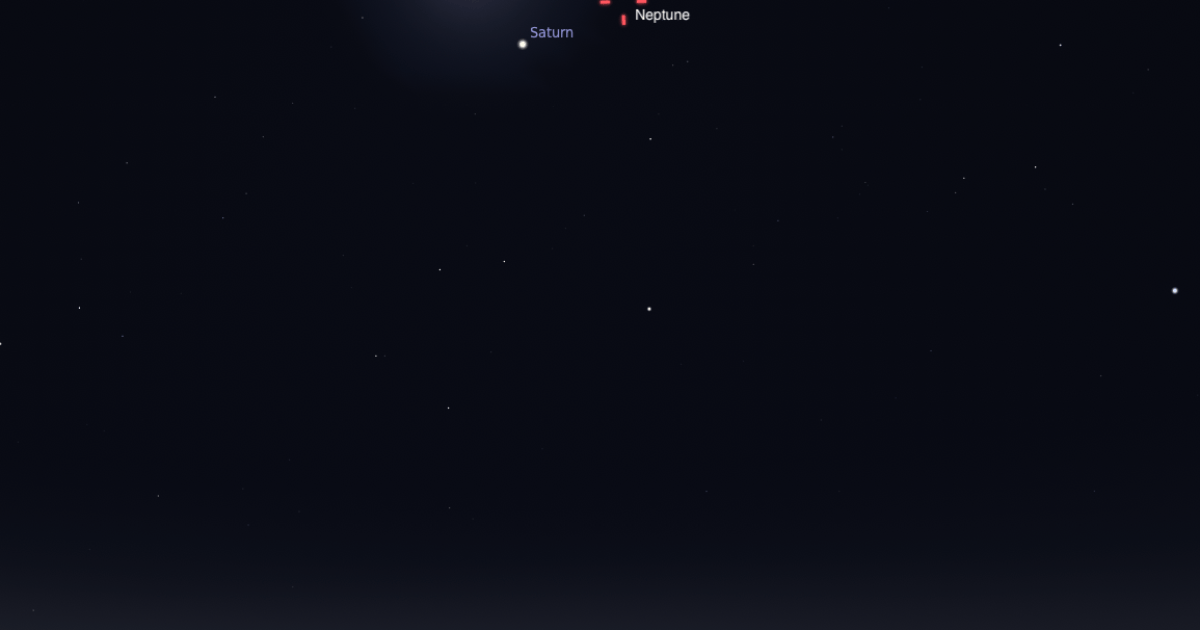
A waxing gibbous Moon sits near Saturn and Neptune in the evening sky, creating a celestial triangle among the stars. | Published: November 20, 2026 The Moon forms a triangle with Saturn and Neptune on the 20th; the latter (marked by the red crosshairs) will require optical aid to spot. Credit: Stellarium/USGS/Celestia/Clementine Looking for a sky event this week? Check out our full Sky This Week column. November 19: Mercury moves into Libra The Moon passes 5° north of Neptune at 8 A.M. EST; 12 hours later, our satellite passes 7° north of Saturn at 8 P.M. EST. The trio is visible in the southeastern sky two hours after sunset, forming a triangle with the Moon to the upper left of Saturn, and Neptune to Saturn’s right. Only the Moon and Saturn are visible to the naked eye, while Neptune will require optical aid. From the gibbous Moon, drop down first to check out Saturn through a telescope, including its lovely ring system and brightest moon, Titan. Saturn is the brightest object in this part of the sky after the Moon, so you don’t have to worry about misidentifying it. After passing south of the ringed world earlier this week, Titan now sits about 3.2’ to Saturn’s west, in line with the rings. Fainter moons Tethys, Rhea, and Dione may be visible clustered closer to the planet, but the bright moonlight might also make them challenging for visual observation. From Saturn, scan 6.6° west-southwest to land on Neptune. If you have a go-to scope, it may take you right to the outermost planet, which glows at magnitude 7.7 and offers up a tiny, 2”-wide disk. It may look like a “flat,” bluish-gray star, rather than a bright pinprick of white light. Look for a large parallelogram of 4th- and 5th-magnitude stars just over 9° to Saturn’s southwest if you need a closer stepping stone. The star at the northeastern point of that shape is 5th-magnitude 29 Piscium, and it lies about 2.6° southwest of Neptune. Sunrise: 6:51 A.M.Sunset: 4:40 P.M.Moonrise: 2:04 P.M.Moonset: 2:12 A.M.Moon Phase: Waxing gibbous (84%)*Times for sunrise, sunset, moonrise, and moonset are given in local time from 40° N 90° W. The Moon’s illumination is given at 10 P.M. local time from the same location. Alison Klesman is senior editor of Astronomy magazine. She holds a Ph.D. in astronomy and has studied a variety of topics, from minor planets to supermassive black holes.
The Sky Today on Friday, November 20: The Moon passes Saturn and Neptune
Full Article
Original Source
Read the full article at Astronomy →KhanList aggregates and links to publicly available news content. We do not host full articles from third-party sources. Always verify important information with original sources.