
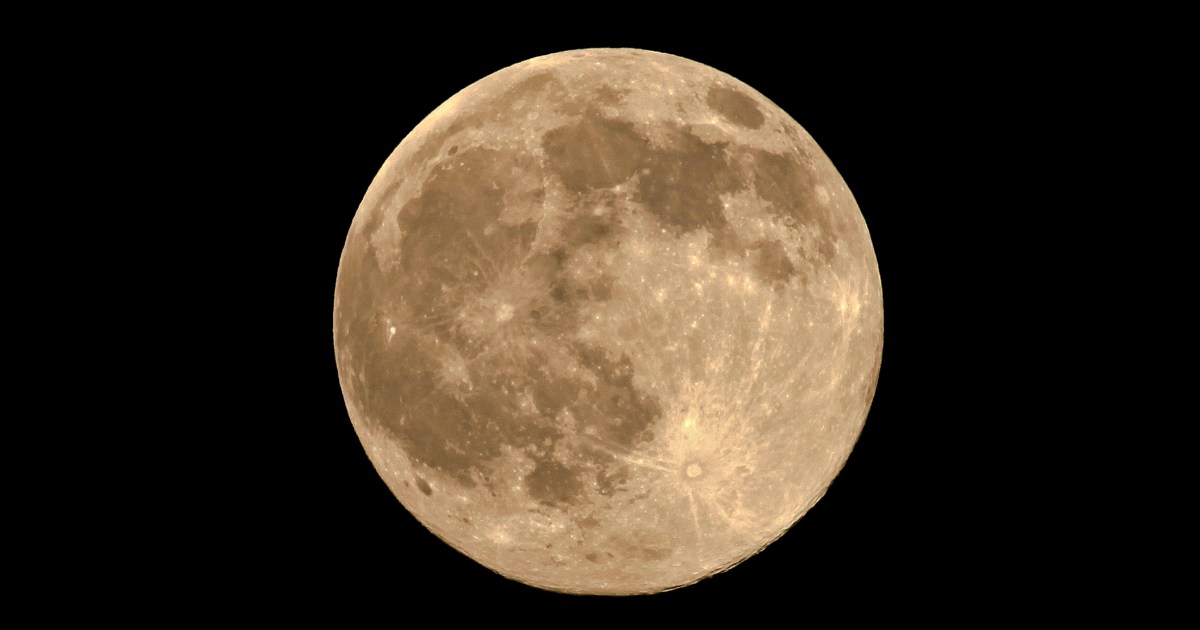
Friday, October 23The Moon passes 5° north of Neptune at 11 P.M. EDT; you can catch the pair in the south around that time, along with Saturn in the southwest, just to the Moon’s lower left. Saturn is visible to the naked eye, but Neptune is not. The distant ice giant will require binoculars or a telescope to spot and may still be a challenge, hanging below the bright Moon in Pisces. Above the Moon, look for the four bright stars that form the Great Square of Pegasus: Algenib, Alpheratz, Scheat, and Markab. Alpheratz, at the upper left-hand (northeastern) corner of the Square, is not technically within the bounds of Pegasus, and is officially cataloged as Alpha (α) Andromedae, in the constellation Andromeda. However, it is also cataloged as Delta (δ) Pegasi, as it once belonged to the Winged Horse’s domain. Venus reaches inferior conjunction with the Sun at midnight EDT. Sunrise: 7:19 A.M. Sunset: 6:09 P.M. Moonrise: 4:41 P.M. Moonset: 4:26 A.M. Moon Phase: Waxing gibbous (95%) *Times for sunrise, sunset, moonrise, and moonset are given in local time from 40° N 90° W. The Moon’s illumination is given at 10 P.M. local time from the same location. Saturday, October 24Mercury reaches a stationary point in Libra at 8 A.M. EDT. The tiny planet is only briefly visible after sunset, but if you’ve got a clear horizon, give it a try. Look west roughly 20 to 30 minutes after sunset, and scan for a magnitude 0.5 point of light just above the horizon. Mercury is 2.5° high in the southwest 20 minutes after sunset, and 1° high in the west 10 minutes later. You may want to try sweeping the area slowly with binoculars, but make sure the Sun has set completely below the horizon before pulling out any optical aid. Mercury’s disk stretches 9” across and the planet is 28% lit if you can catch it through a telescope. Today’s standstill marks an end to Mercury’s prograde, or eastward, movement. After this, it will begin tracking westward, or retrograde, heading back past Alpha (α) Librae in just a few days and crossing into Virgo in early November, joining Venus. The Moon passes 7° north of Saturn at 2 P.M. EDT. You can catch them rising together in the east after dark, with Saturn just to the Moon’s lower left as they gain altitude with every passing hour. Despite the waxing Moon’s brightness, you should still be able to easily spot the ringed planet with the naked eye. Sunrise: 7:21 A.M. Sunset: 6:07 P.M. Moonrise: 5:05 P.M. Moonset: 5:35 A.M. Moon Phase: Waxing gibbous (98%) Dione and its tiny shadow transit Saturn early in the evening on October 25. Credit: Stellarium/Oleg Pluton Sunday, October 25Saturn’s small moon Dione transits the disk this evening at 8:43 p.m. EDT, best seen from the eastern half of the U.S. However, the transit itself will be difficult to watch visually no matter your location, and will be best captured via high-speed video. Even if you aren’t an advanced photographer, however, you can watch Dione enter and exit the disk, as well as track several of Saturn’s other moons throughout the night. Around 9 P.M. EDT (8 P.M. CDT), Saturn is well above the horizon, in the east for Midwestern observers and the southeast for those along the East Coast. It’s the brightest point of light in this part of the sky and should be visible to the naked eye even with the Moon nearby. You’ll need a telescope to spot its rings and moons, however, and the larger the better to help cut through the Moon’s glare. Prior to the transit’s start, 10th-magnitude Dione is approaching the planet’s northeastern limb, with similarly bright Tethys east of the rings and Rhea to their west. Brighter Titan, which shines around magnitude 8.5, is also visible far west of Saturn all evening, about 2’ from the planet’s center. As Dione begins its transit, it will likely seem to disappear for visual observers, as its tiny disk will be difficult to pick out against Saturn’s bright cloud tops. Video capture might also nab the moon’s shadow, which will cross the far northern polar region of the planet, appearing around 9:40 P.M. EDT and disappearing roughly half an hour later, before Dione reaches the northwestern limb. The moon does this just before 10:40 P.M. EDT — now, visual observers will see it pop into view just off the limb and begin pulling away from Saturn to the west. Sunrise: 7:22 A.M. Sunset: 6:06 P.M. Moonrise: 5:33 P.M. Moonset: 6:46 A.M. Moon Phase: Full Monday, October 26October’s Full Moon occurs at 12:12 A.M. EDT, shining brightly in both the morning and evening sky. The October Full Moon is also called the Hunter’s Moon, which follows the Full Harvest Moon we saw in September. Observing the Full Moon can actually be a bit challenging. At Full phase, the Sun appears directly overhead from the nearside and it is lunar “noon,” which means shadows are at their shortest and the landscape does not appear as three-dimensional as we peer up at it. However, that doesn’t mean there’s no observing to be had! First, though, if you plan to use a telescope, consider a Moon filter to cut down on the glare. If you don’t have one, you can observe while wearing sunglasses to get the same effect — just make sure not to slip them over your eyes until you’re about to step up to the eyepiece. Using higher magnifications will also reduce the amount of bright light streaming into your eye, as greater magnification reveals less of the lunar surface in a single field of view. Although many features are not at their best during a Full Moon, the rays of ejecta left behind as impactors slammed into the surface to create craters can be viewed during a Full Moon. In particular, the large crater Tycho in the lunar south has a huge, well-defined system of rays you can explore, some of which stretch hundreds of miles from the crater itself. Other craters that have stunning rays you can seek out during Full Moon include Copernicus, Proclus, Aristarchus, Stevinus, and Byrgius. Sunrise: 7:23 A.M. Sunset: 6:05 P.M. Moonrise: 6:06 P.M. Moonset: 8:02 A.M. Moon Phase: Waning gibbous (99%) Kemble’s Cascade is an asterism of stars that appear to flow from northeast to southwest, ending in the open star cluster NGC 1502 (lower left). Credit: Weike Pan (Flickr, CC BY-NC-ND 2.0 DEED) Tuesday, October 27The Moon’s bright light washes out dimmer targets, but not all deep-sky objects are out of reach. Late this evening, the constellation Camelopardalis sits in the north, to the right (east) of the Little Dipper and sandwiched between Cassiopeia and Ursa Major. In Camelopardalis’ southwestern region is a 6th-magnitude open cluster called NGC 1502. Stretching about 8’ across, this compact group of young stars lies about 9° south of magnitude 4.6 Gamma (γ) Camelopardalis and is visible in binoculars or any telescope. But it’s only the beginning: NGC 1502 lies at one end of a line of stars known as Kemble’s Cascade. This asterism resembles a waterfall with NGC 1502 serving as the spray of water coming from the pool at its base. From NGC 1502, look for a snaking line of nearly two dozen stars roughly 2.5° long, shining between about 7th and 10th magnitude and stretching up toward the northwest. You’ll want binoculars or a finder scope to take them all in at once, or you can slide slowly along the line within the smaller field of view of your telescope. The asterism is named for Father Lucian Kemble, who described the pattern in a letter to astronomy popularizer Walter Scott Houston. Sunrise: 7:24 A.M. Sunset: 6:04 P.M. Moonrise: 6:47 P.M. Moonset: 9:20 A.M. Moon Phase: Waning gibbous (95%) Look west around 6 A.M. local daylight time on the 28th to catch the Moon hanging above the Pleiades star cluster, with Uranus nearby. You’ll likely require binoculars or a telescope to spot the distant planet. Credit: Stellarium/USGS/Celestia/Clementine Wednesday, October 28The Moon passes 5° north of Uranus at 6 A.M. EDT this morning. You’ll find our satellite hanging above the Pleiades (M45) in Taurus, roughly 45° high in the west around 6 A.M. local daylight time. Together with Uranus, the Moon and Pleiades form a triangle in the sky that slowly sets as twilight approaches. If you want to view Uranus, you’ll need some optical aid — technically its magnitude of 5.6 puts it within naked-eye range, but the bright Moon nearby will wash it out. You can find the ice giant 5° to the lower left of the Moon as they sink, or about halfway along a line drawn from the Pleiades toward the upper left and ending at the bright star Aldebaran. Magnitude 0.9 Aldebaran (Alpha [α] Tauri) is typically envisioned as the eye of Taurus the Bull. The red giant is the 14th brightest star in the sky, shining with a luminosity more than 400 times that of the Sun from a distance of roughly 67 light-years. Despite its brightness, its surface temperature is quite cool, which results in the reddish color. Compare its orangey-red hue to that of Mars in the east. The Moon reaches perigee, the closest point to Earth in its orbit, later today at 2:06 P.M. EDT. At that time, our satellite will stand 226,433 miles (364,409 kilometers) away. Sunrise: 7:25 A.M. Sunset: 6:02 P.M. Moonrise: 7:39 P.M. Moonset: 10:36 A.M. Moon Phase: Waning gibbous (88%) Thursday, October 29The W-shaped constellation Cassiopeia is prominent in the northern sky after sunset as it wheels around the North Celestial Pole, which marked by the North Star, Polaris. Around 8 P.M. local daylight time — after dark but before moonrise — you’ll find the Queen to the right of Polaris when facing north, positioned such that her stars now look like the numeral 3. In the northern region of Cassiopeia, located to the lower left of the this pattern, is a loose open cluster cataloged as Collinder 463. The Collinder catalog, created in 1931 by Per Collinder, contains nearly 500 open clusters of young stars. Entry No. 463, our target, shines around 6th magnitude and sits roughly 8.2° north of 3rd-magnitude Epsilon (ε) Cassiopeiae, along a line drawn between this star and Polaris. Spanning roughly 73’, it’s easy to observe in binoculars or a small scope. At low magnification, such as through binoculars or a finder scope, many observers think its gaggle of stars form a rough crescent-shaped smudge of light on the sky. What shape do you see? Sunrise: 7:26 A.M. Sunset: 6:01 P.M. Moonrise: 8:41 P.M. Moonset: 11:47 A.M. Moon Phase: Waning gibbous (80%) Mars stands at the border of Cancer and Leo the morning of the 30th, preparing to join bright Jupiter in the latter by tomorrow. Together with Regulus, the three points of light form a line in the early-morning sky. Credit: Stellarium Friday, October 30Magnitude 0.8 Mars, currently tracking eastward through the sky, now stands at the border of Cancer and Leo. It is still within the bounds of the Crab this morning, roughly 60° high in the southeast and just over 6° to the upper right of brighter Jupiter in Leo, about 90 minutes before sunrise. To Jupiter’s east (lower left) is magnitude 1.4 Regulus, the brightest star in the Lion, which also serves as the great cat’s heart. Together with Jupiter and Mars, the three form a line slashing upward in the predawn sky. Far to the planetary pair’s upper right is Procyon, the bright nose of Canis Minor, the Little Dog. And to that star’s far lower right is even brighter Sirius, the nose of Canis Major, the Big Dog — the brightest star in the sky. However, Jupiter (at magnitude –2.0) currently outshines Sirius’ magnitude –1.4 glow. Mars will continue to move east, joining Jupiter in Leo by tomorrow morning. Sunrise: 7:27 A.M. Sunset: 6:00 P.M. Moonrise: 9:53 P.M. Moonset: 12:45 P.M. Moon Phase: Waning gibbous (69%) Alison Klesman is senior editor of Astronomy magazine. She holds a Ph.D. in astronomy and has studied a variety of topics, from minor planets to supermassive black holes.
The Sky This Week from October 23 to 30: Gaze at the Full Hunter’s Moon
Full Article
Original Source
Read the full article at Astronomy →KhanList aggregates and links to publicly available news content. We do not host full articles from third-party sources. Always verify important information with original sources.