
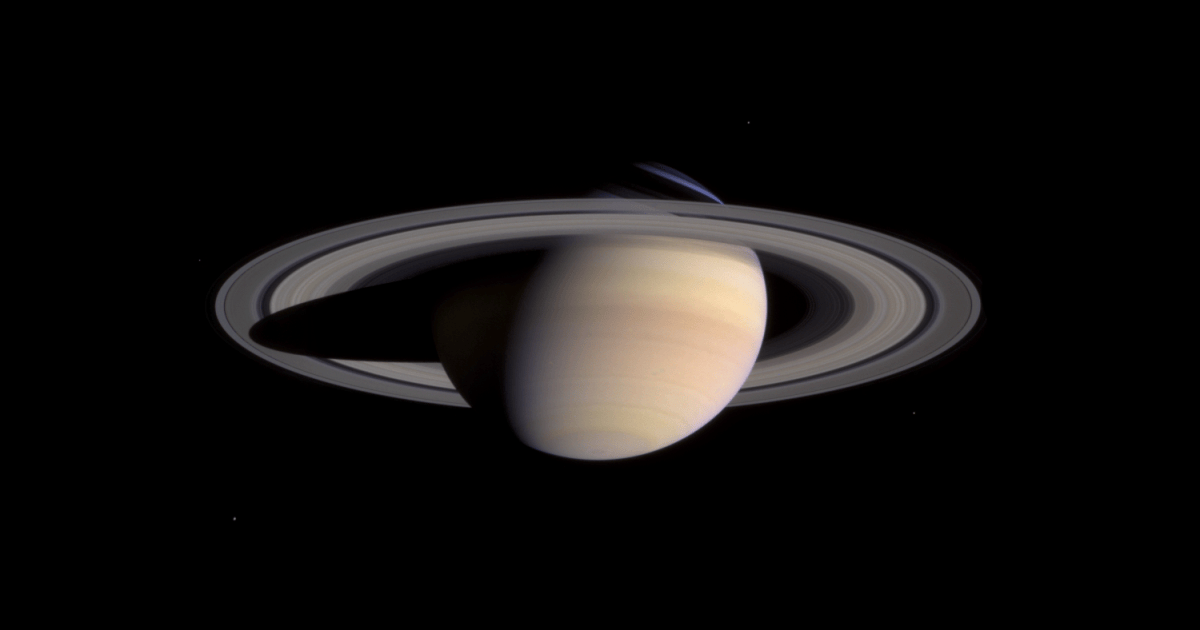
Caption: NASA’s Cassini spacecraft captured this stunning color view of Saturn and several of its smaller moons in late March 2004. Credit: NASA/JPL/Space Science Institute Friday, October 2Venus appears to halt its motion through the sky today, standing stationary at 10 A.M. EDT. Now in Virgo, you can catch the bright planet, along with Mercury, for a brief time after sunset. Venus stands just 2° high in the west 20 minutes after sunset. Its bright magnitude of –4.8 can help you spot it, but only if no buildings or trees are in the way. Mercury is fainter (magnitude –0.1) but twice as high, standing 4° above the horizon at the same time. It is located about 7.2° to Venus’ upper right. After the pair disappears and the sky has grown dark, turn your gaze southward to see if you can pick out the shape of the Teapot, a famous asterism within the larger constellation Sagittarius. The Teapot appears with its spout facing right (west) and its handle on the left (east), tipped as though it is pouring tea down over the tail of Scorpius the Scorpion. The Teapot’s brightest star is magnitude 1.8 Kaus Australis (Epsilon [ε] Sagittarii) in the lower righthand corner of the Teapot’s body. The other stars in the asterism range from 2nd to 3rd magnitude, and include Zeta (ζ), Tau (τ), Sigma (σ), Phi (φ), Lambda (λ), Delta (δ), and Gamma (γ) Sgr. Sunrise: 6:57 A.M.Sunset: 6:40 P.M.Moonrise: 10:50 P.M.Moonset: 1:56 P.M.Moon Phase: Waning gibbous (55%) *Times for sunrise, sunset, moonrise, and moonset are given in local time from 40° N 90° W. The Moon’s illumination is given at 10 P.M. local time from the same location. Late on the 3rd, Dione is transiting Saturn’s north polar region along with its shadow. Tethys and Rhea (not shown) lie to the planet’s west, while Titan (also outside this field of view) is far to the east. Credit: Stellarium/Oleg Pluton Saturday, October 3Last Quarter Moon occurs at 9:25 A.M. EDT. In the evening sky, the small moon Dione transits Saturn starting just before midnight EDT. Tenth-magnitude Dione crosses the far northern region of the planet, beginning its journey just minutes after 11:40 P.M. EDT and taking about an hour and a half to complete the crossing. Its tiny shadow accompanies it, but said shadow will be all but impossible to pick up visually. Astrophotographers experienced with high-speed planetary video capture might catch it, though, so if that’s your forte, give it a try! The shadow is visible just north-northwest of Dione, very close to the moon itself. While Dione is transiting, look also for Tethys and Rhea, two moons of similar brightness that lie close to Saturn. Both are to the planet’s west, with Tethys closer to the planet than Rhea. Titan, some 1.5 magnitudes brighter, lies 3.3’ east of Saturn, on the planet’s other side. Sunrise: 6:58 A.M.Sunset: 6:39 P.M.Moonrise: — Moonset: 2:50 P.M.Moon Phase: Waning crescent (44%) Sunday, October 4We’re back at Saturn this evening with the planet as the main attraction as the ringed world reaches opposition today at 8 A.M. EDT. Rising around sunset and setting around sunrise, it is visible all night in the constellation Cetus, located near the Whale’s northern border with Pisces. Glowing at magnitude 0.3, Saturn is the brightest point of light in this region of the sky. It rises in the east beneath the Great Square of Pegasus and sits to the far upper left of Fomalhaut in Piscis Austrinus around midnight, the hour when the planet is highest, standing above the southern horizon. Always a treat in a telescope, Saturn’s disk now spans 20”, while its rings are nearly 45” from end to end. Their southern side is visible, along with the planet’s south pole, as the world is tilted some 7° to our line of sight. Titan, the planet’s brightest moon at mid-8th magnitude, still lies east of the ringed world. Tethys, Rhea, and Dione are closer in, all around 10th magnitude. Their positions will depend on when you observe the planet: Early on the evening of the 4th, only Dione and Rhea are visible to Saturn’s west, as Tethys is passing behind the disk in an occultation. Tethys reappears around 8:20 PM EDT, popping out from behind the southeastern limb. It pulls away from Saturn to the east over time, while Rhea approaches and crosses south of the planet (although it does not pass in front of or behind the disk) between about 1 A.M. and 3 A.M. EDT (now the 5th for most U.S. observers). Dione also approaches the planet from the southwest, disappearing in an occultation around 6:40 A.M. MDT, shortly before sunrise in this time zone. The event is best viewed from the West Coast, where skies are still likely to be dark. Sunrise: 6:59 A.M.Sunset: 6:37 P.M.Moonrise: 12:02 A.M.Moonset: 3:34 P.M.Moon Phase: Waning crescent (33%) Monday, October 5The Moon passes 1.2° north of Mars at 2 A.M. EDT. The pair shares Cancer early this morning, rising around 1:15 A.M. local daylight time and remaining visible until sunrise. Mars is now magnitude 1.1, a bright point of light in central Cancer, hanging between Castor and Pollux above it and Regulus and Jupiter below, once Leo rises. The waning Moon is located to Mars’ lower left, passing close to the scattered stars of the Beehive open cluster (M44) and occulting some of them, depending on your location. Our satellite first begins plowing through the northern part of the cluster around 5 A.M. EDT, and takes about four hours to cross through. Stars will disappear at the bright western limb of our satellite and reappear at the darkened eastern limb — the latter will be easier to catch, best watched through binoculars or a telescope. Later in the morning, Mercury passes 5° north of Venus at 11 A.M. EDT. If you’re quick and have a clear western horizon, you may be able to spot this pair after sunset, but it will be challenging. Venus is now less than 1° high in the west 20 minutes after sunset, so even its brilliance (now magnitude –4.7) won’t aid you much in spotting it. If you do have a horizon free of trees or buildings, and especially if you can get to an elevated observing site, give it a try. Mercury will be easier, still just over 4° high 20 minutes after sunset, located to Venus’ upper right and still shining at magnitude –0.1. Sunrise: 7:00 A.M.Sunset: 6:35 P.M.Moonrise: 1:17 A.M.Moonset: 4:09 P.M.Moon Phase: Waning crescent (23%) Tuesday, October 6The Moon passes 0.2° north of Jupiter at 6 A.M. EDT. But before that, our satellite occults the planet for observers in parts of Canada, the U.S., Mexico, and Cuba. This is a relatively rare event, occurring on average only once every 13 years, so it’s definitely not one to be missed! Jupiter now resides in western Leo, shining brightly at magnitude –1.9. The planet rises shortly after 2:30 A.M. local daylight time, leading the constellation’s brightest star, magnitude 1.4 Regulus, by nearly 10°. As Jupiter rises in the eastern half of the U.S., the waning Moon is very close to the planet, immediately to its west, preparing to slowly pass in front of the gas giant, covering it for roughly an hour. You can easily watch the event with the naked eye, but binoculars or a telescope will yield a more detailed view. If you are watching through a scope, you will also catch Jupiter’s four Galilean moons, lined up with three moons on one side and one alone on the other. Some observers will get a bonus event: As Jupiter rises along the East Coast, Europa is farthest west, followed by Io and then Callisto closest to Jupiter. Ganymede is east of the planet. But keep a close eye on those western moons: Io and Callisto are approaching each other, as Io moves east and Callisto moves west. Just before 3:45 A.M. EDT (not long after Jupiter has risen in the Midwest), the two moons seem to merge as Callisto briefly occults Io in another rare event. After this, Io lies closest to Jupiter on the planet’s west, with Callisto between it and Europa, farther out. Not long after, the Moon will occult the entire jovian system. Whether you will see the occultation — and how much of it you will catch — depends on your location. The map below depicts where the event will be visible, including regions along the northern and southern edge of the shadow where a partial occultation can be seen. The best views are in northeastern Canada and the entire eastern half of the U.S., but regions in the Southwest and portions of central Mexico are also well positioned. The timing of the event also depends on your location, beginning around 4:15–4:20 A.M. EDT (3:15–3:20 A.M. CDT) and ending roughly an hour later. Observers in the central and western U.S. won’t see Jupiter disappear, but can catch the reappearance around 3 A.M. MDT. The Oct. 6 lunar occultation of Jupiter will be visible in darkness across most of the eastern and central U.S. and parts of southern Canada. For parts of the American West and eastern Mexico, the Moon and Jupiter will not yet have risen when the occultation begins; they will see only the reemergence of Jupiter from behind the Moon’s dark limb. Strips across northern Montana and southern Canada, and across southern Mexico, southern Cuba, and the Greater Antilles, will see a partial occultation of Jupiter, with the Moon grazing the planet’s disk. Credit: Astronomy: Roen Kelly, after David Dunham/International Occultation Timing Association For more details on the occultation, including its visibility and timing, check out our article dedicated to the event: See the Moon occult Jupiter October 6 or visit the International Occultation Timing Association’s page here. Later this evening, asteroid 2 Pallas reaches opposition at 7 P.M. EDT. Additionally, the Moon passes 0.6° south of Regulus at midnight EDT. Sunrise: 7:01 A.M.Sunset: 6:34 P.M.Moonrise: 2:31 A.M.Moonset: 4:37 P.M.Moon Phase: Waning crescent (14%) Wednesday, October 7Saturn’s brightest moon, Titan, has closed the gap between itself and its parent planet to sit less than 1’ northeast of the ringed world tonight. With Saturn already above the horizon as the sky is darkening, you can take your time observing it. Titan shines at mid-8th magnitude, which makes it stand out among the fainter moons that cluster closer to the planet. Dione, Tethys, and Rhea all shine around 10th magnitude and begin the evening west of the planet, but their positions change quickly thanks to their relatively tight orbits. Rhea and Tethys are moving west, but Dione is tracking eastward. It is occulted by the southwestern limb of the planet just before 2:15 A.M. EDT on the 8th (now early in the morning for all but those in the Pacific time zone) and reappears just under two hours later, now at the southeastern limb. During this time, Titan has been moving westward as well, and stands due north of Saturn around 6 A.M. MDT (note the time zone change, as it is dawn or nearly dawn farther east) on the 8th. The evening of the 8th will find Titan northwest of the planet, moving farther away again. Sunrise: 7:02 A.M.Sunset: 6:32 P.M.Moonrise: 3:43 A.M.Moonset: 5:03 P.M.Moon Phase: Waning crescent (7%) Pallas is located in central Cetus, easy to find with the help of several nearby bright stars. The asteroid is moving slowly southwest over time, at a rate of only a few arcminutes per night. Credit: Alison Klesman (via TheSkyX) Thursday, October 8Asteroid 2 Pallas recently reached opposition in Cetus the Whale. Let’s track it tonight using binoculars or any size telescope. Although it’s highest around 1 A.M., Pallas is visible all night and has already reached an altitude of 20° by 10 P.M. local daylight time, standing above the southwestern horizon. While Saturn is in northern Cetus, Pallas is near the center of the constellation, about 5.4° southeast of magnitude 3.5 Eta (η) Ceti. Around 10 P.M., you can also use Saturn to find Pallas by simply dropping just a little less than 19° down from the naked-eye planet toward the horizon. Pallas glows at magnitude 8.3 and sits roughly ¼° northeast of a field star of roughly the same magnitude (8.2). It’s moving slowly, inching closer to the star over time and closing the gap by a few arcminutes over the course of the night. Using that star as a signpost, you may be able to notice its motion if you take a photo every few hours. If you come back tomorrow night, you’ll definitely notice a change: Pallas and the star have swapped positions, so that Pallas is now southwest of the field star and pulling away over time. Sunrise: 7:03 A.M.Sunset: 6:31 P.M.Moonrise: 4:53 A.M.Moonset: 5:26 P.M.Moon Phase: Waning crescent (3%) Friday, October 9Swimming high above the southern horizon after dark, Capricornus the Sea Goat is home to just one Messier object: M30. This compact globular cluster shines at magnitude 7.2 and is perfectly positioned for viewing with binoculars or a small scope around 9:30 P.M. local daylight time this evening. You can find M30 in the southeastern corner of Capricornus. It sits just over 3° east-southeast of 4th-magnitude Zeta (ζ) Capricorni. Spanning about 11’ in diameter, the cluster has a dense core of stars that is unresolvable in smaller scopes, but the outskirts of the cluster will easily separate into individual stars even with a 4-inch instrument. If you do have a larger telescope, do pull it out, as larger instruments reveal additional detail — especially in the cluster’s crowded central region. Lying nearly 28,000 light-years from Earth, M30 is some 24,000 light-years from the center of our galaxy and orbits the Milky Way every 100 million years. Astronomers estimate this cluster is roughly 13 billion years old. Sunrise: 7:04 A.M.Sunset: 6:29 P.M.Moonrise: 6:00 A.M.Moonset: 5:49 P.M.Moon Phase: New Alison Klesman is senior editor of Astronomy magazine. She holds a Ph.D. in astronomy and has studied a variety of topics, from minor planets to supermassive black holes.
The Sky This Week from October 2 to 9: Saturn at its best
Full Article
Original Source
Read the full article at Astronomy →KhanList aggregates and links to publicly available news content. We do not host full articles from third-party sources. Always verify important information with original sources.