
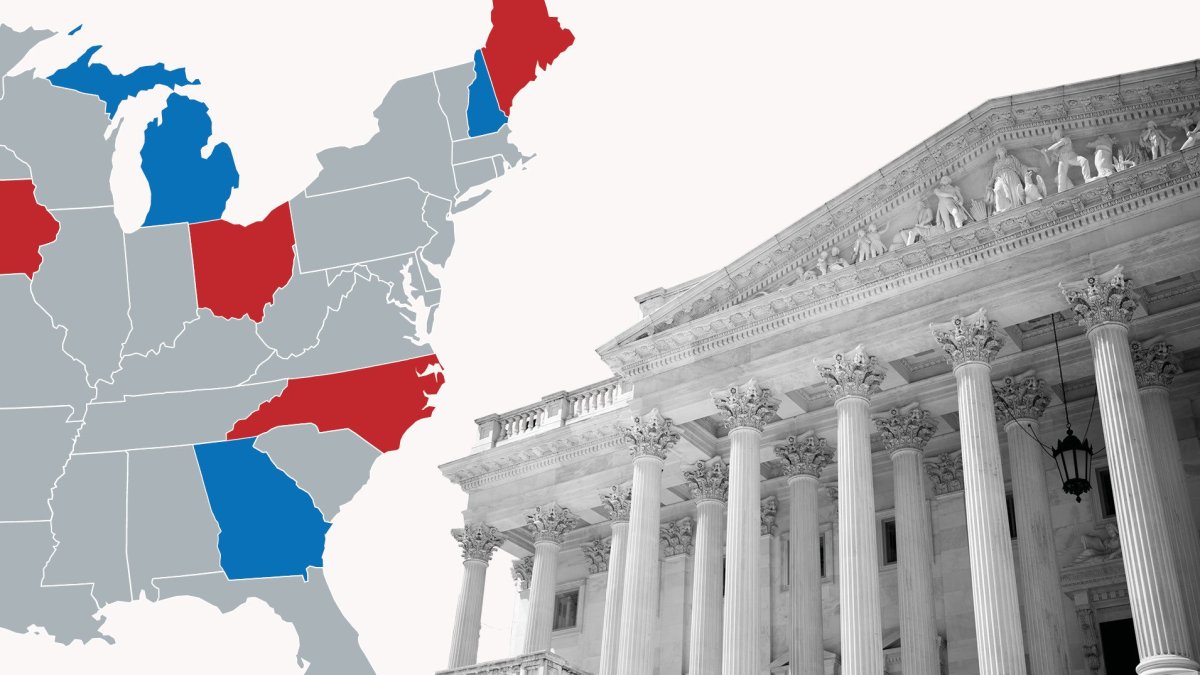
The Trump administration is looking at a bruising set of midterm elections that could result in the Republicans losing control of both the House of Representatives and the Senate. Most analysts say that the Democrats are likely to gain control of the House because the Republicans only have a majority of four seats. However, to flip the Senate, the Democrats would need to retain all their seats and win four from the Republicans. The Republicans, who were previously confident in their ability to keep the Senate, are struggling beneath the weight of Donald Trump’s unpopularity. Voters are increasingly dissatisfied with the US President’s decisions, high inflation, gas prices, the war on Iran and immigration among top concerns. And with less than two months to go until the 3 November elections, Democrats have been eyeing up states that once seemed beyond their reach, with Republicans increasingly unsure they can hang on to the 100-seat Senate. Here are the nine standout races to watch that could determine control of the US Senate – six currently held by Republicans and three by Democrats. Maine Democrats have been targeting Republican-held Maine, where incumbent Susan Collins has held her Senate seat since 1997 – despite the state leaning Democrat in presidential elections. “On paper, Maine should be a comfortable win for the Democrats,” according to Nathan Gonzales of Inside Elections, a non-partisan political analysis organisation. Former vice president Kamala Harris won the state by 7 percentage points in 2024. However, “Susan Collins is tough to beat”, he added. Dr Peter Finn, a lecturer in International Relations at the University of Greenwich, who curates the LSE United States Politics and Policy blog series on the midterms, told The i Paper that Collins could be a tricky opponent because she “is an independent within the Republican Party, she’ll go against the leadership if she thinks she should”. That means that voters dissatisfied with Trump might still vote to keep her on as senator. The Democrats have already harmed their own campaign in Maine by their initial choice of candidate, Graham Platner. A progressive, an oyster farmer and ex-Marine, Platner attracted controversy over a tattoo that resembled a Nazi symbol, and ultimately had to drop out of the race due to allegations of sexual assault. The current candidate is Troy Jackson, a former lumberjack and state legislator who shares Platner’s progressive politics. Recent polls show Jackson with a three- to four-percentage-point lead. Texas A traditionally Republican stronghold that has not seen a Democratic candidate win either of its Senate seats since 1993, Texas has become competitive. Democrat candidate James Talarico, a former teacher and member of the Texas House of Representatives is close in the race against scandal-hit Republican Ken Paxton, the state’s attorney general. Dr Finn told The i Paper that the demographics of the state had changed in a way that was favourable to the Democrats. “It’s much more diverse than it was in the past, as with lots of places. I’m not saying it’s definitely going to happen. The cities lean Democrat and the bigger they become the more likely [a Democrat victory is],” he said. The Democrats’ chances in Texas have been helped by the Republicans’ choice of candidate. Paxton is a Trump loyalist and a stalwart of Texas politics with a long history of scandal including multiple accusations of fraud and a failed attempt to overturn the 2020 presidential election by suing states that Joe Biden won. Last year his wife filed for divorce “on biblical grounds” over alleged infidelity, damaging Paxton’s conservative crusader image. Paxton had to fight a vicious primary, in which he and his opponent John Cornyn tore metaphorical chunks out of each other and spent millions of dollars. A Trump-backed group has pledged to spend $10m in support of Paxton. Kyle Kondik of the non-partisan analyst organisation Sabato’s Crystal Ball, told The i Paper that the organisation considered Texas a toss-up, rather than a sure thing for the Republicans, because: “The question is whether Paxton is too toxic to win even in a Republican state.” Ohio In Ohio, former Democratic Senator Sherrod Brown, a pro-trade union progressive, is going up against incumbent Jon Husted, who took Vice President JD Vance’s place in 2025 when he quit to serve as Vice President. Non-partisan analysts such as the Cook Political Report, Inside Elections and Sabato’s Crystal Ball, have Ohio pegged as a toss-up despite the fact that the state has leaned towards the Republicans in recent years. Recent polls show Brown leading Husted by three to four percentage points. One factor in the race has been the unpopularity of data centres. Brown, who has a reputation for economic populism, has made data centres a focal point of his campaign, accusing his opponent of “being the face of data centres”. The attacks appear to be resonating with voters. In a memo, the National Republican Senatorial Committee warned that Brown’s messaging on data centres was “significantly more effective than traditional messaging” and described data centres as an “anchor hanging around Husted’s neck”. Iowa Economic disillusionment over Trump’s tariffs and the rising cost of fuel and fertiliser in the agricultural state of Iowa mean the Republicans are at real risk of losing the state. Democratic candidate Josh Turek is facing Ashley Hinson, who is fighting for the Republicans after the retirement of incumbent senator Joni Ernst. Turek has campaigned hard in rural areas, targeting small farmers in his messaging and linking the cost of living crisis to Trump’ s war on Iran, and the closure of the Strait of Hormuz. In a statement following Hinson’s vote to continue the war, he said: “By voting to continue this war in Iran, Ashley Hinson has once again shown that she does not care about Iowans. As gas prices hit nearly $4 per gallon and our farmers deal with skyrocketing input prices”. According to the non-partisan analysts, the polling suggests that the state still leans Republican. However, the cost of living crisis for farmers has rendered the race much more competitive for the Democrats than would have previously been the case, and analysts say it may be one of the most competitive contests. North Carolina Democrats have a good chance to win North Carolina, where incumbent Republican senator Thom Tillis, an outspoken Trump critic, is retiring. The Democratic candidate, former governor Roy Cooper, is well liked in the state. He was elected twice as governor in 2016 and 2020, even when Trump won the state in those presidential elections. Conversely, the Republican candidate, Michael Whatley, a Trump ally, has never previously run for office, and is likely to be damaged by his close association with the unpopular president. Opinion polls show Cooper holding a steady lead over Whatley, who most recently chaired the Republican National Committee. According to Nathan Gonzales from Inside Elections, “North Carolina is the Democrats’ best takeover opportunity”. Alaska Alaska, sometimes referred to as the “last frontier” has an unconventional voting system that puts the Democratic candidate, Mary Peltola, in with a shot of taking the seat off Republican Senator Dan Sullivan. Kyle Kondik of Sabato’s Crystal Ball said: “The ballot in Alaska Senate — 3 Rs vs. 1 D — is helpful to Peltola in that state’s unique top-four, ranked-choice system” because Republican votes may end up split. Sullivan may also struggle with the fact that another of the candidates on the ballot is an independent called Dan J Sullivan, which the Republican candidate fears could result in confusion for voters, reducing his chances. Peltola previously held the state’s one House seat for a single term and has campaigned as a centrist. in the nonpartisan primary last month she won 82,000 votes to Sullivan’s 69,000. Alaska is another state in which the war on Iran and the attendant rise in the price of fuel has played into the race. The state is particularly vulnerable to hikes in the price of fuel because of the dispersed population and lack of roads. There is also a shortage in petrol and diesel power for off-grid generators used for electricity in remote areas, as well as off-road vehicles. Peltola has blamed the war on Iran for the rising costs. However, the Democrats have weaknesses too, with three states they fear could be lost to the Republicans, reducing their chances of winning the Senate. Michigan Democrats are hoping to keep their seat held by retiring senator Gary Peters. After a bloody primary in Michigan, progressive Abdul El Sayed won the Democratic nomination. He has since faced criticism from within the Democratic Party for his outspoken stance on Israel, and his association with the controversial streamer Hassan Piker. Centrist argue that he has taken left-wing stances unpopular with the Michigan electorate. “Michigan will not only be a vital race because losing it would mean that the path to a Senate majority becomes significantly more difficult, but it is the only race where a candidate from the progressive wing is running in a swing seat,” said a source familiar with the campaign. Losing Michigan might be taken as a signal of “how unelectable progressives are, dampening the hopes of the progressive wing of the party for getting the presidential nominee in 2028”. The source added that they thought El Sayed could still win in Michigan because its “overall polling shows such a strong lead for Democrats”. Georgia In Georgia, the Democratic senator Jon Ossoff is up against Trump-backed Republican representative Mike Collins. Most polls show Ossoff leading. That may, in part, be down to Ossoff’s acidic takedowns of Trump. The 39-year-old’s viral attacks appear to have dramatically helped his fundraising efforts. As The i Paper previously reported, in the second quarter of 2026 Ossoff raised $20m (£14.7m) and had $42m (£31m) on hand. In comparison, Collins had raised $2.1m (£1.5m) and had about $2m (£1.4m) on hand, giving Ossoff a 20 to one fundraising advantage. Ossoff’s youth and good looks have also led many to compare him to former president Barack Obama, and there is now growing interest among Democrats in an Ossoff 2028 presidential run. Meanwhile Collins is facing scrutiny over reports that his former aide, Preson Parra, shared images of himself in Ku Klux Klan robes. Meyer Siegfried, a spokesperson for Collins, said: “Parra has no affiliation with Mike Collins’ office or campaign. The posts are vile, completely unhinged, and Mike Collins unequivocally condemns them.” New Hampshire New Hampshire is set to be crucial to the fight for the Senate majority. John Sununu, who served in the Senate from 2003 to 2009, last week won the Republican nomination in New Hampshire. He will take on Chris Pappas, who was first elected to the House in 2018. They will be competing for the seat held by retiring Democratic senator Jeanne Shaheen. Non-partisan analysts say Democrats are leading but Republicans see New Hampshire’s open-seat status as one of their few opportunities to gain an advantage. They also believe they have a strong candidate in Sununu. He comes from a well-known political family, as the brother of Chris Sununu, who was New Hampshire’s governor for eight years. His father is John H Sununu, who was chief of staff to President Bush. Trump gave his support to Sununu this year, despite a 2024 op‑ed in which Sununu called Trump a “loser”. Speaking about the midterm elections generally Gonzales said: “Most of the close races will be determined by whether Trump-first Republican voters turn out in an election where he isn’t on the ballot and whether independent voters are most concerned about the current direction of the country under Republican control or the future direction of the country with Democrats in power.”
The six races that could lose Trump the Senate – and three he could win
Full Article
Original Source
Read the full article at Inews →KhanList aggregates and links to publicly available news content. We do not host full articles from third-party sources. Always verify important information with original sources.