
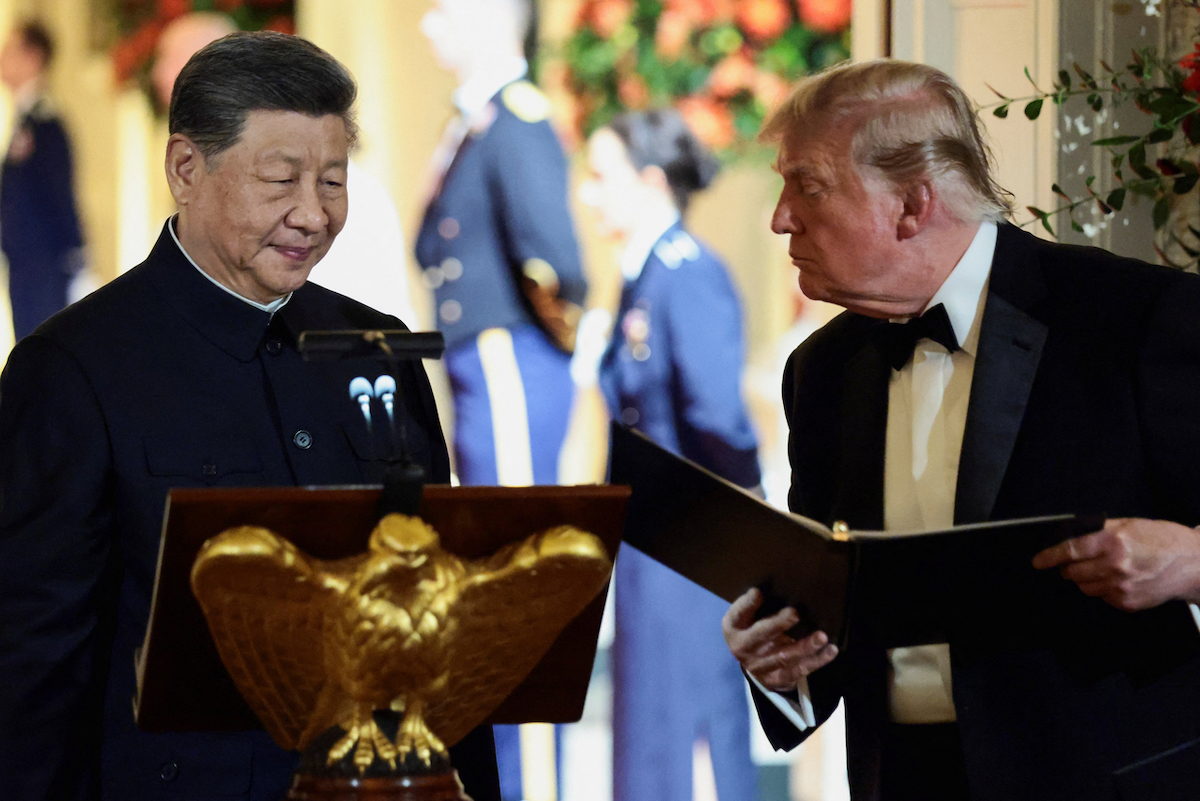
When Donald Trump went to Joint Base Andrews on September 23 to greet Xi Jinping in person, strategic analysts took notice. American presidents rarely wait on the tarmac for visiting foreign leaders unless they want to say something. The gesture was not a scheduling quirk or a show of personal warmth. It signaled that Washington now treats China as a peer, a rival of equal standing. How did the country that cast itself as the world’s sole “superpower”, the indispensable power of the postwar order, arrive at this point? Figures on GDP, defense budgets, university rankings, innovations and trade balances tell part of the story. But they do not explain the mood of Americans. For that, it helps to borrow from psychology. Grief is among the most ordinary human experiences. A death, a broken relationship, a grave illness or the loss of hard-won standing can leave a person numb and without direction. In 1969, the psychiatrist Elisabeth Kubler-Ross set out five stages of coping in “On Death and Dying”: denial, anger, bargaining, depression, and acceptance. Later writers, including Iris Lin and Nhi U. Huynh, in their book, “The 7 Stages of Grief”, extended the model to seven stages: shock, denial, anger, bargaining, depression, reconstruction, and acceptance. Nobody who has lost someone believes the stages arrive in tidy order. People double back, skip ahead and live in two at once. Nations arguably do the same. The idea that the West is mourning a loss of status is not new. George Yeo, the former Singaporean foreign minister, has used Kubler-Ross’s framework to describe the West’s reaction to China’s rise. In his reading, “the West is currently in the bargaining stage and has yet to traverse the difficult path of depression and acceptance.” Laid against the seven-stage version, his diagnosis acquires more texture. It also invites an argument, which I will come to in this piece. Shock For several decades after the Second World War, the US was the unchallenged center of the world economically, militarily, technologically, and culturally. Western-led institutions, from the IMF to the World Bank and the WTO, set the rules. Their products and lifestyles set the aspirations. After the Cold War, some in the West declared the “end of history” and assumed that liberal democracy was where every society would eventually end up. The first jolt came from China’s growth after Deng Xiaoping launched “reform and opening up” in 1978. For a time, the West comfortably regarded China as the world’s workshop, a place that made cheap goods and left the clever work to others. By the 2020s, that picture was untenable. Chinese companies led in electric vehicles, batteries, green energy, and 5G, and competed hard in artificial intelligence and semiconductors. Policymakers in Washington and Brussels were stunned. Like a bereaved person who functions normally on the surface while feeling nothing underneath, the West was slow to grasp that its monopoly had gone. Denial Shock tends to give way to denial, and the Western response followed the pattern. For years, the standard commentary held that Chinese statistics were invented, that its companies merely copied, that innovation could not flourish under an authoritarian one-party state and that the political system would soon buckle under its own contradictions. Each claim contained a grain of truth, which made it easier to cling to. Each was also a way of refusing to accept a loss. There is irony here. After the Opium Wars of the 19th century, the Qing court initially refused to concede that Western gunboats and technology were superior. China paid heavily for that reluctance. The wheel has turned now. Anger When China’s industrial strength and technological progress became impossible to dismiss, anger followed. The past decade of American policy towards Beijing owes much to it. Washington and its allies pressed grievances over intellectual property theft, state subsidies, human rights, Taiwan and the South China Sea. The anger also found expression in tariffs, export controls aimed at Huawei and the semiconductor supply chain, pressure on TikTok and security groupings such as the Quad and AUKUS. Lin and Huynh observe that people in this stage often direct their pain outwards, towards an enemy, rather than inwards. The American version of this is easy to recognize. Deindustrialization, political polarization and widening inequality were largely home-grown. It was more comfortable to treat China as the “felon” behind them. Bargaining This is where Yeo places the West today, and the description fits much current policy. Having failed to “decouple” from China, Western governments now speak of “de-risking” and diversifying supply chains. The aim is to keep the benefits of trade while limiting dependence, and to do business on terms set in Washington and Brussels rather than Beijing. Behind all the technocratic jargon is the age-old dream of going backward in time. As Lin and Huynh point out, people who bargain with loss end up torturing themselves with ‘what if’ questions. The geopolitical variation of the ‘what if’ question is: what if we never let China join the WTO? Depression Bargaining rarely works. Once it becomes clear that conditions will not slow China’s progress or revive the old order, a sense of despondency sets in; many signs of it are already visible across the US and Europe: bitter political divisions, extreme inequality, falling trust in democratic institutions, crumbling infrastructure and a young generation that doubts it will do as well as its parents. Yeo’s point is that the West cannot see China clearly until it has gone through this reckoning with its own weaknesses. As in individual grief, the pain is useful. Nobody can rebuild without first admitting what has been lost, and that is uncomfortable for a society used to being told that it is exceptional. Reconstruction Reconstruction occurs when one ceases to wonder why this had to happen and wonders instead what could still be done. The crucial realization is that while one cannot change the situation, one can determine how one reacts to it. For the West, it means treating China’s rise as a historical fact rather than as an existential threat or an affront. Energy spent on futile attempts at containment can be redirected towards the sources of Western strength: world-class universities, original research, open societies and sound institutions. The aim becomes finding a new and balanced role in a multipolar world, not restoring a unipolar one. Acceptance The last stage is the most mature, and it is the one most easily misunderstood. Acceptance does not mean surrender, and it does not mean that the US needs to abandon Western values. It means giving up the hubris of supremacy and dealing with the world as it is now. Lin and Huynh describe acceptance as a realistic understanding of the situation, combined with creativity and adaptation. In geopolitical terms, that is the condition for a durable, rules-based balance between Washington and Beijing. Only then can the two powers cooperate seriously on problems that no one country can solve: climate change, pandemics, financial stability, nuclear security and the risks that come with artificial intelligence. Where does the US actually stand? My own view differs somewhat from Yeo’s. I think the US has moved further along than he suggests, and that the Joint Base Andrews reception is evidence. But the claim needs qualification. Depression and reconstruction, as described above, are far from complete. American politics remains angry, and many in Congress would not describe their China policy as bargaining, let alone acceptance. But grief is not a march in formation. A society can bargain in its trade policy, despair in its domestic politics and accept in its diplomacy, all at once. A president who greets his Chinese counterpart on the tarmac, with every ceremonial courtesy, is doing something that a country still in denial or fury would not do. He is treating the other side as an equal. That is the central psychological shift, whatever disputes about tariffs and chips continue underneath. But if this interpretation is accurate, the problem is not Washington’s getting caught in a grief loop, but rather its confusion between the two. An acceptance expressed at the airport while not being true everywhere else in policy cannot be called an acceptance. This is simply negotiation in disguise. A cycle, not a conspiracy The West often portrays China’s modern rise as a trick or an anomaly. It is better understood as part of a long historical cycle. Yeo points out that during the “century of humiliation”, from the Opium War of 1840 to the revolution of 1949, China went through something similar when confronted with Western power and technology. At first, China fought back against the invaders and let its anger show in events such as the Boxer Rebellion. However, China later realized its weaknesses and adopted a policy of reform, accepting capitalism and Western technology starting in 1978. Now, the West must learn the lesson China learned after much suffering: no power lasts forever, and the quicker a declining nation adapts, the more it will gain. A shared future In private and public life, grieving’s purpose is to let go of nostalgia and live in the present. If the US and its allies can mourn their fading primacy calmly and without strategic panic, the 21st century could be more stable and more inclusive than its first decades have been. If they cannot, and continue to treat China’s rise only as a menace, the world will drift towards confrontation and, in the worst case, catastrophic war. Trump’s welcome for Xi at Andrews may or may not prove the first diplomatic step towards acceptance. To be sure, it would be unwise to read too much into a single ceremony. But history has repeatedly taught the same lesson: the dominance of any empire or civilization is never permanent. The societies that prosper are the ones that learn to live with change. Follow Bhim Bhurtel on X at @BhimBhurtel. Subscribe to his Substack here.
The seven stages of American decline
Full Article
Original Source
Read the full article at Asiatimes →KhanList aggregates and links to publicly available news content. We do not host full articles from third-party sources. Always verify important information with original sources.