
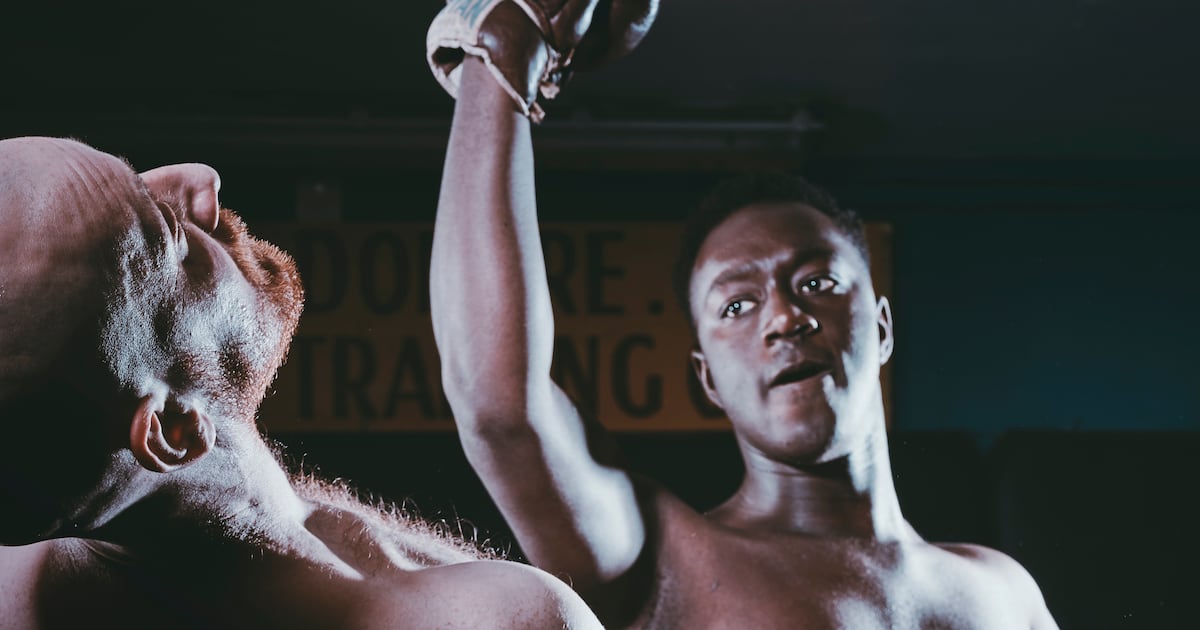
You can pass some people on the street every day and never think much about them. In Dublin in the middle of the 20th century, one such figure stood outside the GPO on O’Connell Street almost every day for four decades: a black man in a bowler hat, Crombie coat and starched white collar, with an advertising board for Nugget boot polish hanging from his shoulders.His name was Billy “Cyclone” Warren. The people who passed him knew little of his life story, and he has left only a faint trace in the historical record. What survives is patchy, but this much we know.Warren was born in the United States and became a professional boxer at the beginning of the 20th century. He came up in the era of the “battle royal”, which in American terms at the time meant, grotesquely, that several black men would be put into the ring together, sometimes blindfolded or in sacks, and made to fight while white spectators watched and gambled on who would be the last man standing. His career took him across the US, Australia and Europe. He is said to have sparred with Jack Johnson, who in 1908 became the first black world heavyweight champion.READ MOREWarren’s eventual arrival in Ireland can be traced, at least in part, to a friendship he forged in New York with Mike Farrell, a boxer from Galway. Farrell was unusually short for a fighter; he was also blind in one eye. The two men first encountered each other in the ring. Farrell won the fight but afterwards offered Warren his hand and helped him to his feet.It was an unusual gesture for the time, not just because Farrell was white and Warren black but because that kind of sportsmanship was uncommon at the time. Boxing was less a gentlemanly contest than a brutal means of making a living. Fighters entered the ring because it was one of the few ways available to them to feed themselves and pay their way. Companionship between opponents was not a given.Farrell eventually lost the sight in his remaining eye and returned to Ireland, where he spent his later years in a home for the blind in Drumcondra, in north Dublin. Warren also ended up in the city, and the two men would sometimes meet for a pint.Beyond that, the story becomes more tantalising and much harder to pin down.It’s possible Warren became involved in Ireland’s revolutionary movement, and there is speculation about him running guns for Michael Collins. There are indications that he may have carried out intelligence work.Sheik Bah, who plays Billy Warren, during rehearsals for Cyclone. Photograph: Ste Murray This extraordinary life is the subject of Cyclone, a new work of immersive theatre from Anu that attempts to piece together a narrative from the fragmentary data available. It presented Louise Lowe, its director and writer, with a problem familiar from much of her company’s work: how do you make a person dramatically real when the historical record has left so many gaps?“Of the 52 or 53 shows we’ve made, only one of them, The Dead, has been about fictional people,” Lowe says. “We’re making stories about real people and real places, so that difficulty is always there.”[ The Dead brought to life: how James Joyce’s celebrated short story is being re-created as an immersive experienceOpens in new window ]She first came across Warren about a decade ago, while researching Anu’s work around the centenary of the Irish revolutionary period. What caught her attention was not a substantial account of Warren’s life but the fact that his name kept appearing at the edges of other people’s stories.“I came across his name a number of times in the Bureau of Military History, in other people’s testimonies. It would be somebody giving a small testimony about something that happened on Bloody Sunday, or where weapons were passed on, and his name would come up. “I remember thinking, Why have I never heard of him? We thought about including him in some of the earlier works, but it always felt a little bit forced. We hadn’t found the right vehicle for him.”The way into Warren’s story eventually came through Farrell’s, and through the friendship between the two men. “I turned my attention towards Mikey Farrell because there was more on him, through his old boxing club and elsewhere. In a way, we could talk about Billy through some of that outside material. We pieced it together in a very piecemeal way.Who gets to be Irish? What do you have to achieve to be recognised as Irish? This is a story that happened in the last century, but we’re still having the same conversation— Sheik Bah“What sticks with me is that Dublin is so renowned for its characters – people like Bang Bang and Forty Coats, who became synonymous with the city and its streets. “Billy seems to have been one of those figures. He was iconic outside the GPO for 40 years; traffic wardens remembered stopping traffic to let him cross the road. And when he was dying, people from all over the country sent gifts and money. He seems to have been genuinely loved by the city.”Lowe found a brief account of Warren and Farrell walking together to and from the home for the blind in Drumcondra. This small detail offered a way into the reality of these characters’ lives, and changed the tone of the work.“It went from being a very physical, very high-octane show in my head – which is why we planned to book the National Stadium – to being something much more intimate, more quiet. Now it’s somewhere in between. We want to show the choreography of boxing and bring that level of physicality into the show, but at its heart it’s still this meeting between these two men.”The venue has changed to a location in north inner-city Dublin, where Anu itself is based, but one that has turned out unexpectedly to carry another charge. The company had already been developing Cyclone for several years when, a few weeks ago, they discovered that Warren had once lived in the exact spot where the show is to be staged. The connection emerged almost by accident, while the team were in the studio cross-checking an old map of the area. They had overlaid the new map on to the old one and seen that the locations aligned exactly. Warren’s former home, they realised, had stood on the site they had independently chosen for the production, just off Talbot Street. The discovery felt uncanny.For the cast, too, there is a sense of things falling into place. Sheik Bah, a recent graduate of the Lir Academy, who plays Warren, has a background in dance, while the actor Campbell Courage, who plays Jack Johnson, is a former boxer. Much of Cyclone sits somewhere between their two disciplines: abstracted movement in which boxing is given the language of dance.Campbell Courage during rehearsals for Cyclone. Photograph: Ste Murray For Courage, a self-described obsessive of the sport, Warren also represents a surprising gap in boxing history. “I pride myself on knowing almost everything about boxing. I knew about black boxers who came to Ireland – Tom Molineaux, for example – so the fact that I had never heard of Billy Warren until I started doing this was crazy to me. “How did I not know about an Irishman, a black Irishman, who was a boxer and lived here?”That makes Cyclone, for him, partly an act of putting Warren back into the record. “It’s great that we’re able to bring this person back and create a community around him. Hopefully it gives people more awareness of who he was.”For Bah, there is another reason why Warren’s story feels timely. “Who gets to be Irish? What do you have to achieve to be recognised as Irish?” he asks. “This is a story that happened in the last century, but we’re still having the same conversation. Obviously, so much has changed, but every so often it rears its ugly head again.”Courage adds: “We look at Billy as an Irishman. He lived here for 40 years and he gave so much to the cause that made Ireland what it is. There’s this sense from the people around him of, ‘No, he’s Irish.’ He belongs to this place.”[ Who was Bartley Madden, Croke Park’s last Irish boxing headliner?Opens in new window ]There is also the possibility that staging Warren’s life might uncover more of it. He was a fixture in Dublin for so long that memories of him still survive second-hand even where the documentary record does not. The actors hope Cyclone might draw out some of those accounts.“He was around for so long that people have these family stories – ‘My grandad would have seen him,’ or this, that or the other,” Bah says. “My hope is that when people come to see the show, some of those stories start coming out. Maybe then we can know more about him than what survives in newspaper clippings.”And it is true. Records preserve only the peaks of a life that emerge into written documents: articles, boxing records, the Bureau of Military History. The rest remains submerged in darkness. We know only Warren’s fights, his travels, his revolutionary ties. Maybe these are not the most interesting things about a person. Cyclone tries to bring the rest into focus, to get closer to a man who spent 40 years hiding in plain sight.Anu is staging Cyclone at 1 Railway Court, as part of Dublin Theatre Festival, from Friday, September 25th, until Saturday, October 10th, with previews from Monday, September 21st
The secret life of the man who stood on O’Connell Street in Dublin for 40 years
Full Article
Original Source
Read the full article at Irishtimes →KhanList aggregates and links to publicly available news content. We do not host full articles from third-party sources. Always verify important information with original sources.