
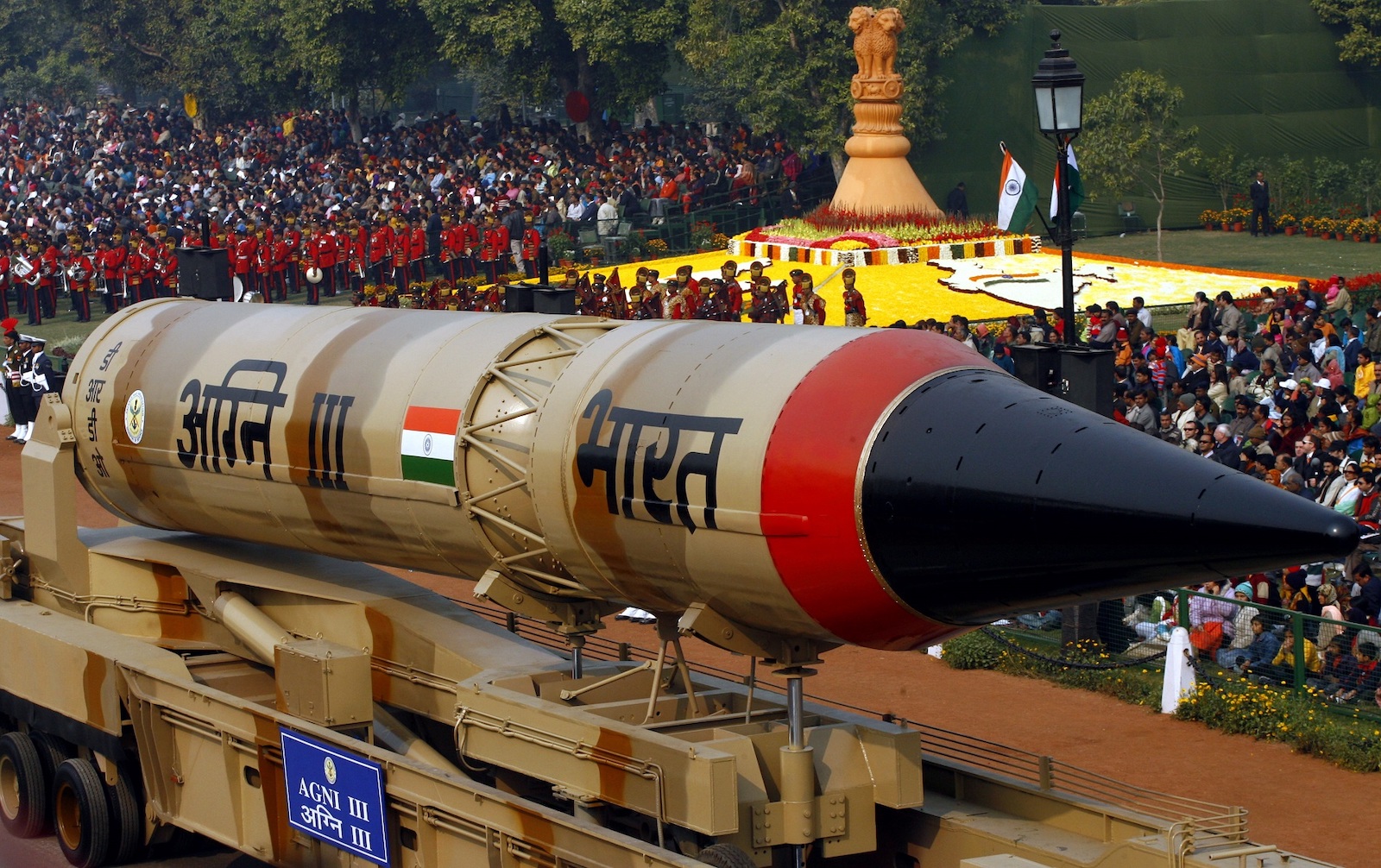
Originally published by Pacific Forum, this article is republished with permission. A central problem in US nuclear thinking is that it is fragmented. Washington is laser-focused on the “three-body problem”: It considers the US-Russia-China triangle fundamental, and when it does not ignore the China-India-Pakistan triangle, it treats it as a mere “Southern Asia” issue. Washington, plainly, regards these triangles as two distinct, even separate theaters and pays little attention to the second. Yet these two triangles are interconnected and increasingly merging into a single nuclear hexagon. That hexagon is driving the world’s primary arms-racing and posture recalibrations. Crucially, US treaty allies in Asia – notably Japan and South Korea – are inextricably bound to this geometry, as interactions in the hexagon shape their security and extended deterrence needs. Other dynamics are at play, but are peripheral concerns relative to the hexagon. North Korea, though dangerous, remains a localized side problem whose posture does not drive significant strategic force-sizing among major powers. The dynamics in Europe involving the NATO and the UK and French nuclear arsenals are important but function as a secondary, alliance-anchored subset of the US-Russia balance. Meanwhile, the Middle East is a prospective, geographically decoupled dynamic where Israel possesses a deterrent and Iran exists only as a downstream threshold state attempting to acquire capabilities. The US policy apparatus has not adapted to this changed and changing geometry, but it should. Washington’s US-Russia-China myopia should stop. Failing to recognize and address the merging of the US-Russia-China and China-India-Pakistan triangles runs a major risk: that an impulse in the hexagon sparks a multi-directional cascade that endangers Asian and global strategic stability. The mechanics of cascade China is the connective tissue between the two triangles. It serves as the anchor for what might be called “transmission belts”—the capabilities, doctrine shifts, and posture adjustments through which stability or instability in one triangle impacts the other. A cascade can originate anywhere within the hexagon, however: through major-power competition at the apex, regional frictions involving allied territories or localized subcontinental flare-ups. For instance, when Beijing expands its capabilities to counter Washington, – or ,conversely, when Moscow deploys novel systems or conducts exercises in Eurasia – it drives the United States and its allies to adjust missile defenses. In response, Beijing deploys more advanced systems, including near its southern and maritime borders. New Delhi, which perceives Beijing as shifting toward a counterforce capability, fears that its minimum deterrence is at risk. To compensate, India accelerates its development of multiple independently targetable reentry vehicles and transitions its forces toward canisterized, ready-to-launch postures. Viewing an emerging Indian first-strike or counterforce capability, Pakistan builds its arsenal, expands its reliance on tactical nuclear weapons, and lowers its launch threshold. Conversely, cascades can just as easily start from “the bottom” or “the middle”: a localized tactical border dispute along the Line of Actual Control or in Kashmir can compel Beijing into precautionary alerts, triggering counter-adjustments by Washington or Moscow. In this interconnected hexagon, therefore, competitive postures, regional friction points, and subcontinental flashpoints exist in a continuous, multi-directional feedback loop. The risks inherent in this geometry threaten stability at least in four areas. Compressed timelines and lowered operational thresholds Unlike the 30-minute decision window of the Cold War, flight times across Southern Asia are compressed to five-to-10 minutes, leaving little margin for warning, intervention or off-ramps. When modernization drives velocity in major-power competition, regional doctrines are forced into high-readiness modes—such as New Delhi transitioning its forces from de-mated storage to canisterized, ready-to-launch postures in response to Beijing. Observing this Indian readiness, Islamabad lowers its own nuclear threshold to counter perceived conventional imbalances, turning localized strategic anxieties into hair-trigger operational realities across the subcontinent. These dynamics are aggravated by the integration of artificial intelligence and automated early-warning systems into compressed decision cycles, introducing acute dangers of algorithmic miscalculation and crisis flash crashes that human operators have little time to intercept. The support-deterrence paradox and technology trickle-down Deterrence in the hexagon is no longer a bilateral calculation but a cross-theater reaction trap where capabilities diffuse across regions without necessarily stabilizing. When the United States fields technologies – such as hypersonic glide vehicles to penetrate Russian and Chinese defenses – those systems trickle down, incentivizing Beijing to deploy similar capabilities, including near its southern borders. India then seeks its own hypersonics or defense systems from Russia. Compounding this, US cooperation with India to balance China fosters a “use-it-or-lose-it” mentality in Pakistan regarding its nuclear weapons. Horizontal contagion and the transparency vacuum Multipolar entanglement enables dangerous horizontal contagion: a maritime flashpoint involving the United States and China in the Taiwan Strait or the South China Sea can trigger precautionary military alerts for Indian and Chinese forces along the Line of Actual Control or in Kashmir, creating a continental-scale hair-trigger. Significantly, because the hexagon is anchored in Asia, any major military disruption in critical maritime chokepoints during such a crisis would quickly shatter global supply chains, semiconductor manufacturing, and commercial shipping. Compounding this entanglement is a severe transparency vacuum. China’s refusal to engage on arms control creates a black box. Because Beijing does not disclose its arsenal size and modernization trajectory, India cannot freeze its force levels, and Pakistan cannot pause its expansion if India does not, locking the hexagon into an unchecked “race to the unknown.” The exceptions game, allied hedging, and normative rot The transmission mechanisms linking these ecosystems are also political and legal. When Washington carves out exceptions for partners – such as the 2005 US-India civil nuclear cooperation agreement, concluded partly to bolster New Delhi against Beijing – competitors respond by establishing their own counter-balancing exemptions, such as Chinese nuclear assistance to Pakistan. Furthermore, as strategic stability degrades across the hexagon, the credibility of US extended deterrence guarantees in Asia faces stress, driving regional allies such as Tokyo and Seoul toward hedging strategies or nuclear latency. Combined with rapid civilian nuclear expansion and dual-use technological creep across Asia, these pressures undermine the application of nonproliferation standards, generating a corrosive normative rot that North Korea, Iran and others can exploit. To manage these risks, the United States should pursue six lines of effort. Re-linking global-to-regional instability flows US strategy should account for how major-power actions and developments in the primary nexus interact with regional security pressures. Strategic planning should recognize that while US modernization and missile defense deployments influence Beijing’s calculus, China’s nuclear expansion is driven by its own major-power ambitions and regional competition, just as Russian strategic adjustments and regional allied postures shape the broader security environment. In turn, Beijing’s expanding arsenal serves as a primary accelerant forcing New Delhi to abandon minimum deterrence and shift toward canisterized, ready-to-launch postures. Managing subcontinental and regional-to-subcontinental feedback loops Strategy should address the security dilemmas generated by the second triangle. Policy should grapple with how China’s development of advanced capabilities – deployed primarily to deter the United States – creates a security dilemma for India, which in turn drives Pakistan to increase its reliance on tactical nuclear weapons and lower its operational thresholds. Controlling upward chain reactions and horizontal contagion Strategic planning should address the danger of upward chain reactions where regional volatility forces major-power intervention. Policy should establish frameworks for escalation control during horizontal contagion, specifically addressing how a localized crisis starting at the Line of Actual Control, in Kashmir, or elsewhere can rise back up to the major-power level, compelling the United States or Russia into strategic signaling. Overcoming transparency vacuums and information black boxes US strategy should confront China’s refusal to engage in arms control and its opacity regarding force modernization, which locks the hexagon into an unchecked race to the unknown. As an initial step, and because formal warhead-capping treaties are unviable, policy should pivot toward alternative behavioral constraints – such as pre-launch missile notifications, maritime incident agreements, joint risk-reduction protocols on automated early-warning systems, and regional transparency belts making use of commercial monitoring to manage compressed decision cycles and establish predictability. Reversing nonproliferation normative rot and the ‘exceptions game’ US policy should address the legal decay eroding international nonproliferation standards while reinforcing the credibility of extended deterrence guarantees to prevent regional allied hedging. Strategy should account for how ad-hoc, bilateral partnership exemptions lead to counter-balancing deals by rivals and generate normative rot that regional threshold countries can exploit. Policy should enforce guardrails around partnership cases, reassure key Asian allies against cascading threats, and champion binding regional restraint norms, including universal compliance with no-test standards. Institutionalizing cross-departmental policy translation To ensure strategic coherence, Washington should bridge the institutional gap between conventional military planning and nuclear stability. Policy mechanisms should establish assessment evaluations across key command centers to evaluate the cross-theater impact of proposed conventional arms transfers, missile defense deployments, and long-range strike capabilities before they trigger destabilizing chain reactions. The main strategic game is no longer restricted to the US-Russia-China triangle. It is now defined by a broader hexagon, with the China-India-Pakistan triangle also shaping the global balance. Three decades ago, several analysts argued that the nuclear future would be written in Asia. What was then viewed as an emerging strategic trajectory has now become an indisputable reality, even as nuclear dangers exist elsewhere. Addressing this shift requires American policy to build an Asia-centric framework tailored to the cascading risks of the modern nuclear geometry. David Santoro (david@pacforum.org) is president and CEO of the Pacific Forum. In 2021, Lynne Rienner published his latest book: US-China Nuclear Relations: The Impact of Strategic Triangles.
The rise of the nuclear hexagon and the future of Asian stability
Full Article
Original Source
Read the full article at Asiatimes →KhanList aggregates and links to publicly available news content. We do not host full articles from third-party sources. Always verify important information with original sources.