
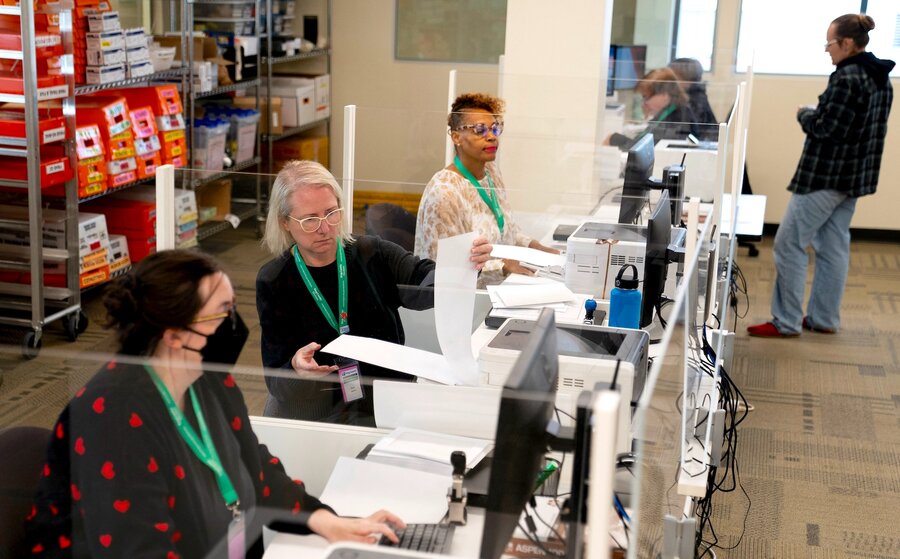
Organizing and running elections in the United States is left to individual states to determine and oversee. But this month alone, the U.S. Supreme Court has weighed in on these processes multiple times. On Sept. 14, it issued a one-paragraph concurrence limiting proposed federal changes to mail-in voting. Earlier this week, Missouri’s redistricted voting map was back on the emergency docket for the third time this month. And on Friday, the court ruled to allow use of a vast federal database to check voter eligibility.Amid the legalese and partisan arguments surrounding such cases, American voters are both confused and concerned about the trustworthiness of the country’s election processes. According to two recent surveys, the share who believe that November midterms will be “fair” ranges from 49% to 55% .In other words, close to half have doubts about election integrity – not a good sign for democracy. But this is precisely what is spurring greater efforts among local election official and volunteers to boost both trust and transparency. And that is a good sign for democracy. “Making mundane processes visible and recruiting citizens to help,” sums up an assessment by Robert Glover, a University of Maine professor and poll worker, goes a long way in restoring or maintaining the public’s confidence in elections.Arizona’s Maricopa County, one of the country’s largest voting populations, offers regular Tour Tuesdays and has also sought to recruit local military veterans to serve as election volunteers. (Research shows trust increases by up to 15% when the public learns that veterans are helping at the polls.) Other counties hold open houses and information sessions that let voters know that most states implement checks and balances that are quite similar – which helps dispel distrust about what’s happening in other parts of the country.“Election officials cannot control whether voters like the outcome, but they can make the processes that produce it visible and comprehensible,” Dr. Glover wrote in The Conversation this week. And an increasingly effective way to do that is through posting online videos and livestreams of even relatively bland scenes of the system in operation – “checklists, sealed containers, bipartisan teams of observers, … and individuals doing repetitive administrative work.” Recent research confirms that such official sharing of the process can have measurable and relatively rapid impacts. Deepen your worldviewwith Monitor Highlights.Politics with respectGet political stories with respectful analysis.There‘s a world of new ideas in everyBooks newsletter.There‘s more to life, enrich yours withCulture & Learning weekly.Follow humanity‘s discoveries withScience & Nature stories in your inbox.Gain a spiritual perspectivefrom the stories in your inbox.Want to understand the deeper impact of critical events? Learn the Monitor‘s insight.Already a subscriber? Log in to hide ads. “Americans lack information about the basic protections put in place to safeguard the accuracy and integrity of elections,” according to a study published in the Election Law Journal earlier this year. Experimenting with shortform video messaging with nearly 15,000 people, the researchers found that members of both parties are “open to learning and revising their beliefs about the elections, even if they begin at very different baseline levels of trust.”“Our national experiment,” the researchers concluded, shows that sharing transparent and timely information “can help build a shared national trust in elections.” ALREADY A SUBSCRIBER? LoginReal news can be honest, hopeful, credible, constructive.The Christian Science Monitor was founded in 1908 to lift the standard of journalism and uplift humanity. We aim to “speak the truth in love.” Our goal is not to tell you what to think, but to give you the essential knowledge and understanding to come to your own intelligent conclusions. Join us in this mission by subscribing.
The renewed roots of election integrity
Full Article
Original Source
Read the full article at Csmonitor →KhanList aggregates and links to publicly available news content. We do not host full articles from third-party sources. Always verify important information with original sources.