
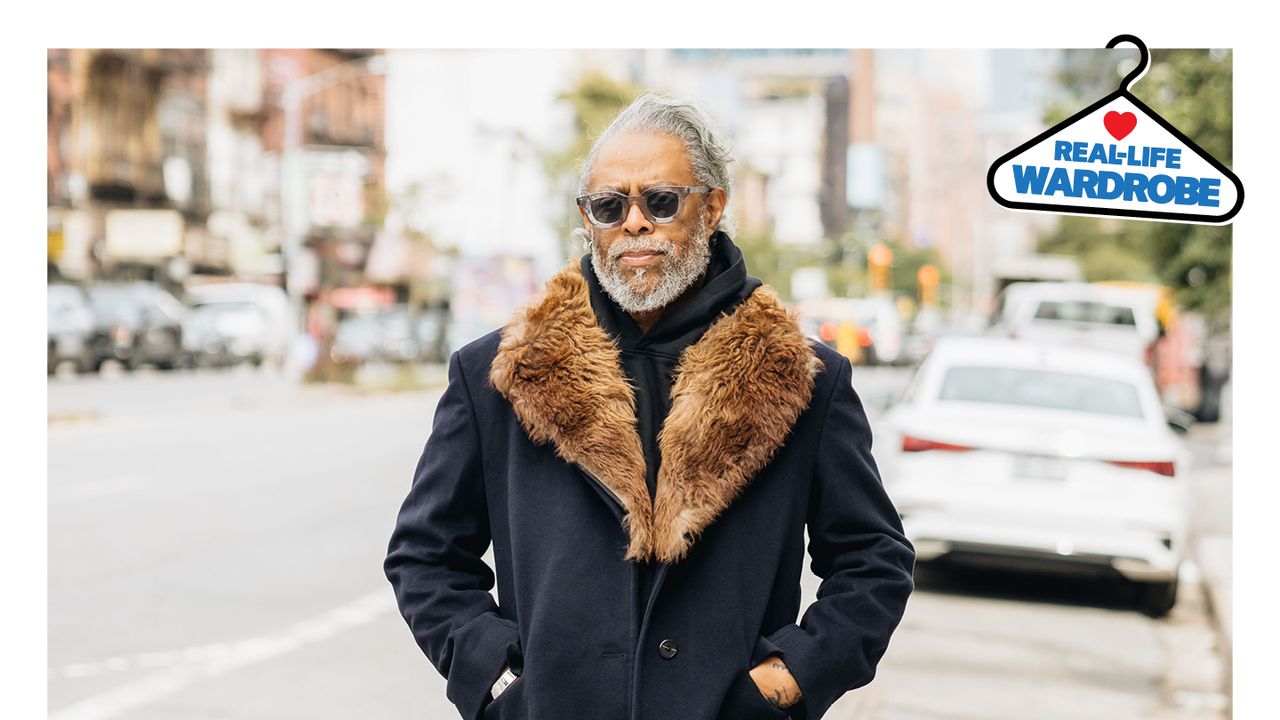
The acclaimed artist goes deep on his major new exhibition, Virgil Abloh’s lasting legacy, and what he learned from comic books.All clothing and accessories, subject’s own. Coat by Prada. Vintage hoodie. Jeans by Levi’s. Shoes by Prada.Arthur Jafa’s work is always unmistakably his own. It doesn’t matter if he’s working behind the camera as a cinematographer, as he has to great acclaim on films like Julie Dash’s Daughters of the Dust or Spike Lee’s Malcolm X and Crooklyn; directing iconic music videos for the likes of Jay-Z, Solange, and Kanye West; or confronting the realities of Black American life through his video art practice, as he did in his 2016 masterpiece Love Is the Message, the Message Is Death. If the 65-year-old Mississippi native was involved in a project, his potent and complex perspective shines through loud and clear.Naturally, that’s also true of the way Jafa dresses. After falling in love with fashion in the ’80s through Martin Margiela’s boundary-pushing collections, Jafa has grown into one of the consistently most stylish men in contemporary art, with a penchant for freaky Rick Owens concoctions, hardwearing Visvim workwear, and sleek Fear of God tailoring.With a sprawling survey of his work, I Am Tony, now on display at New York City’s New Museum—and an excellent accompanying catalog out now from Phaidon—I met up with Jafa to discuss the fashion industry’s relationship to Blackness, his deep love for comic books, and the film projects he hopes to pursue next.Jacket, vest, and boots by Visvim. Jeans by Levi’s. Glasses by Rhude. GQ: When was the first time art made an impact on your life?Arthur Jafa: Well, it depends on whether it’s art with the big “A” or the little “A.” You know what I mean? I was always creative. One of the earliest things I can remember doing was playing with Lincoln Logs and then ultimately Lego blocks. I just remember from very, very early on—two years old—putting things together, making things with my hands.And then I also discovered comic books. In some ways, in terms of an actual art form, comics were probably the first that made an impression on me. They inspired me. Jack Kirby in particular: Fantastic Four, Silver Surfer, Captain America, mostly Marvel comics. Even though I was very aware of DC, Superman and Batman primarily, it was the Marvel comics that had the most primordial effect on me. I used to have metal comic book stands. This is before comic stores and all this kind of stuff; you’d buy comics in convenience stores. I remember looking at covers of Fantastic Four when I was four years old.You have such a distinct and intriguing power as a cinematographer. You paint beautifully complex portraits, like the family in Crooklyn or the Peazant family in Daughters of the Dust. What initially drew you to pursue cinematography?I don’t know if I did pursue cinematography. I was always more interested in being a director. I co-produced Daughters of the Dust. The plan initially was to hire a real cinematographer. The first summer we shot, we went down with very, very little money, maybe $35,000. I shot it myself. We put a trailer together, and with that, we were able to raise money to shoot the film. So we came back the following summer, set up. I just sort of stepped in and shot it myself.And you filmed that gorgeous of a movie on your first try?I was always really interested in cinematography, not so much as a profession, but as an art form. At that time, I definitely considered myself an independent filmmaker, so I envisioned I was going to have to shoot my films on the side. It never really occurred to me that I might make a living as a cinematographer. But after I shot Daughters, I won a cinematography award at Sundance, which opened a lot of doors. I got to be the second director of photography on Malcolm X, mostly because Spike [Lee] and Ernest [Dickerson] saw the work I’d done on Daughters. And eventually I shot with Spike [on Crooklyn]. I don’t really feel like I really pursued it, per se. It still is, in many ways, the most lucrative thing I know how to do.I know you’re looking to direct your own feature films. How close are you to seeing that through?Financing films and getting them made is a tricky proposition, so I don’t want to jinx it, but I have two scripts, very different but I think really good. I’m confident I’m going to get them made in the coming year. That’s the plan.Do you think art should always serve a purpose?No, not necessarily. I think it would be quite an achievement if you made something that serves absolutely no purpose. It’d be very difficult to do. Since purpose often is attributed to things. [The audience] says certain things—they say it was inspiring or it uplifted them. A lot of people thought Love Is the Message was uplifting, but it wasn’t my intention when I made it.Let’s talk about your New Museum survey. How’d it come about? Why is it happening here and now?Basically, Barbara Gladstone and Max [Falkenstein] at Gladstone Gallery have a relationship with the chief curator [at New Museum]. They were interested in doing the show with me and they made it happen. It’s connections, like so many other things. Why now? That’s a causality question. I’m not sure why this particular time. Somebody told me the other day that the day the show opened was the 100th birthday of John Coltrane. But that’s purely coincidental. It’s great. I was very happy to hear that. I probably would even read something into it, but it wasn’t intentional.Coat by Rick Owens. Shirt by Denim Tears. Jeans by Levi’s. Shoes by Prada. Was there a first moment you became interested in clothing and style?As in fashion?You could say fashion, but I separate it from style.Like, conscious of brands and things like that?Not necessarily brands, but when you recognized the power of style and dressing yourself and what it can do for the way others perceive you.I was much older when I started thinking about it in such an instrumental way. The first time I was cognizant of someone being dressed a certain way somehow informing or impacting who they were was, again, in comic books. Superman had certain colors. Batman had completely different colors. Spider-Man and Marvel Comics was a breaker of that template of underwear on the outside of the tights. Spider-Man didn’t have that. Captain America didn’t really have that. The Hulk just had purple pants. That was, for sure, the first time I was really conscious of a person’s dress functioning as a uniform.I was much older, probably a junior or senior in high school, when I became aware of fashion designers. That was mostly by way of improvement in coverage of Black designers in magazines. In Essence, particularly in the early ’70s, you would see things about Black fashion designers. When I went off to college, I really educated myself about the various designers and houses and history of fashion design—something I appreciated in the same way I appreciated architecture as an art form that I always really liked.In a recent interview, you said, “There’s no modernism in contemporary art as we understand it without Black aesthetics.” Given that fashion is an art form, too, how do you feel about the fashion industry’s relationship to Blackness?Well, that’s obviously a very, very big, broad question. I do think we’ve seen, in the 20th century in particular, the general impact of Black culture on the mainstream. Black artistic creative practices, mostly unacknowledged. But today in particular, a large percentage of fashion is street fashion. When you start talking about street fashion, you’re basically talking about the way Black folks dress and how that’s impacted everything. Demna, for example, initially had that at Balenciaga—that oversized silhouette that's straight out of hip-hop in the ’90s.You wrote a beautiful tribute to Virgil after his untimely death a few years ago. What was your relationship to him?Admiration. He was evidence that there were younger Black creatives who were going to be able to take the culture forward. It was a profound loss for everybody, [but] for Black folks in particular. Because he not only was a genius in what he did, but he was very invested in sharing the codes, sharing the map of how you do it. It was super high on his list of things he was invested in, so he had a really profound effect on me.I was just profoundly sad when he died. I remember thinking Black people don’t get to have anything. You know what I mean? He was a change agent. And change agents are really important. Not necessarily always the greatest artists. Sometimes they're both the greatest and change agents, but as often as not, change agents are people who change the feel and the context that they operate in. Virgil was about [this] as much as anybody. I told someone at one point, “He’s going to be running LMVH before it's all over.”Coat by Rick Owens. Shirt, jeans, and boots by Prada. Can you remember your first significant clothing purchase?After Daughters of the Dust came out and I moved to New York, there was a distinct moment where I had a little money in my pocket and I had developed an interest in fashion design. I was very into buying Margiela things and giving them to my girlfriend. I just wanted to look at them. I felt like I had to rationalize [the purchases by] making a gift of them, but now I just buy things if I like them. For example, I have the Rick Owens white pony boots, but I wouldn’t think of wearing them. I just have them in a Ziploc bag on my desk, because I think they’re incredible objects.The way I think about fashion design is very similar to the way I think about architects. They generally are not working by themselves. And it does exist somewhere between pure art and commerce. Literally, when do I remember buying something? Not until the late ’80s. I was always an athletic T-shirt person, with jeans and Stan Smiths or something like that, in high school.Does anything you wore today have special significance to you?My hair. It’s a slightly ramped-down version of what I wore to the opening a few nights ago, which was quite a spectacle. Fortunately, I didn’t have to look at myself all night. It was a really interesting experience to have my hair treated the way that it was treated to get it into that form. But my plan initially was to just get a braid yesterday like I normally do. But I felt like I had a couple photo shoots like this one, so it might be worth spending the money just to preserve it.I loved your Interview conversation with Christelle Oyiri from last year. You explained why you named your MoMA’s Artist Choice exhibition “Less Is Morbid.” You said, “It’s a mentality that even in spaces, plantations, slave ships, whatever, where we were radically constrained, our imaginations are always free. So we have to operate like that, because there’s never a shortage of space to think.” With that quote in mind, where are you at right now? What’s fascinating you? What’s worrying you?I’m still generally interested in art. Cinema. The shift from being a consumer to a producer in an art context and in cinema. A lot of people consume it, but like I said, [there’s a] difference between selling the work to one person for $100,000 or showing or displaying your work to 1,000 people for a dollar each, you know what I mean?I’m definitely thinking about cinema in a very explicit, do-or-die kind of way. Not to diminish my art practice, which I love and continue to be invested in, but I definitely desire to be in film. So I’m very focused on that. As I said, I got two different projects. They’re very different. So we’ll see which one gets traction first.Sign up for Show Notes to get news on the latest runway shows, parties, and insider events on the international fashion circuit.Christopher Fenimore writes and photographs GQ’s Real-Life Wardrobe column. He currently splits time between Cutchogue and Brooklyn, NY. ... Read More
The Real-Life Wardrobe of Arthur Jafa, Who Keeps His Rick Owens Boots in a Ziploc Bag
Full Article
Original Source
Read the full article at Gq →KhanList aggregates and links to publicly available news content. We do not host full articles from third-party sources. Always verify important information with original sources.