
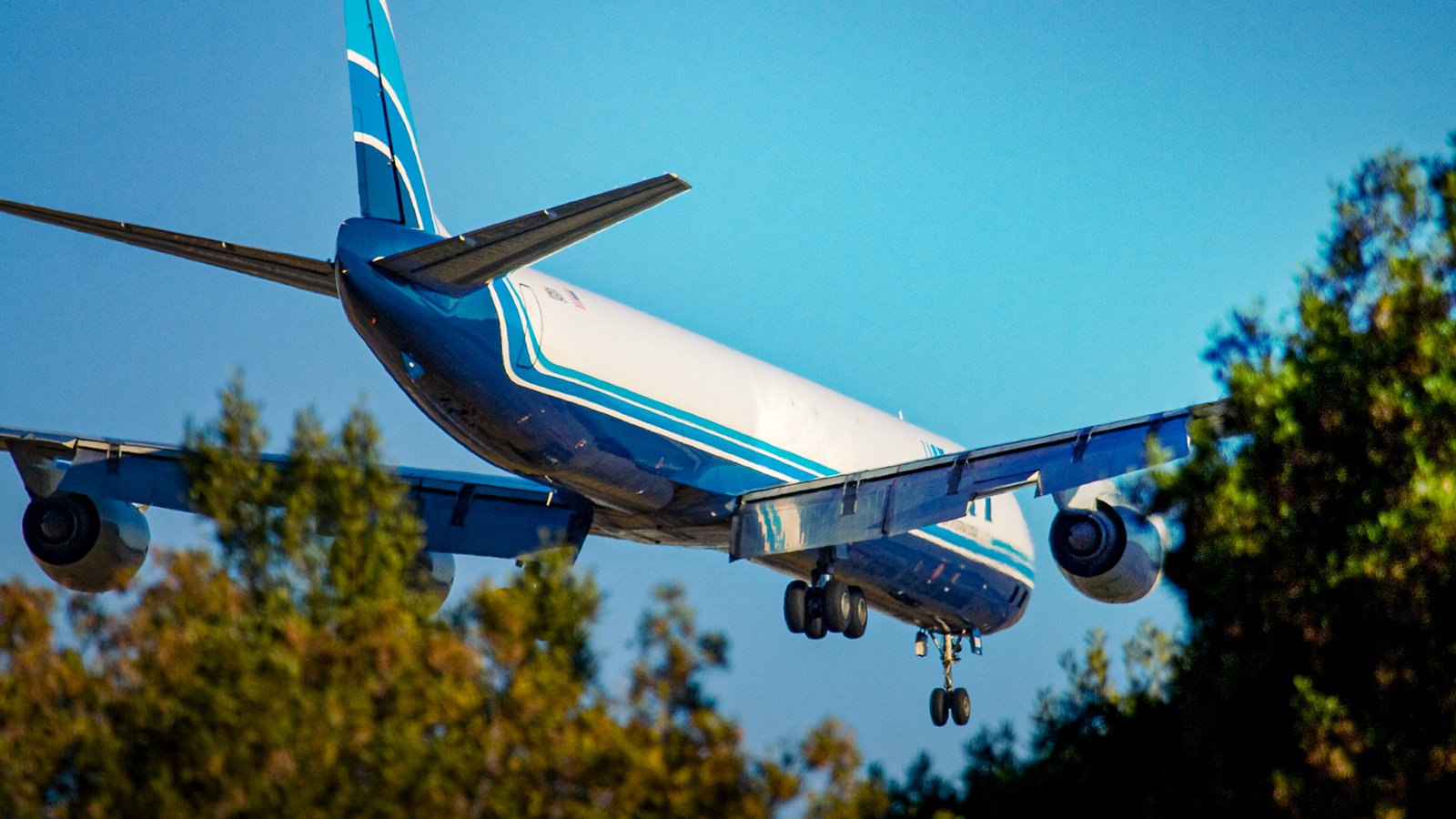
Some of aviation's most successful innovations have been driven by unexpected challenges. Interestingly, one of the industry's most successful jet engine programs owes part of its early commercial success to an aircraft designed in the 1950s. The Douglas DC-8, which made its final flight in November 2025, remained in service far longer than originally anticipated. A decision to replace its aging engines not only extended its operational life but also helped secure the future of an entirely new engine family. By the late 1970s, the Douglas DC-8 was becoming increasingly difficult to operate under tightening noise regulations, even though many aircraft still had substantial structural life remaining. Rather than retiring these aircraft, an ambitious re-engining program involving Cammacorp, United Airlines, and CFM International gave them a second lease on life. But how exactly did an aging four-engine jetliner become instrumental in launching one of aviation's most successful engine families while securing its own operational future? How The DC-8 Super 60 Fleet Entered The Commercial Market Credit: Karolis Kavolelis | Shutterstock To understand what was happening to the DC-8 Super 60 fleet, we first need to go back in time. Developed by the Douglas Aircraft Company in the mid-1950s, the DC-8 was one of the first American long-range commercial jetliners. The project grew out of Douglas's efforts to compete for a US Air Force (USAF) jet-powered aerial refueling tanker contract, which it ultimately lost to the rival Boeing KC-135 Stratotanker. The DC-8 subsequently entered commercial service with Delta Air Lines in September 1959. As demand for air travel grew, Douglas introduced the improved Super 60 series in 1965, comprising three variants. The DC-8-61 featured a fuselage stretched by 36 feet (10.97 meters) and accommodated up to 220 passengers, while the DC-8-62 prioritized range through aerodynamic refinements and a smaller fuselage extension. The DC-8-63 combined the stretched fuselage of the -61 with the performance improvements of the -62. All three variants were powered by four Pratt & Whitney JT3D turbofan engines. By the 1970s, however, the world was changing. The Boeing 747 entered commercial service in 1970, ushering in a new era of widebody aviation and supporting the growth of international air travel. At the same time, environmental concerns were gaining political attention, with the first Earth Day taking place on April 22, 1970. Increasing aircraft movements brought growing concerns about noise pollution in communities surrounding major airports. Meanwhile, the 1973 oil crisis sent fuel prices soaring, placing additional financial pressure on airlines operating older, less fuel-efficient aircraft. Against this backdrop, the International Civil Aviation Organization (ICAO) introduced aircraft noise certification standards under Annex 16, Volume I, with more stringent Chapter 3 standards adopted in 1977. Although ICAO established international standards, individual countries and airports determined how to implement restrictions on existing aircraft. In March 1977, the US Congress outlined new regulations for compliance with Stage 3 by 1985. Therefore, for the DC-8 Super 60, the problem was its increasingly outdated and noisy engines. Many aircraft still had years of useful life remaining, yet tightening noise requirements threatened their commercial viability. With so much potential life left in these aircraft, was retirement really the only option? A Former Douglas Executive Proposed An Alternative To Retirement Credit: Markus Mainka | Shutterstock In response to the new ICAO noise standards and subsequent US regulations, a solution emerged that could keep the DC-8 Super 60 fleet in service. Jackson McGowan, who had retired as president of McDonnell Douglas' Douglas Aircraft Division, established a company called Cammacorp in March 1977 to manage a program to equip existing DC-8s with new engines. Acting as a management contractor for the re-engining project, Cammacorp began exploring the feasibility of modifying the aircraft rather than replacing them. Just a few months later, in May 1977, discussions were already underway with DC-8 operators about potential conversions. The economic logic behind the proposal was relatively straightforward. Although replacing four engines would still be a substantial investment for airlines, it could let them keep their existing aircraft while reducing noise emissions and fuel consumption. More importantly, it offered an alternative to purchasing entirely new aircraft at a time when many DC-8s still had considerable structural life remaining. For operators, the potential savings extended beyond fuel efficiency, as re-engining could also help preserve access to airports facing increasingly stringent noise restrictions. However, the success of the project depended on finding a suitable replacement engine. Discussions with General Electric began early in the program, with particular attention turning to the CFM56, a new turbofan being developed through its partnership with France's Snecma. The engine promised improvements in both noise performance and fuel efficiency, but its commercial future was still uncertain. How United Airlines Helped Secure The Future Of The CFM56 Credit: Peter Scharkowski | Shutterstock On March 29, 1979, United Airlines announced that it would re-engine 29 of its DC-8-61 aircraft with CFM56-2 engines. This marked the first commercial order for the CFM56, which General Electric and France's Snecma spent approximately five years and more than $500 million developing through their joint venture, CFM International. The order provided a crucial commercial breakthrough for the engine program, which would eventually become one of the best-selling jet engine families in aviation history. The project quickly gained momentum. By May 1979, McGowan announced that Cammacorp had secured 78 orders from seven airlines for the CFM56-powered Super 70 series. To support the conversions, Cammacorp contracted McDonnell Douglas' Long Beach facility for engineering assistance, while modification work was undertaken at several facilities, including McDonnell Douglas' Tulsa plant, Delta Air Lines, Air Canada, and UTA Industries. The growing number of commitments demonstrated that airlines were increasingly willing to invest in extending the operational lives of their existing DC-8 fleets. Interestingly, Boeing also explored a similar approach for its rival 707. In 1979, the manufacturer flight-tested a modified aircraft known as the 707-700, equipped with CFM56 high-bypass turbofan engines. Although the tests demonstrated the technical feasibility of re-engining the aircraft, Boeing ultimately decided against commercializing the program. The DC-8 was a better candidate because it had greater engine ground clearance, making it more practical to accommodate the larger-diameter CFM56 engines. How The CFM56 Transformed The Douglas DC-8 Credit: Andrey Zhorov | Shutterstock Each re-engined DC-8 received four CFM56-2 turbofan engines, each rated at approximately 22,000 pounds (9,979 kg) of thrust. The modifications went beyond simply replacing the original Pratt & Whitney JT3D engines, requiring new mounting structures and associated systems to accommodate the larger, more modern turbofans. The improvements were substantial. The re-engined DC-8 Super 70 series was approximately 70% quieter than the original Super 60 aircraft, while fuel consumption was reduced by up to 23%. Some estimates put the improvement in fuel efficiency at between 18% and 25%, depending on the aircraft variant and operating conditions. These improvements helped airlines reduce operating costs while meeting increasingly stringent aircraft noise requirements. Original DC-8 (Series 10–50) DC-8 Super 60 Series (Series 61, 62, 63) DC-8 Super 70 Series (Series 71, 72, 73) Engines P&W JT3C / JT4A (Turbojets) P&W JT3D (Early Turbofans) P&W JT3D (Low-bypass Turbofans) CFM56(High-bypass Turbofans) Fuselage Length Approx. 150–156 feet (45.72–47.55 meters) Up to 187 feet, 4 inches (57.10 meters) 187 feet 4 inches (57.10 meters) Passenger Capacity 125–177 Up to 269 Up to 259 The conversion program produced three new variants: the DC-8-71, DC-8-72, and DC-8-73, corresponding to the original -61, -62, and -63 models. By 1986, 110 DC-8s had undergone the transformation. Although the program was initially intended to extend the aircraft's useful life in passenger service, the Super 70s' improved operating characteristics proved particularly valuable in the cargo sector. Why The DC-8 Super 70 Found A Second Life In Air Cargo Credit: Airlinephoto | Shutterstock Although the re-engining program was initially intended to extend the DC-8's operational life, it was in the freight sector that the Super 70 found its greatest success. As passenger airlines transitioned to newer, more efficient aircraft, cargo operators recognized the value of the DC-8's long fuselage, substantial cargo capacity, and durable airframe. The stretched Series 60 variants were particularly attractive, offering considerable cargo volume, while the upgraded CFM56 engines helped keep fuel consumption and noise emissions manageable. For freight operators, acquiring and converting older DC-8s was often considerably cheaper than purchasing brand-new aircraft. The aircraft's robust construction became another major advantage later in its life. Cargo operations can place considerable demands on aircraft through repeated loading and unloading, high utilization rates, and frequent takeoffs and landings. The DC-8's durable structure made it well suited to these operations, allowing carriers to keep the aircraft in service long after many passenger airlines had retired theirs. This was particularly valuable to UPS, which acquired a substantial fleet of re-engined DC-8 freighters and continued operating them for decades. The DC-8's cargo career extended beyond commercial freight operations. Humanitarian organization Samaritan's Purse gave the aircraft one of its final chapters when it acquired a DC-8-72CF, registered N782SP, from storage in Roswell, New Mexico, in 2015. The aircraft subsequently completed more than 200 humanitarian missions, transporting millions of pounds of relief supplies to disaster zones and crisis-affected regions worldwide. The DC-8's Legacy Extended Far Beyond Its Final Flight Credit: Andrey Zhorov | Shutterstock As late as 2004, 159 Douglas DC-8s, mostly Super 60s and Super 70s, were still operating worldwide. However, the 2008 global financial crisis and rising fuel prices accelerated the retirement of older, less fuel-efficient aircraft. By 2017, only a handful of DC-8s remained in active service, primarily with organizations such as NASA and humanitarian operators. By the 2020s, the aircraft had become a true aviation rarity, with most surviving examples either retired, dismantled, or preserved in museums. One of the last remaining examples was operated by Samaritan's Purse. Following a final humanitarian mission to Jamaica, the organization retired the aircraft on November 14, 2025, bringing an end to more than six decades of DC-8 operations. Its longevity showed how a durable airframe and the CFM56 re-engining program extended the aircraft's useful life far beyond what might otherwise have been possible. Interestingly, the DC-8's retirement did not necessarily mark the end of its closest rival, the Boeing 707. Two civilian-built Boeing 707s, registered N707GF and N707MQ, have been associated with Omega Aerial Refueling Services and converted into aerial refueling tankers. Their continued existence shows how some early-generation jetliners found highly specialized roles long after they disappeared from scheduled passenger service.
The Re-Engined Narrowbody Quadjet That Found Its Real Calling As A Freighter
Full Article
Original Source
Read the full article at Simpleflying →KhanList aggregates and links to publicly available news content. We do not host full articles from third-party sources. Always verify important information with original sources.