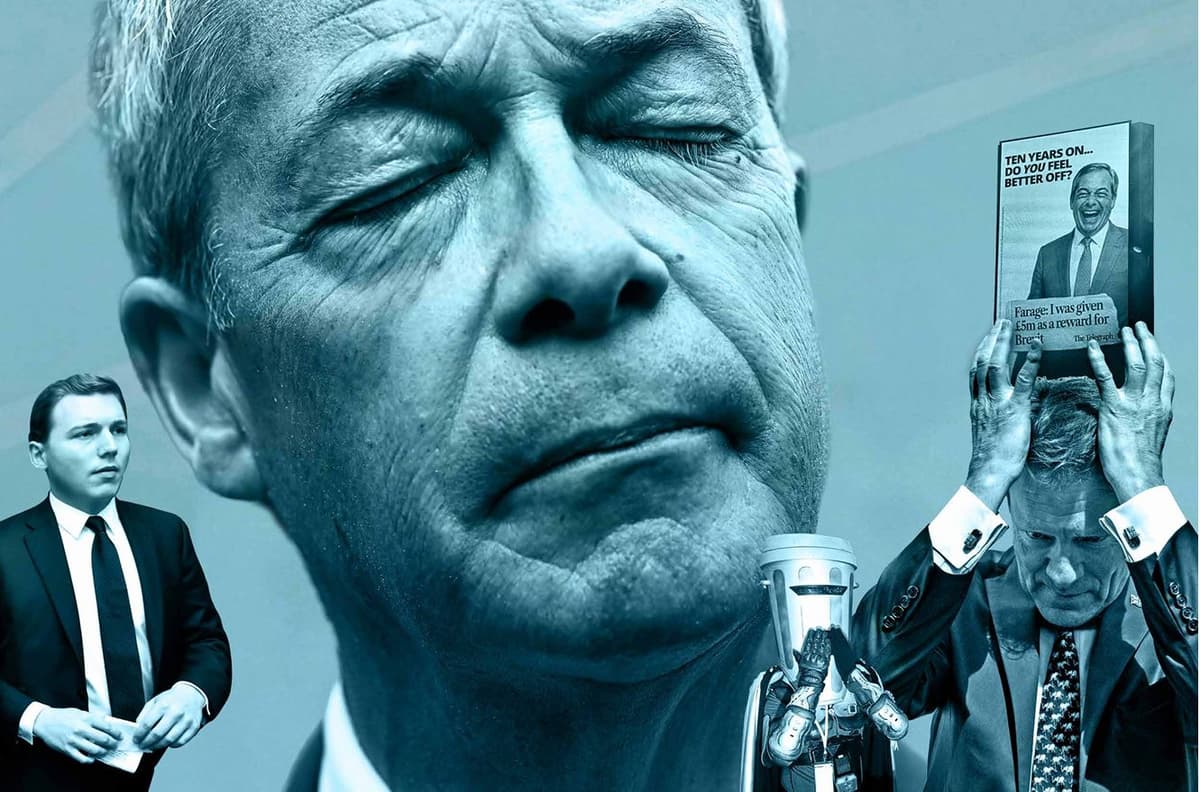
Reform UK is used to dramatic advances and reversals of fortune. In the past weeks, even the giddy dramas of Nigel Farage’s populist challenger party have defied expectations. A party founded on the principle of thumbing a nose at existing institutions and power hierarchies has found itself for the first time under pressure about its own conduct — amid a flurry of disclosures about undeclared financial support and scrutiny of its secretive benefactors.Faced with a parliamentary standards investigation into multi-million-pound gifts and squaring up to media scrutiny, Farage, the party’s leader and single most powerful animating force, reminded us of his ability to change the course of an argument in a single move. His “sod you” moment came at 2pm in the heatwave. Furious at a wave of stories casting doubt on the probity of some major financial contributions to Reform and facing an investigation by the Parliamentary Standards Commissioner, Farage moved into what a chess-loving ally called his “Grob’s attack” mode — referring to an aggressive, unconventional chess opening that takes the fight directly to the opponent by forcing them into fight-or-flight mode.The announcement of a snap August 13 by-election in his Essex seat now hovers somewhere between masterstroke — guaranteeing attention is on Reform during the early period of the Andy Burnham premiership and changing a critical narrative to a referendum on its leader in a territory where his personal support is mighty — and embarrassment. The main competitor has turned out to be Count Binface, a joke candidate. Beyond this whirlwind lurked questions over Reform’s trajectory and how far Farage, whose campaign for a referendum paved the way for Brexit and whose ability to bounce back to pole position on the Right of British politics in incarnations ranging from the Referendum Party to Ukip and the Brexit Party, is now serious about building an election machine aimed at securing power — and forming a government that can address public dissatisfactions, as well as thrive on the wings of anger and ennui with traditional parties.The eye of the storm: George Cottrell, Nigel Farage, Count Binface and Richard TiceThe London Standard / Getty ImagesIn some ways, Reform had already succeeded in its aim of disrupting the status quo. Its strong performance in the May local elections were one of the nails in the coffin of Sir Keir Starmer’s government — results that devastated Labour in the Red Wall and coastal seats, pushing Starmer’s battered party into third place in Wales. This cemented Burnham’s rise to Number 10, completed in a hasty coronation this week.Raising copious funds enables a party with its own sights on Downing Street to focus on the means to get there — winning constituencies in the next general election. This week Reform has been overhauling its party machine — 60 staff are being recruited at a cost of “several millions”. The aim is to hire party agents to strengthen the link between a prospective candidate and local voters.Beefy young men in shorts But inside the party’s sleek Millbank tower HQ, turf wars abound. In some quarters, concerns were aired that Farage — irked by the many intrusions on his private life and funding sources — was happier as a one-man band with a fan club at rallies across the country than a leader saddled with the discipline of policy announcements and grids. From high twenties in polls earlier this year, Reform is now on around 25 points, only five or six points clear of Labour and the Tories, each on around 19-20 points. Anti-Reform tactical voting means that it has struggled to pull by election successes. And a highly personal falling out with Rupert Lowe led to the formation of Restore Britain, to the right of the Reform, slicing into its vote. When I visited Millbank recently to interview Robert Jenrick, who defected from the Tories and is the party’s Treasury spokesman, the lifts were full of beefy young men in sports shirts and shorts doing party business and Jenrick working away in a white-walled office. Of Farage, there was no sign — and that is not unusual, his appearances are often limited to visits to use the well-equipped studio to record his punch viral videos.Reform UK party leader Nigel Farage (left) and Reform’s Treasury spokesman Robert JenrickPAOne party official says: “Nigel isn’t like other leaders — he knows what he wants to achieve in a week and he will make sure it happens — or he will simply go out there and talk about something that matters to him and he thinks resonates. But he’s not someone you can ask to be in place by 10.30am on a Tuesday or be sure will be in a regular Teams meeting.” Some worry that his reluctance to make structured appointments like a chief of staff, mean they must deal with a coterie that feels like a praetorian guard, rather than an organised leader’s office. That tension, between Reform as a vehicle for a combative leader who inspires entrenched hostility from foes and belief in the powers of “Nigel” as a force of political nature — and as head of a party preparing to be a serious electoral challenger from a base of only eight MPs (seven now that Farage has himself resigned to fight a by-election), was coming to a boil. So was the funding issue — with revelations of the freewheeling approach to financial support the party mustered as it grew from protest movement, harrying the traditional parties and feeding on sundry public discontents, to consistent electoral competitor.Jenrick used the conversation to mock Burnham as merely “Starmer in a dodgy polo shirt,” predicting that his honeymoon would be short. And he defended the controversial £5million gift from Christopher Harborne, telling me, “It was a perfectly legitimate thing to do and a choice that he (Harborne) made at the time. There were certainly no strings attached to the individual concerned.”He and Reform in general were enjoying the prospect of an emergency Labour PM transition. But in private conversations with donors early last week, I picked up unease about the Harborne case and the burgeoning media stories launched by a Sunday Times investigation into an even more colourful supporter of Farage — his longstanding friend and acolyte George Cottrell, aka “Posh George”, a maverick aristocrat who has served time for wire fraud in the US. All of this had unleashed some bad-tempered interviews with Farage — notably a BBC one in which he dismissed probing on the Harborne gift as “none of your business” and last week, an encounter with Sky TV warning that there would be “serious consequences” if news broadcasters door-stepped him or his family at one of his homes.An undertone of bitterness This tetchiness was dividing opinion inside Reform too. Its outrage at journalist questioning funding streams united the front bench in a “them-against-us mode”. But I spoke with two well-heeled donors who were hedging by holding talks again with the Conservatives and another senior benefactor, Mohamed Amersi, who donated £25,000 to Reform UK last year, but said he would not support the party financially again “until the cloud hanging over this (funding) issue is resolved”, adding that “others feel the same”. Farage changed the narrative in a single swooping gesture. His press conference, on July 7, started out as long justification and attack on an unfair “establishment” he believes has targeted him disproportionately. He then announced that he would sidestep the rulebook of Westminster processes and allow the people of Clacton to judge him in a people-versus-the establishment” by-election. The response from the other parties was damning. Kemi Badenoch was scathing. Farage was “cracking under pressure” and “could not handle scrutiny” — a tour de force performance that she hoped would remind Tories who had listed towards Reform of the true face of Farage-ism. After a short period of equivocation — all parties being caught blind-sided by the announcement that Farage was preparing to stand down in Clacton with the express purpose of returning after a by-election win, the Tories said they would not stand a candidate. And nor would any other major party. As Rachel Reeves, the likely outgoing Chancellor put it, “It is a farce and distraction — but if he wants to spend the summer arguing with a bin, I won’t stop him.”Count Binface will stand against Nigel Farage in ClactonPAAll of this felt bizarre and at times comically absurd, albeit with an undertone of bitterness. The by-election was clearly a stunt and a costly one of an estimated £250,000 to mount (Farage offered to foot the bill, but that would plainly contravene rules that election funding cannot be at the whim of one individual.) Reform insiders told me that for all the umbrage, the standoff at the Clacton corral was not that different to Labour essentially manufacturing the Makerfield by-election to furnish Burnham with a seat and expedite him to Westminster. Abruptly, the clock stopped and an entirely new chapter began on Friday with the shocking news that the death on July 8 of Ann Widdecombe, the Tory veteran and Right-wing commentator who had embraced Reform as her new political family from the Brexit campaign onward, at her home in Haytor on Dartmoor was caused by a violent attack. Detectives have since obtained a warrant of further detention under the Terrorism Act to continue to hold a 28-year-old suspect arrested in Rotherham on suspicion of murder. On Tuesday, counter-terrorism police issued a statement saying that the signs are that the attack on Widdecombe had been premeditated — and they were working to establish the motive.The shock of the killing of an elderly woman ricocheted through Westminster. Widdecombe was known to us all for decades — a former senior Tory minister and who had embraced a range of pursuits — from Strictly Come Dancing to anti-blood sports campaigning, while remaining firmly attached to her Right-wing cultural conservative causes. That has fuelled speculation that her death may have been motivated by hatred of her politics.Across the benches there was revulsion at the news that her death appears to have been a pre-meditated matter — and senior Labour figures were at pains to downplay divisions with Reform.Home Secretary Shabana Mahmood and Number 10 were keen to play down any lack of empathy on their own benches, not least because the immediate beneficiary would be Reform. Turning up in Haytor with huge white wreaths only days after the killing in a show of force, Farage, Reform deputy leader Richard Tice and Zia Yusuf, its home affairs spokesman, channelled raw emotion — but also created a memorable image that summed up an argument they were keen to make that resonated beyond their grief.Ann Widdecombe with Nigel FaragePAFarage had, after all, just been forced on to the defensive about donations to pay for his personal security and been embroiled in a spat with broadcasters about approaching one of the homes he owned and where his daughter was living. Whatever the motive for Widdecombe’s killing, this was a way to elevate the message that he is exposed to danger and needed tight security. Parliamentary authorities insist that this is already available to all prominent figures. Farage counters that it is not enough to protect him from the kind or intensity of threats he faces. The Widdecombe killing has focused minds on the security of MPs. Nonetheless Reform still faces the uncomfortable inspection it finds objectionable. Police are investigating donations made by Fiona Cottrell, the mother of “Posh George”, and questions about the provenance of the funds, and the parliamentary inquiry will resume into the propriety of the Harborne £5million gift and the web of the Cottrell family’s largesse. If, or rather when, Farage beats the bin to re-elect himself, those topics will not go awayThe defence Farage will now mount will rest on the view that Reform is a force that aims to change the rules of politics — and political funding — not simply abide by the status quo. It has however exposed a leadership sensitive to criticism to unwelcome attention — and awkward questions about its underpinning. Bankers have appeared befuddled about the purpose and sourcing of the money trail, which have seen the security services and National Crime Agency keen for greater transparency. For Reform’s top team it’s just another example of an establishment so hostile to Reform that it applies double standards to damage it. The Clacton by-election will have that one insistent theme. But the awkward questions will continue, because Reform is both a formidable fighting force and also a notably opaque one too. And that is one topic it really does not like to see in the headlines.Anne McElvoy is executive editor at POLITICO and host of Politics at Sam and Anne’s podcast
The questions continue as Reform UK blinks under an unwelcome spotlight
Full Article
📰 Original Source
Read full article at Standard →KhanList aggregates and links to publicly available news content. We do not host full articles from third-party sources. Always verify important information with original sources.