
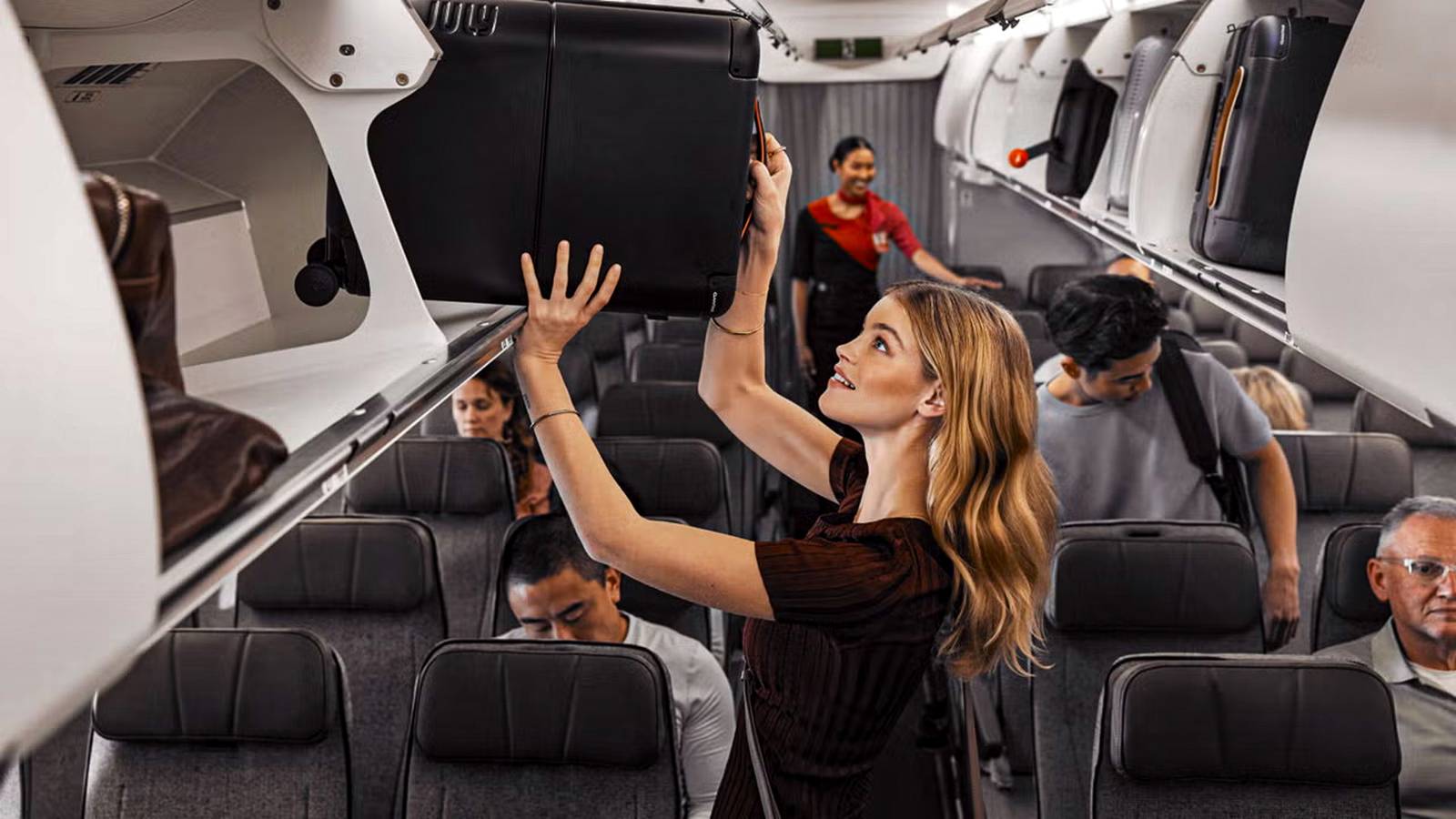
Published Nov 12, 2026, 4:00 AM EST Luke Diaz is a freelance military writer with experience with active duty experience in the US Navy as well as defense and industrial engineering. He is a former Naval Flight Officer who performed tactical air control on the carrier-based E-2 Hawkeye. In a move that puts traveler comfort ahead of scraping every shred of profit for a jetliner, Qantas pulled out three seats from its Airbus A321XLR that are requisite revenue-generating hardware for most shareholders. The aircraft, tail number VH-OGD, is the first delivery of a 48-seat subfleet that will include a fourth bathroom, using space that was reserved for the usual row of seats in the main cabin. The modification highlights a design tension inherent to the long-range narrowbody platform. The cabin reconfiguration was designed in response to customer feedback that followed the first three deliveries of the type. The overarching tone from passengers, aviation commentators, and the media was scathing and derisive, often framing the issue as a ‘legacy stink’ left behind by the airline’s highly controversial former CEO, Alan Joyce. Thus, instead of 180 economy and 20 business, the updated cabin of Qantas’ long-haul narrowbody now seats 197 travelers in ‘coach.’ The customer feedback Qantas received was immediate and highly critical of the airline's management, forcing a mid-stream redesign before the bulk of the fleet was even built. Consequently, the airline also committed to retrofitting the first three A321XLR aircraft already in its fleet with the extra toilet during future heavy maintenance checks. Qantas' Launch Day Brought An Unwelcome Comparison Credit: Qantas Qantas ordered the new extra-long-range Airbus single-aisles in 2022 to replace aging Boeing 737-800s. In 2025, Qantas launched commercial A321XLR flights, beginning September service with Sydney and Melbourne. Sky TG24 noted that while marketing focused on cabin width and fuel efficiency, the media attention was honed in on the jet’s layout flaws. It was specifically highlighted that the first three aircraft of Australia’s flag carrier had fewer toilets in economy than its low-cost competitors, Ryanair, Scoot, and Jetstar. For comparison, a standard Ryanair Boeing 737 carries 197 passengers with three toilets, like the new Qantas A321XLR. That ratio averages 66 people per facility. A Scoot Airbus A320 accommodates 180 passengers with three toilets, or 60 per facility. Meanwhile, a Jetstar A320 seats 186 with three units, averaging 62. In contrast, the original Qantas cabin provided just two toilets for 180 seats, at a 50% elevated ratio of 90 people per facility. As Runway Girl Network reported, the airline stated that the first aircraft will be finalized in 2022 with three toilets to match outgoing 737 specifications. Management has since promised all 48 jets on order will feature four toilets following the updated design. The layout assigns three facilities to economy and one to business class. However, The Guardian has emphasized that the first three airframes will likely operate unchanged for approximately three years before undergoing a formal retrofit. The first modified four-lavatory aircraft was currently scheduled for a December 2025 delivery. It didn’t ultimately reach Australia until late February of this year, according to Australian Aviation. The arrival resolved the initial cabin design crisis, shifting the industry conversation away from consumer complaints. Yet, analysts turned to the manufacturing choices and cabin design priorities that had led to the ill-equipped jets’ arrival in the first place. How One Toilet For 90 Passengers Adds Up Credit: Qantas Packing 200 passengers into a narrow fuselage turns cabin calculus into a test of passenger patience. While three total lavatories average one per 67-person full cabin, the forward facility is reserved for business class. That left only two rear toilets for 180 economy travelers, inflating the ratio to 90 people per facility. An arrangement that fell below the amenities relative to the legacy aircraft it replaced despite Qantas’ claims. One Mile at a Time calculated that the outgoing Boeing 737-800 provided two toilets for a cabin of 162 economy seats, which equals 81 passengers each. The A321XLR added 18 coach seats compared to the 737 without expanding toilet capacity. Airline Geeks also reported that the legacy jet carried 174 total customers, increasing total flyer volume by 15%. That design deviated drastically from the standard of the rest of the jets in the full-service airline’s fleet. While budget carriers maximize efficiency by allowing open passenger access to all facilities, AeroLOPA noted that Qantas' own standards typically maintain a ratio between 42 and 49 passengers per lavatory on long-haul airframes. This underscored the unusual deficit in the new narrowbody layout, which fell well behind the carrier's traditional passenger-comfort standard in its international widebody fleet. General industry benchmarks added to the negative optics that resulted after the first three planes began service. Other prominent ‘legacy style’ operators of the Airbus A321 family, including Delta Air Lines, routinely equip their economy cabins with at least three dedicated lavatories on short and medium range routes. Why The Back Of An A321XLR Gets Crowded Credit: Qantas The A321XLR delivers a single-aisle operational reach of 4,700 nautical miles (8,704 km), supporting flight durations approaching 11 hours. This capability enables operators like Iberia to service long-haul routes like Madrid to Boston. Many A321neos are equipped with Airbus' SpaceFlex module, which combines the rear galley and lavatory footprint which increases passenger seating capacity. Yet, according to AeroLOPA, mid-cabin restrooms were first rejected by all six of the original launch customers: Iberia, American Airlines, Aer Lingus, Air Canada, Qantas, and United Airlines. Due to that design choice, facilities were concentrated at the extremities of the aircraft, which caused serious bottlenecks during lengthy flights lasting eight to eleven hours. The practical consequences immediately manifested during real-world operations for more carriers than just Qantas. Iberia’s configuration placed all three economy lavatories at the extreme rear of the fuselage, with one unit dual-functioning as a flight attendant jumpseat. This layout restricted active availability to just two units for 168 economy passengers. It resulted in persistent queues that routinely clogged the rear galley workspace, according to at least one Runway Girl Network review. Even so, Qantas still implemented the most aggressive configuration among these initial operators at the outset. Deploying the dense 200-seat layout well exceeds the 182 seats found aboard Iberia and Air Canada variants or the 184 on Aer Lingus, 155 on American, and 150 on United jets. How A Row Traded For A Toilet Changed The Cabin Credit: Qantas Tail number VH-OGD was the first A321XLR incorporating a mid-cabin product redesign driven by preliminary operational feedback. Eliminating a three-seat economy row contracted total cabin capacity from 200 to 197 seats, leaving 20 in business and 177 in economy. This adjustment reduced the economy passenger-to-toilet ratio from 90 to approximately 59, or a 34% reduction in demand. The rear aisle congestion also caused significant disruptions to the crew's workflow. Flight attendants frequently had to pause meal services, back up their food carts, and manually clear crowds out of the aisle just to pass. Because the new front-economy toilet can accommodate a substantial portion of the cabin's passengers, the back aisle remains open and makes everything easier for the cabin crew, which also improves the customer experience in-flight. While sacrificing three seats removes only 1.5% of the total aircraft inventory, the configuration change greatly impacted the amenity available on each flight. The cut marginally limits the maximum revenue potential on Qantas’ routes with high demand and slightly raises unit operating expenses per seat. On the other hand, the additional restroom reduces overall cabin congestion and even lessens the operational risk of a single component failure grounding a flight, and mitigates mechanical wear across onboard plumbing. A Retrofit Still Years Away For The First Three Credit: Airbus Even after the cabin update for the vast majority of Qantas’ A321XLR fleet, the initial three airframes will remain with the original high-density layout for an extended period. The Guardian projected approximately three years of active service before modification. The remaining 45 aircraft within the 48-unit order book will arrive with four factory-installed toilets. In February, Qantas also launched its highly anticipated Economy Plus product. The extra legroom addition heavily improves passenger comfort and recline dynamics on the Airbus A321XLR. The 36 Plus seats on the A321XLR feature a generous seat pitch of 34 to 35 inches (86.36 to 88.9 cm). Standard economy seats have a pitch of 30 inches (76.2 cm). When the traveler in front reclines, the space tightens significantly. As the A321XLR flies transcontinental routes and mid-haul international segments, posture changes are essential to prevent fatigue. Qantas also designed the A321XLR economy cabin with a focus on streaming entertainment. The seats include built-in drop-down tablet holders with anti-slip mats. Where Qantas' A321XLR Flies And What Is Coming Next Credit: Airbus The Airbus A321XLR registered as VH-OGD arrived in Australia in late February. Although Qantas initially scheduled the aircraft's international debut from Brisbane to Manila for October 25, reports say its deployment was deferred to February 1, 2027. The A321XLR's operational role runs completely parallel to Qantas's massive widebody modernization. The effort is internally split across Project Sunrise, which will debut in first-of-their-kind Airbus A350-1000ULR variants on what is projected to be the longest commercial flights in the world. The first locked-in route connects Sydney to London Heathrow starting in October 2027, followed shortly after by a nonstop link between Sydney and New York JFK in mid-2028. Meanwhile, Project Fysh is in the works to introduce Boeing 787s and A350s intended to replace the retiring A330 and A380 fleets. The 787-10 fleet will fly medium-haul routes from Sydney and Melbourne to Singapore, Tokyo, Hong Kong, and Auckland. The standard A350-1000 will take over the long-haul routes that require maximum capacity but don't need the Sunrise range, such as Los Angeles, San Francisco, Johannesburg, and the traditional one-stop kangaroo route to Europe via Singapore.
The Qantas Airbus A321XLR That Has 3 Fewer Economy Seats
Full Article
Original Source
Read the full article at Simpleflying →KhanList aggregates and links to publicly available news content. We do not host full articles from third-party sources. Always verify important information with original sources.