
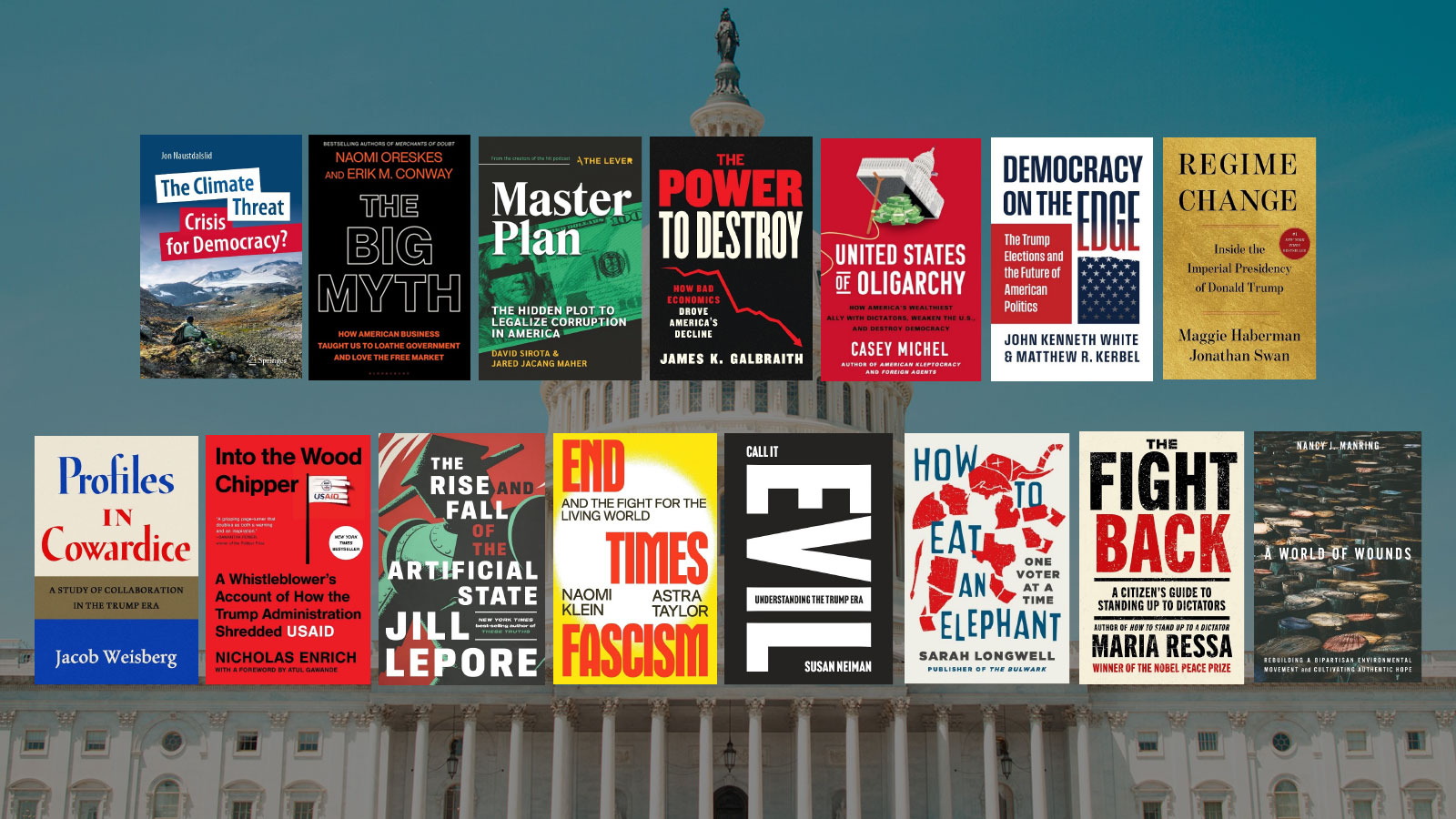
President Donald Trump has been very good for the book business. Delusions of grandeur can attract as much critical attention from book authors as grandeur, wreckage as much as construction. The 15 books presented here, nine of which were published in just the last 60 days, provide background and context, detailed accounts, cultural perspectives, and political strategies for understanding and responding to the second Trump administration. Many, many more can be found on bookstore shelves, including “Nerd Reich,” which earned this name-drop with its clever title. The list begins and ends with titles that directly link climate action and democratic politics. The first points out that our long failure to act on climate change raises important questions about democracy. The last argues that effective bipartisan action on climate change is still possible — and could renew our democracy. Four books lay out the decades-long political and legal contests between free-market oligarchy and democratic governance (which must include regulation of the market and accountability for bad actors). The opponents of democratic governance, they show, have promoted self-serving accounts of history, flawed economic frameworks, and combative theories of law. Through these schemes, they have captured government agencies, institutions, and protocols — and further empowered their scheming. How these plans led to the Trump presidencies and how they figure in his second administration is covered by the next four books, which recount the Trump elections, the first 18 months of his second term, and the moral cowardice that enabled his early successes, including the lawless institutional violence against USAID by Elon Musk’s DOGE (Department of Government Efficiency). The strange social visions animating the oligarchs’ attacks on democratic government are explained in the three books that follow. Historian Jill Lepore describes their dreams of the “artificial state.” Activists Naomi Klein and Astra Taylor decry their “end times fascism.” And philosopher Susan Neiman argues for labeling them evil. The 2026 midterm elections are the first chance since 2024 for voters to record opposition to these figures and to begin the process of holding them to account. But completing that process will require building a “pro-democracy movement” and, that political strategist Sarah Longwell argues, entails eating away at the anti-democratic faction, “one voter at a time.” Nobel Peace Prize winner Maria Resser reminds us that this is a global challenge. And, returning to the final book, political scientist Nancy Manring suggests that climate impacts could be one motivation for bipartisan civil action. As always, the descriptions of the titles are adapted from copy provided by their publishers. When two dates of publication are listed, the second is for the paperback edition. If you purchase a book through one of the links below, a percentage of the proceeds funds our journalism. The Climate Threat: Crisis for Democracy by Jon Naustdalslid (Springer Nature 2023 / 2024, 229 pages, $49.99) The climate threat emerged in a world also undergoing political convulsions. After introducing the ways climate and democracy intersect, political scientist Naustdalslid next examines the anti-democratic impulses that sometimes appear in environmental circles. Then he considers whether alternative forms of democracy might address climate change more effectively. A key point in the book is the need to focus more seriously on energy as the real problem behind global warming. The failure of global climate policies to reduce CO2 emissions and halt climate change has caused many to lose confidence in democracy’s ability to handle climate change, which has led them to entertain more authoritarian measures. The book documents these trends, puts them in historical context, criticizes them, and sketches more democratic alternatives. The Big Myth: How American Business Taught Us to Loathe Government and Love the Free Market by Naomi Oreskes and Erik M. Conway (Bloomsbury Publishing 2023 / 2025, 592 pages, $23.99 paperback) In the early 20th century, business elites, trade associations, wealthy powerbrokers, and media allies set out to build a new American orthodoxy: down with “big govern-ment” and up with unfettered markets. Oreskes and Conway document campaigns to rewrite textbooks, combat unions, and defend child labor. They detail the ploys that turned economists Friedrich von Hayek and Milton Friedman into household names; recount the libertarian roots of “Little House on the Prairie”; and tune into the GE TV show that launched Ronald Reagan’s political career. By the 1970s, with memories of WWII dimming, this propaganda was succeeding. But free-market ideology then gave us opioid scourges, financial crashes, and climate destruction. Only by understanding this history can we create a future where markets serve, not stifle, democracy. Master Plan: The Hidden Plot to Legalize Corruption in America by David Sirota and Jared Jacang Mahe (Lever Books 2025, 276 pages, $22.99 paperback) For decades, a shadowy network of corporate elites, political operatives, and Supreme Court justices has worked behind the scenes to dismantle campaign finance laws and rig the system in favor of the ultra-wealthy. Based on the award-winning investigative podcast from “The Lever,” journalist David Sirota and producer Jared Jacang Maher trace this plot back to a little-known memo written by future Supreme Court Justice Lewis Powell. They reveal how this memo became a roadmap for dismantling democracy — one that inspired wealthy anti-government radicals like Joseph Coors to fund the Heritage Foundation, and that paved the way for operatives like Roger Ailes to build Fox News. With materials not included in the podcast, Master Plan details how America’s democracy was hijacked — and reveals what can be done to reclaim it. The Power to Destroy: How Bad Economics Drove America’s Decline by James K. Galbraith (University of Chicago Press 2026, 280 pages, $30.00) Amid a mounting sense of decline, Americans live with a new kind of dissonance: economists announcing that everything is fine. The Power to Destroy shows that this dissonance reflects a failure to evolve. Today’s experts still deploy tools from yesterday’s wars: obsolete economic ideas and doctrines focused on market functioning and crude economic indicators. Such conventional policies, economist James Galbraith argues, are increasingly ill-equipped to counter the daunting challenges of our moment―from inflation to trade sanctions, industrial cold wars, and climate change. As Galbraith makes plain, for all the virtues of the market system, it is governments and their policies that make markets possible. The ideas behind policies determine the fate of the US economy. New and better ideas are urgently needed. United States of Oligarchy: How America’s Wealthiest Ally with Dictators, Weaken the U.S., and Destroy Democracy by Casey Mitchel (St. Martin’s Press 2026, 384 pages, $31.00) For years, a small group of billionaires has amassed increasing power, steering American politics for their own benefit. Many of these figures are familiar: Elon Musk, Mark Zuckerberg, and Jared Kushner. There is only one word to describe such extreme levels of wealth, avarice, and political control: Oligarchy. Placing profit over patriotism, they have become vectors of influence for some of the world’s most repulsive dictatorships, all of whom are trying to create a world dominated by imperialism and tyranny. Connecting everything from the devastation in Ukraine to destruction in Gaza to destabilization in Greenland, these oligarchs have transformed American policy and American politics into their own private fiefdoms. The oligarchs now seek to reign. The only question is whether or not it’s too late to stop them. Democracy on the Edge: The Trump Elections and the Future of American Politics by John Kenneth White & Matthew R. Kerbel (University Press of Kansas 2026, 236 pages, $27.99) Our recent elections have been anything but normal. In “Democracy on the Edge,” leading political scientists John Kenneth White and Matthew R. Kerbel unravel the elections of 2020, 2022, and 2024 to show how each represented a flashpoint in the reordering of political priorities and electoral coalitions. In unpacking recent electoral cycles and placing them in broader historical context, White and Kerbel show that both major parties face unique difficulties. The efforts of Republicans and Democrats are buffeted by dramatic and unpredictable cultural, economic, and generational shifts. The final denouement of this political saga has yet to be written, but Trump’s reelection leaves us with the possibility of two unfamiliar outcomes—a brand of American authoritarianism or the establishment of a multicultural republic. Regime Change: Inside the Imperial Presidency of Donald Trump by Maggie Haberman and Jonathan Swan (Simon & Schuster 2026, 496 pages, $34.00) From the two reporters who have covered him more closely than perhaps anyone else over the past decade comes this definitive portrait of Donald Trump in the White House. “Regime Change” covers the first year of Trump’s second presidency—a term liberated from every constraint that defined his first. Based on hundreds of interviews and unprecedented reporting from deep within the administration’s most closely guarded rooms, Regime Change takes the reader inside the Situation Room and into secret Oval Office deliberations. Maggie Haberman and Jonathan Swan reveal a second term propelled by a historical irony: the indictments, the convictions, the assassination attempts, and four years of exile made him not weaker but far more powerful, more vengeful, and more volatile than any President in modern history.Profiles in Cowardice: A Study of Collaboration in the Trump Era by Jacob Weisberg (Penguin Press 2026, 288 pages, $31.00) Jeff Bezos, Amazon, and Big Tech. Stephen Schwarzman, Blackstone, and Wall Street. Brad Karp, Paul, Weiss, and Big Law. Mitch McConnell and the United States Senate. Eight individuals in all, together forming an entwined network of power in America, and a new way to understand how authoritarianism can take root in an open society—not by overthrowing institutions, but by bending and bullying them into submission. In “Profiles in Cowardice,” Jacob Weisberg has written one of the first defining books of the Trump Era. The book is a masterful study of the rationalizations people create to justify basic human instincts such as greed, vanity and, above all, fear. This is not a morality tale with easy villains. It is an attempt to describe the moral mechanics of democratic failure— so that we may better understand what courage requires. Into the Wood Chipper: A Whistleblower’s Account of How the Trump Administration Shredded US AID by Nicholas Enrich (Summit Books 2026, 240 pages, $29.00) Nicholas Enrich had finally achieved his lifelong dream: becoming USAID’s lead official for global health. But that dream turned into a nightmare in the tumultuous time after President Trump’s second inauguration. In the months that followed, USAID became the first target of Elon Musk’s newly created Department of Government Efficiency (DOGE). Urgent and profoundly human, Enrich’s story offers a behind-the-scenes look at a federal agency under siege, from the early days when Enrich and his team were unaware of what was to come to the shockingly ignorant, callous, and bigoted conversations they witnessed. Enrich reveals in this detailed, no-holds-barred account what was truly at stake when DOGE set out to dismantle one of America’s most effective humanitarian institutions, and how millions of lives hung in the balance. The Rise and Fall of the Artificial State by Jill Lepore (Liveright 2026, 336 pages, $29.99) With Orwellian overtones, “The Rise and Fall of the Artificial State” demonstrates how technology has corroded global democracy, leading to the destruction of both human community and capacity for self-government, and potentially creating a digital citizen’s assembly, where AI will recommend the course of action to humans in place of human-run legislatures. Especially sobering, with the proliferation of “dizzying predictions,” is that the Artificial State has come at the expense of the natural world. But nothing about the Artificial State, historian Jill Lepore argues, was inevitable. And it can be dismantled—just as feudalism, fascism, and slavery were in the past. But disassembly requires identifying the parts and tracing the sources. It requires telling a new history. This is the purpose of “The Rise and Fall of the Artificial State.” End Times Fascism and the Fight for the Living World by Naomi Klein and Astra Taylor (Farrar, Straus and Giroux, 2026, 384 pages, $32.00) As the planet burns and shared reality melts, a new iteration of the far right is on the march. How can we understand this dangerous new development, and what resources can we draw on to resist it? In their scathing assessment of the contemporary scene, celebrated activists and authors Naomi Klein and Astra Taylor show that the religious fundamentalists, Silicon Valley technologists, and ethno-nationalists who make up this apocalyptic alliance share more than one might think. “End Times Fascism” is the ideology of the actors who strive to make the world unlivable and then seek to protect themselves from the fallout– whether by repairing to private islands, rocketing off to Mars, or bunkering the nation. But the new survivalists are not impregnable. Their inability to envision a shared future leaves them vulnerable to “pro-Earth” politics. Call It Evil: Understanding the Trump Era by Susan Neiman (W.W. Norton 2026, 240 pages, $27.99) “Call It Evil” is a bold reckoning with one of the most fraught words in our vocabulary. Far from being a religious or outdated concept, evil is a vital lens, philosopher Susan Neiman argues, through which to understand the threats we face today. Neiman opens this revelatory work with the idea that the reelection of Donald Trump is the outcome not simply of political and economic forces but of the erosion of values that have been subject to derision for more than a century. Misreadings of Adam Smith and Charles Darwin have led to a view of human nature we now accept as common sense: ideals are for losers. Drawing on history―from European fascism to the moral failures of U.S. leaders―she shows how the normalization of evil corrodes trust, destroys justice, and endangers our future. We should not accept moral confusion as the price of politics. How to Eat an Elephant: One Voter at a Time by Sarah Longwell (St. Martin’s Press 2026, 336 pages, $29.00 pages) American voters, and what they want for their country, are at the heart of “How to Eat an Elephant.” Sarah Longwell, the founder of The Bulwark and one of the sharpest political communicators of her generation, lays out the playbook for building a coalition big enough, bold enough, and tough enough to defeat authoritarian populism for good. Not with a single election but by building something new: A modern pro-democracy movement that can create its own communications infrastructure – just like the right has done for decades. Drawing on her own unlikely political journey from a lesbian Republican operative to the vanguard of the anti-MAGA movement, Longwell explains exactly how we got here and what we must build next—while constantly quoting voters. Hence, her question: how do you eat an elephant? One voter at a time. The Fight Back: A Citizen’s Guide to Standing Up to Dictators by Maria Ressa (Harper Collins 2026, 256 pages, $30.00) The window for saving democracy is closing. If 2024 was the tipping point for elections, then 2025 and 2026 have taught us what happens when citizens don’t hold the line and Western democracies begin to fall. It’s time for the fight back. As Nobel-Peace-Prize-Winner Maria Ressa knowingly writes, we face three convergent crises: (1) The crisis of truth: Tech platforms and AI have destroyed our information ecosystem. (2) The crisis of order: The United States—the nation that built the postwar international system—is now dismantling it. (3) The crisis of accountability: The law has been weaponized and institutions captured; those with power answer to no one. “The Fight Back” is a field guide for this moment. It’s grounded in frontline experience from different continents, with frameworks for immediate action in the age of AI. A World of Wounds: Rebuilding a Bipartisan Environmental Movement and Cultivating Authentic Hope by Nancy J. Manring (Stanford University Press 2026, 288 pages, $28.00 paperback) At the end of the Reagan administration, American public opinion polls showed there were no discernible differences based on political party in response to the question, “Do you consider yourself an environmentalist?” Today, half as many Republicans self-identify as environmentalists when compared to Democrats. Political stagnation on climate action, in turn, has led to a growing number of Americans of all ages who experience ecological grief and eco-anxiety. These emotions are responses to the existential distress associated with living with environmental damages and ecological losses. A world of wounds. Political and environmental scientist Nancy J. Manring begins with an unflinching look at both planetary and political realities, but then she maps out realistic strategies for rebuilding a bipartisan environmental movement. Republish our articles for free, online or in print, under a Creative Commons license.
The political climate for climate politics
Full Article
Original Source
Read the full article at Yaleclimateconnections →KhanList aggregates and links to publicly available news content. We do not host full articles from third-party sources. Always verify important information with original sources.