
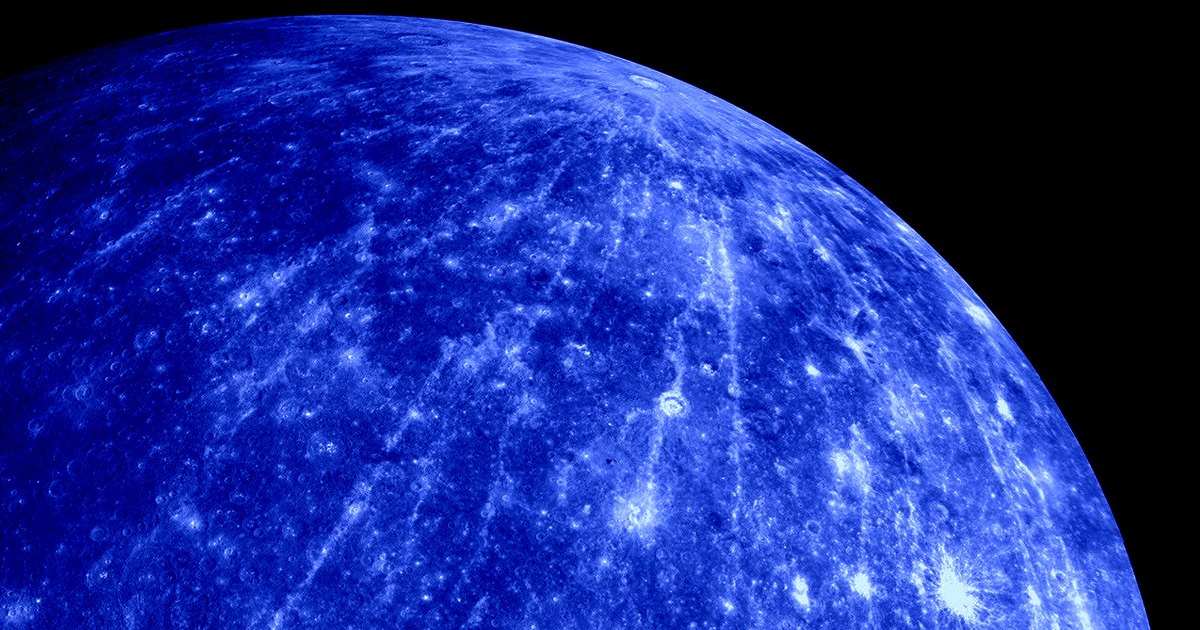
NASA / Futurism Scientists say that the planet Mercury has been actively shrinking over the billions of years that it’s orbited the Sun, a process that’s leaving cracked-up wrinkles behind like an old apple. At just one-third the size of Earth, it’s already the smallest planet in our solar system — it’s larger than Pluto, but Pluto is no longer classified as a planet — in a title it’s bound to hold on to as its continues to diminish in physical size. Now, as detailed in a new paper by a team of scientists from the German Aerospace Center’s (DLR) Institute of Space Research, the oddball planet’s shrivelling could be occurring at an even faster-than-expected rate, losing up to 14.5 miles of total diameter since it formed billions of years ago. That’s anywhere from ten to 30 percent more than previously thought. The scientists suggest that debris from impact craters may have hidden this accelerated shrinking, a process largely thought to be the result of Mercury running out of heat — “like a balloon left out in the cold,” per an accompanying press release. The findings could help scientists get a better sense of what’s going on inside the planet and how it evolved over time. “More shrinking means Mercury could have a larger metal core, less light elements like silicon mixed into the metal core, or a higher starting temperature,” DLR planetary scientist Gaku Nishiyama explained in a statement. “Every planet is an odd little duck that has a story to tell,” Brown University planetary geoscientist Sam Birch, who was not involved in the study, told the New York Times. “If you can understand how fast Mercury is shrinking, you can understand how fast it’s cooling, what size it started at and what it’s made out of.” Mercury’s outermost layer of hard rock has been resisting — or at least trying to resist — this deflation, causing its surface to crack and “wrinkle.” It’s a rough surface lined with steep cliffs known as scarps, as well as ridges that make getting a broader sense of how much it’s shrinking overall difficult. By aggregating previous maps of the planet’s surface, the team found evidence that the roughest areas have fewer wrinkles, suggesting that impact debris is “obscuring shortening structures,” according to Nishiyama. Their newly revised rates of shrinking also happen to better reflect previous physics-based predictions. Fortunately, we’re about to have a close look at the deflating planet. The European Space Agency and Japan Aerospace Exploration Agency’s BepiColombo mission, which launched in 2018, will enter Mercury’s orbit in November, if all goes according to plan — becoming only the second spacecraft to do so in human history. More on Mercury: Mercury Has an Eleven-Mile-Thick Layer of Diamonds, Scientists Find
The Planet Mercury Appears to Have Shrunken Drastically, “Like a Balloon Left Out in the Cold”
Full Article
Original Source
Read the full article at Futurism →KhanList aggregates and links to publicly available news content. We do not host full articles from third-party sources. Always verify important information with original sources.