
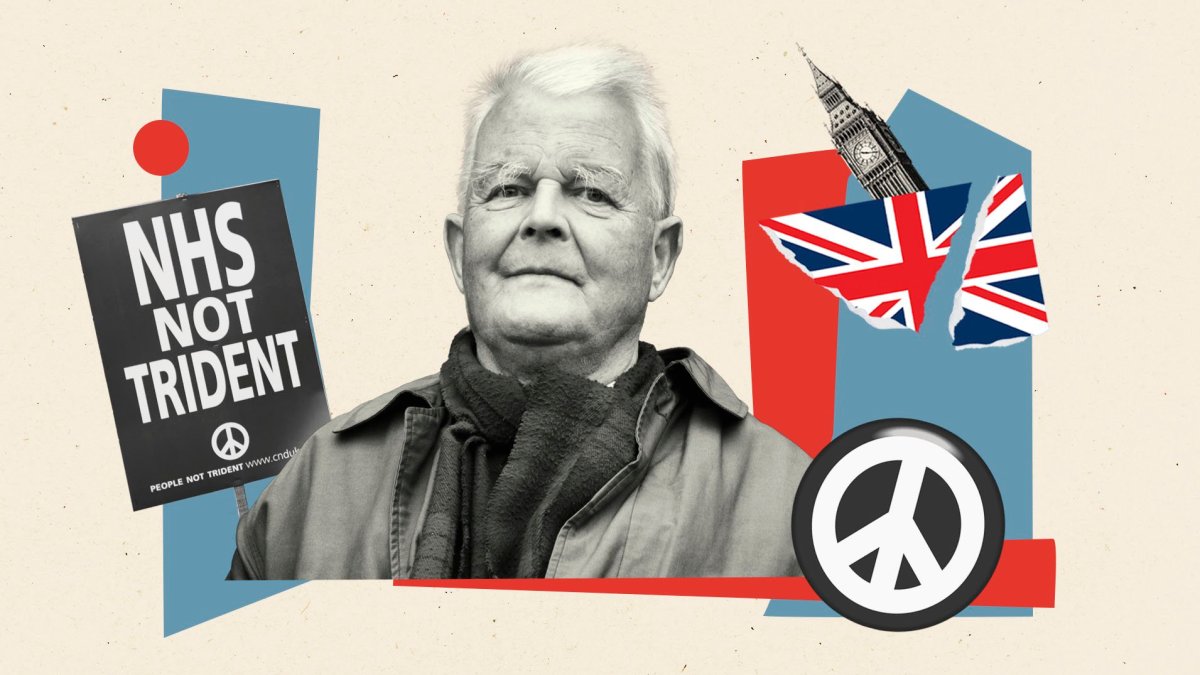
Who broke Britain? Welcome to The i Paper’s opinion series in which experts and writers debate the issues that concern them about modern Britain. • Martin Lewis: the money-saving expert… who accidentally cost Britons billions• The American woman who ripped the heart out of Cadbury• Britain’s pubs and clubs are dying – thanks to this obscure anti-noise crusader “If we wish to survive, we must protest,” wrote the Marxist historian EP Thompson in 1980. It was a potent call for nuclear disarmament at a time of superpower tensions, and it was effective. The Campaign for Nuclear Disarmament (CND) burgeoned and mounted huge demonstrations. CND was given impetus by Nato’s decision to deploy Cruise missiles in Britain to counter Soviet intermediate-range forces. Popular culture, notably the films The Day After and Threads, dwelt on the catastrophic effects of nuclear war. And at the heart of the mass movement calling for Britain to refuse Cruise and unilaterally renounce nuclear weapons was Monsignor Bruce Kent, general secretary of CND. I knew Bruce towards the end of his life (he died in 2022, aged 92), and liked him. But I didn’t respect him. Over decades dedicated to peace activism, he was usually wrong and always intellectually incurious. The obsequiousness with which he was treated even by those who disagreed with him (the Telegraph called him a “pillar of our great national tradition of radicalism”) obscured sentiments for which naïveté was no excuse. Bruce reliably diminished the quality of public debate. Labour fought two general elections, in 1983 and 1987, on a programme of unilateral nuclear disarmament. The party went down each time to landslide defeat. It was an extraordinary act of self-immolation: by helping make Labour unelectable, CND weakened the opposition that might have constrained Margaret Thatcher’s governments. Britain paid a heavy price for its influence.This was also a repudiation of Labour’s own record. Labour in government had ensured Britain would have an independent nuclear deterrent, and been instrumental in founding Nato. CND’s programme was utterly alien to the politics of Clement Attlee and Ernest Bevin. Neil Kinnock deserves credit for confronting the far left in the 1980s and returning Labour to the mainstream. But not till 1989, six years after he became leader, did the party abandon the electorally suicidal policy of unilateral nuclear disarmament. I was a Labour activist in the London borough of Lambeth at the time. Support for CND was a litmus test of ideological purity for any party position. Bruce was, and remained, a big figure in this fiasco. The notion, peddled by peace campaigners, that Cruise missiles were a first-strike weapon designed to fight a “limited” nuclear war was especially baffling. The rationale of Nato’s deployment was the opposite: to impress upon Soviet leaders that any use of medium-range missiles could not be limited to Europe, as it would elicit US retaliation. Cruise thereby bolstered deterrence. More fundamentally, the unilateral disarmers didn’t grasp that Nato, a voluntary alliance of free nations, and the Warsaw Pact, an instrument of Soviet domination, were geopolitically unalike. The nuclear arms race was due not to the march of technology, or to mutual misunderstanding, but to the political division between western democracy and communist totalitarianism. The military historian Michael Howard wrote in the 1970s: “Certainly armaments races can exacerbate international tensions, but they are as much the consequences of those tensions as the cause.” Events bore him out. Once Soviet communism collapsed, and liberty flowered in the former captive nations of Eastern Europe, the arms race lost that crucial dynamic. Bruce didn’t and couldn’t grasp this truth, because he lacked the visceral revulsion against tyranny that he ought to have felt. You think I malign him? Consult his record. In 1983, Bruce wrote in an article for Woman magazine: “Poland is suffering mild repression by world standards, and the Pope even visits the place.” When the article, which attacked the Church’s “one-sided and tunnel-visioned” approach to communism, caused a stir, Bruce didn’t even have the courage of his convictions. He disclaimed any intention of criticising Pope John Paul II, and feebly said his article was a draft he’d been unable to amend. Poland, supposedly a case of “mild repression”, was then under martial law. Imagination and decency should have been enough for Bruce to empathise with a people chafing against oppression. Also in 1983, Bruce gave an address to the 38th Congress of the Communist Party of Great Britain. Quite why British communists should have sought Britain’s nuclear disarmament and withdrawal from Nato seems genuinely never to have occurred to him. Not even the revelation that the party, almost till the day it wound itself up, secretly took delivery of sackfuls of banknotes from the Soviet embassy shook his faith in the good intentions of British communists. Of this episode, Conor Cruise O’Brien, the Irish historian, wrote in the Observer: “Bruce Kent is a man of excellent intentions, boundless faith and limited political intelligence. It is not a reassuring combination.” This was a generous comment. I’d say it’s a lethal combination – lethal, that is, to the ability of free societies to thwart the assaults of those who seek their destruction. Among Bruce’s most fatuous interventions was a letter to the Guardian in June 1995 about the Bosnian war. He noted darkly that there was “something very odd about the rapid recognition of a new sovereign state [Bosnia-Herzegovina] which proceeded without the positive support of about a third of those about to become its new citizens. We do not appear to have learnt yet the lessons of Northern Ireland: minorities are not easily coerced and there are no military solutions to problems which are essentially political.” Six weeks later, while a Dutch contingent of UN “peacekeepers” stood by, Bosnian Serb forces overran the supposed safe zone of Srebrenica and massacred 8,000 Bosnian Muslim men and boys in an act of genocide. It was, and remains, the worst atrocity in Europe since 1945. Bruce, lacking any expertise in the region’s history, and sitting at home in Islington, had identified the “coercion” of the Bosnian Serbs as the driver of the conflict. At this point, he crossed what ought to be an inviolable boundary separating stupidity from moral squalor. His evasiveness and lamentable indifference to the predictable consequences of his campaigning made Britain a worse place.
The peace campaigner who ruined Labour when Britain needed it most
Full Article
Original Source
Read the full article at Inews →KhanList aggregates and links to publicly available news content. We do not host full articles from third-party sources. Always verify important information with original sources.