
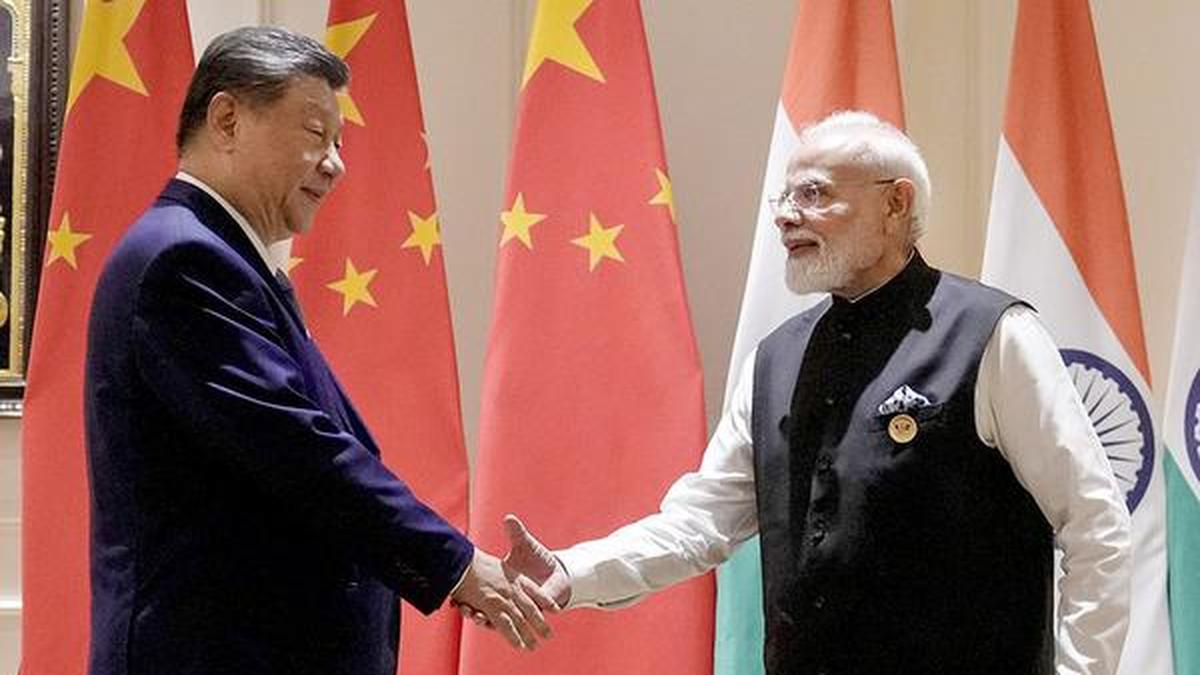
Prime Minister Narendra Modi greets Chinese President Xi Jinping on the sidelines of the BRICS Summit in New Delhi on Saturday. PTI - | Photo Credit: - After the bilateral meeting between Prime Minister Narendra Modi and Chinese President Xi Jinping on the sidelines of the BRICS summit in Delhi on September 12, 2026, India said the two leaders had underlined the need to address each other’s concerns, including “structural trade imbalance and supply chain issues”.This assumes significance as the widening trade deficit with China reveals a central paradox in India’s ambitious Atmanirbhar Bharat mission, launched in 2020 to bolster domestic manufacturing and reduce dependence on global supply chains, with China as the implicit target.India is steadily building its manufacturing and export capabilities. But that expansion remains deeply embedded in China-centric, import-dependent supply chains — creating what may be called the “assembly trap” of self-reliance.Bilateral trade touched $167.6 billion in 2025 but has become increasingly asymmetric, with imports from China rising much faster than India’s exports.Exports to China remained broadly stagnant between 2021 and 2025, while imports rose sharply by about 71% from $87.5 billion to $149.5 billion in the same period — highlighting persistent structural weaknesses in India’s manufacturing and trade competitiveness.Nearly 70% of India’s imports from China are intermediate goods and another 22% capital goods.That composition shows that the India-China trade deficit is not simply a consequence of Indian consumers buying Chinese finished products. It reflects deeper structural asymmetries in manufacturing capability and technological dependence, with India’s reliance on Chinese supply chains extending deep into the manufacturing system as inputs, components and semi-processed goods.The trends in India’s top five import categories from China between 2021 and 2025 reveal that this reliance has deepened rather than diversified, despite initiatives such as Make in India, the Production-Linked Incentive (PLI) scheme and the Phased Manufacturing Programme (PMP).The combined value of top five categories of imports rose from $19 billion in 2021 to $34.6 billion in 2025 — close to one-fourth of total imports from China, showing that India’s import basket has become more concentrated in a few electronics-related categories rather than more diversified.That telecom equipment, laptops and integrated circuits remain in the top five shows that India’s electronics assembly, though expanded, is still structurally exposed to Chinese supply chains.India has emerged as a major hub for mobile phone assembly, but the share of imported parts and components has risen sharply from 3.3% of the import basket in 2022 to 10.1% in 2025 — revealing the contradiction in that success story: it has been shaped, at least so far, by downstream assembly rather than by a deep domestic component ecosystem.Imports of sophisticated inputs and capital goods can facilitate industrial upgrading, but they become problematic when the dependence turns structurally persistent and domestic firms fail to build capability in semiconductors, integrated circuit design, displays and other precision components.Such deepening dependence not only exposes the limits of initiatives to boost domestic manufacturing, but also questions their effectiveness.Financial incentives under PLI or PMP may partly address India’s scaling and investment problems, but cannot alone resolve the structural and capability challenges. That requires shifting focus from incentivising assembly to building domestic technological capability, innovation, supplier networks and component ecosystems.The response should not be blanket import restrictions but calibrated tariffs on parts and components, designed to nurture the upstream segments of domestic manufacturing value chains.India should focus on guarded globalisation — enhancing access to global value chains while building domestic manufacturing capabilities, so that critical technological dependencies do not harden into strategic vulnerabilities. This is the best pathway to address trade asymmetries with China and realise the vision of a truly self-reliant India.Source: World Integrated Trade Solutionby the World BankSurendar Singh is an Associate Professor at O.P. Jindal Global University, Sonipat. Views are personal. Published - September 21, 2026 08:00 am IST
The paradox of self-reliance: India-China trade dynamics | Data Point
Full Article
Original Source
Read the full article at Thehindu →KhanList aggregates and links to publicly available news content. We do not host full articles from third-party sources. Always verify important information with original sources.