
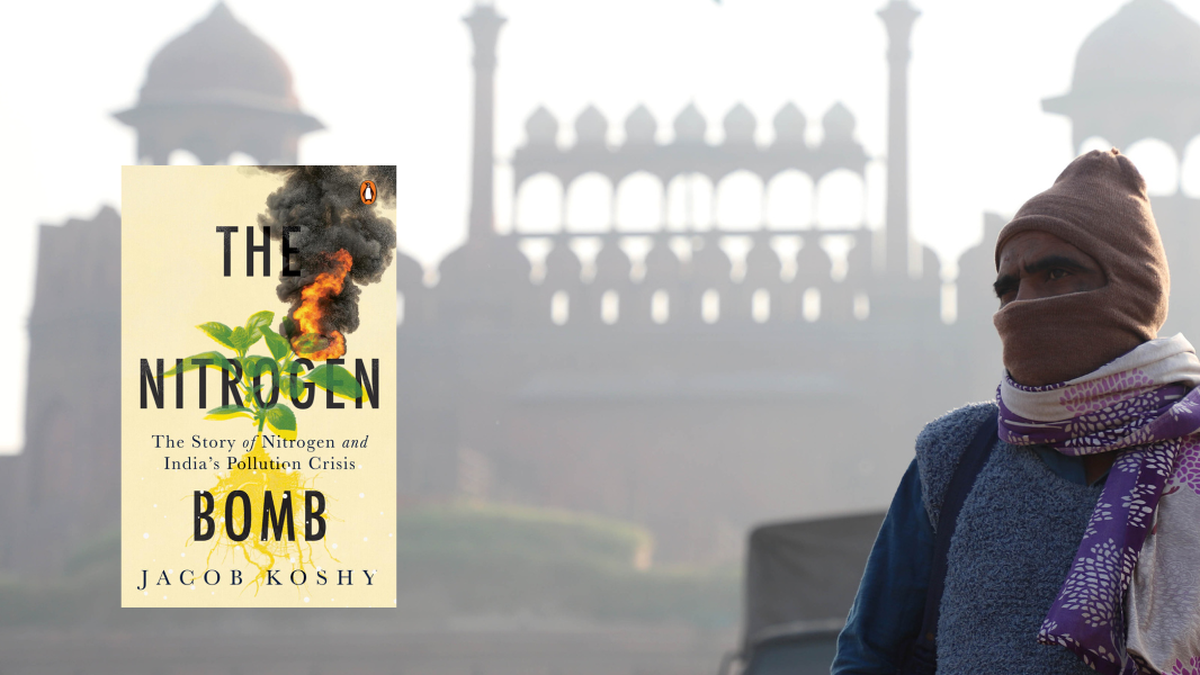
A commuter waits amid heavy fog near Red Fort in New Delhi. | Photo Credit: Getty Images The Indo-Gangetic Plain (IGP) stretches across northern India in a 2,500-kilometre arc from Pakistan to Bangladesh and is home to nearly half a billion people. It is one of the most intensively farmed landscapes on earth, and by every atmospheric measure, one of the most chemically burdened places that has been peopled for millennia. What Odén [Svante Odén, the Swedish scientist who first linked acid rain and its wide-ranging environmental harms] mapped in Scandinavia — nitrogen from farms, nitrogen oxides from engines, ammonia reacting with acids to produce particles that choke lungs and kill quietly — is happening here, now, on a scale and at a speed that would make Europe’s post-war industrial peak antediluvian.Forms of pollutantsIn 2025, I reported on a study by the Centre for Research on Energy and Clean Air (CREA), a think tank, that said secondary pollutants, particularly ammonium sulphate that forms when sulphur dioxide from coal plants meets ammonia from fertilised fields, were responsible for nearly one-third of India’s PM2.5 pollution burden.I remember writing then, trying to explain to readers who, like me, had been led to believe that Delhi’s winters were a problem of primary pollutants from stubble fires and diesel exhaust: ‘Primary pollutants are those that result from the burning of fossil fuels from automobiles, coal plants and organic matter.’ The distinction matters because it changes everything about how you think about solutions. During Delhi’s most polluted winter months, the CREA analysis found, it was secondary pollutants that constituted nearly 41 per cent of all fine particles in the winter air. The problem isn’t what you can see coming out of a tailpipe or a chimney but what is being silently assembled in the atmosphere, molecule by molecule and reaction by reaction.The one-third figure, however, carries a chemist’s caveat. Professor Srinidhi Balasubramanian, who teaches in the Department of Environmental Science and Engineering at the Indian Institute of Technology Bombay, has spent close to two decades studying ammonia as an agricultural air pollutant — first in the maize belt of the American Midwest, at the University of Illinois, following it up at the University of Minnesota, and now across the Indo-Gangetic Plain.Surplus of the baseShe begins her air-quality exposition to me with a line borrowed from a Class VII science textbook. ‘Acid plus base forms a salt,’ she told me. ‘It is as simple as that.’ The acids are the familiar villains — nitrogen oxides from combustion and the sulphur dioxide from coal that is yellowing the Taj Mahal. The base, ‘the single most dominant one, by any stretch’, is ammonia, and the source of that ammonia is overwhelmingly agricultural. Her 2021 work put the farming share at roughly 80 per cent globally, and India, she reckons, at 80 to 85 per cent, the rest leaking from fertiliser plants and industry.If you look at it, it is the other side of the coin that Odén puzzled over in Scandinavia. The problem he had identified was acids and what she is drawing attention to is the base. ‘This is the other face of acid rain,’ Balasubramanian said. ‘As acid rain reduces, your PM problem exaggerates.’ Where Smith’s Manchester and Odén’s Sweden carried a surplus of acid and watched it fall, the fertilised plains of northern India carry, on top of their acids, an overwhelming surplus of the base — and the salt the two make is settling into human lungs. Her own modelling refines the arithmetic behind the CREA figure: ammonia acting alone accounts for about a quarter of India’s PM2.5, she estimates; bundled with the nitrogen oxides and coal-derived sulphur it reacts with, the inorganic secondary fraction climbs to roughly 40 per cent, and with the organic secondaries added, the national balance tips to something like 45 per cent primary against 55 per cent secondary.The winter effectDr. Balasubramanian is among the small group of Indian scientists who have been tracing the chemistry of what happens over the IGP, across multiple institutions. The foundational work began at the Indian Institute of Technology, Kanpur (IIT-K) with Sachchida Nand Tripathi, who in 2003 established what would become the National Aerosol Facility, the first of its kind in India.Kanpur’s findingsKanpur is almost the geographic centre of the IGP and from here his group built the long-term datasets on trace gases and aerosol properties that first revealed the seasonal patterns of IGP pollution. A 2014 study from his lab documented four years of continuous measurements of SO2, nitrogen oxides, carbon monoxide, and ozone at Kanpur, establishing the winter loading patterns that make IGP winters chemically unlike any other season anywhere. Cold temperatures push the chemical equilibrium towards the particle phase, and the planetary boundary layer — the lid of air above the city — often compresses below 400 metres, trapping precursor gases until they react. Nitrogen oxides from vehicles and industry peak in winter, the group found, at exactly the moment when the atmospheric conditions for converting them to ammonium nitrate particles are most favourable.Excerpted from The Nitrogen Bomb (Penguin Viking). Published - October 23, 2026 06:15 pm IST
The other face of air pollution | Excerpt from The Nitrogen Bomb by Jacob Koshy
Full Article
Original Source
Read the full article at Thehindu →KhanList aggregates and links to publicly available news content. We do not host full articles from third-party sources. Always verify important information with original sources.