
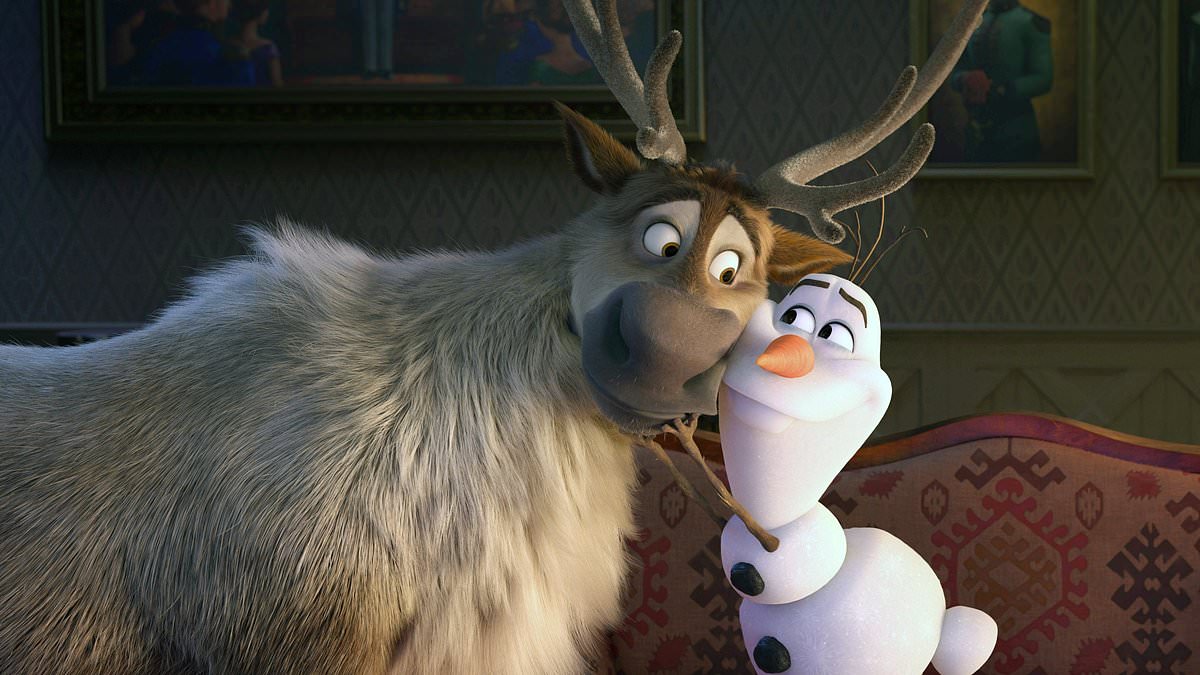
Woke scientists claim that female animals, monsters, robots and magical creatures are 'underrepresented' in children's cartoons. From Frozen's Olaf to Mike Wazowski in Monsters, Inc, many of the most loveable characters in children's cartoons are non-human. But experts from UC Berkeley point out that the majority of these characters are portrayed as male. In fact, in some popular movies, such as Disney's Moana, female non-human characters have no screen time at all. Dr David Bamman, who led the study, said: 'I think our research is so important because it exposes the gender disparity that exists not only within movies broadly, but even within animation.'It shapes the ways children get acclimated to what's considered the norm.' From Frozen's Olaf (pictured) to Mike Wazowski in Monsters, Inc, many of the most loveable characters in children's cartoons are non-human Using computational models, the researchers identified and measured non-human characters, and exactly how mcuh screen time each received. The results revealed that non-human characters are predominantly malePrevious studies have shown that there's a gender disparity in live-action films, with male characters given three times as much screen time as female characters, on average. However, until now, whether or not this applies to non-human characters has remained unclear. To get to the bottom of it, the researchers analysed over 224 animated filmed released between 1937 and 2025. 'The collection is dominated by major commercial animation studios, including 59 movies from Disney (Pinocchio, The Lion King, Zootopia), 46 movies from DreamWorks (Shrek, Kung Fu Panda, The Bad Guys), 26 movies from Pixar (Toy Story, The Incredibles, Inside Out), and 15 movies from Illumination (Despicable Me, Sing), among others,' the team explained in their study, published in arXiv.Using computational models, the researchers identified and measured non-human characters, and exactly how much screen time each received. To classify the gender of these characters, the team relied on the gender of the voice actor.Overall, the results revealed that non-human characters are predominantly male. To get to the bottom of it, the researchers analysed over 224 animated filmed released between 1937 and 2025. Pictured: Slinky from Toy StoryOn average, female animals, monsters, robots, and magical creatures only get around 25 per cent of non-human screentime, while 75 per cent goes to males.However, things are improving.The researchers point out that some recent films like 'Raya and the Last Dragon' and 'Inside Out 2' gave female non-human characters a large share of screen time - nearly 79 per cent and 78 per cent respectively. 'Women and girls (i.e., human characters) have much greater screentime than their live-action counterparts, but non-human characters (e.g., animals) are even more strongly skewed masculine,' the researchers explained.'At the same time, female characters in animation are increasingly sharing the screen together, suggesting that, in contrast to the comparative isolation of early protagonists in Cinderella and Sleeping Beauty, they are gaining a narrative social existence independent of men.'The team did not measure the impact this male-skew might have on children. However, Dr Bamman says 'decades of research show that media shapes how children see themselves and interact with others.'
The Olaf effect: Woke scientists claim female animals, monsters, robots and magical creatures are 'underrepresented' in children's cartoons
Full Article
Original Source
Read the full article at Dailymail →KhanList aggregates and links to publicly available news content. We do not host full articles from third-party sources. Always verify important information with original sources.