
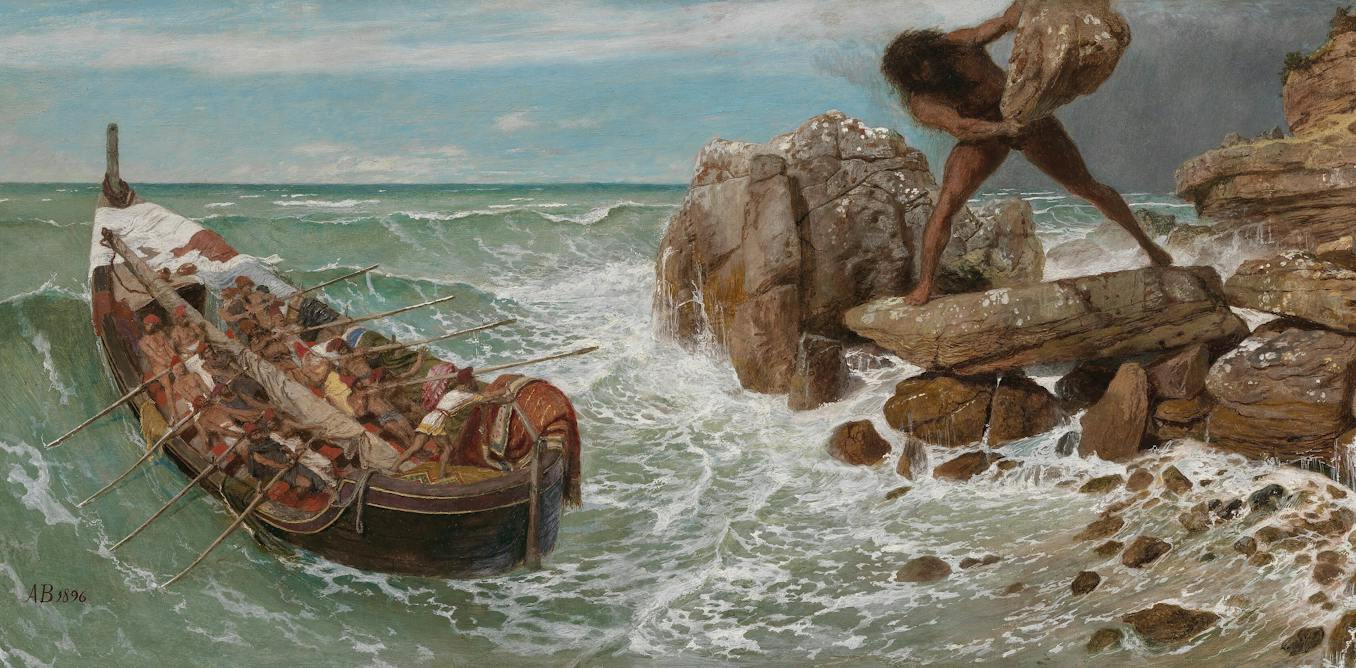
The ancient Greeks are generally thought of as a people at home on the sea. Yet their familiarity with the ocean didn’t stop them from fearing it. Danger and uncertainty always loomed over ancient voyages, and this is reflected in writing from the time. One of the most famous works of ancient Greek literature is, after all, a poem about a man lost at sea for a decade. Homer’s Odyssey is famed for its many monsters, some of which can be read as what scholars have dubbed “ecohorror” – expressions of human fears of the natural world. Monsters themselves are often more than mere misapprehensions of real animals or natural forces. They can be creative “what ifs” – imaginative extrapolations of background cultural fears. The first of the Odyssey’s two main sea monsters, Charybdis, is what initially seems to be a creature causing a gigantic whirlpool, yet the Odyssey hints at another particularly unsettling quality. As Odysseus describes the encounter: We sailed out into the strait, lamenting, for Scylla was on this side, and on the other was Charybdis; dreadfully she sucked down the briny sea water. Whenever she vomited forth again, like a cauldron in a large fire, all boiled over and stirred up, foam fell from above onto the peaks of both cliffs. But when she sucked down the briny sea water, from within she was revealed all stirred up, and roared dreadfully all about the rock, and the ground appeared underneath with dark-blue sand, and pale-green fear took hold of us. Here, we are told that the whirlpool sucks in so much water that the sailors actually seem to glimpse inside. While the poem states that “she was revealed”, Odysseus sees not a monstrous entity, but only the sea floor itself. This eerie absence of physical form – itself immediately followed by the detail of the fear felt by Odysseus and his crew – highlights that Charybdis is an entirely disembodied figure. She’s not a physical creature dwelling beneath the waves but an animate, hungry stretch of ocean itself. This article is part of Rethinking the Classics. The stories in this series offer insightful new ways to think about and interpret classic books and artworks. This is the canon – with a twist. Ecohorror expresses itself here with the enmeshment of a monster with the environment itself by making a monster out of the environment itself. But, rather than being a monster causing a whirlpool, Charybdis is better understood as a monstrous patch of water – a potentially living portion of the environment itself, and one that sparks terror in humans. Becoming prey at sea Across the strait from Charybdis is Scylla. Whereas Charybdis eerily lacks form altogether, part of Scylla’s monstrosity stems from her grotesque body. The poem describes her as having 12 feet, six throats and three rows of teeth in each mouth. It’s a description that anticipates grotesque and unfathomable nature of some modern monsters like those of H. P. Lovecraft. Yet ecohorror expresses itself, not through Scylla’s monstrous form, but in the way that she attacks. As Odysseus describes: We gazed at [Charybdis], fearing destruction, meanwhile Scylla snatched six of my comrades from the hollow of the ship, those who were the best with their hands and fighting. Looking back on the ship, I perceived only the hands and feet of my companions as they were pulled upwards … Scylla devoured them as they screamed and stretched out their hands to me in their horrid struggle. The swiftness with which Odysseus’ crew members are hoisted into the air paints an especially vivid scene. Odysseus in Front of Scylla and Charybdis by Henry Fuseli (1794). Aargauer Kunsthaus Terror is marked by their lamentable screams. Ecohorror here lies in the poet’s explicit inversion of the conventional human engagement with the marine environment. It is, of course, normally fishermen that prey on marine life, hauling them upward on fishing lines to be taken as food. Yet, in this space below Scylla’s cliff-side abode, humans have themselves become the prey for a more fearsome predator of the marine world, to be “fished up” and devoured themselves. Of course, no ancient Greek ever encountered any marine dangers on the exaggerated scale of the threats posed by Scylla and Charybdis. But this did not hinder creative and imaginative cultural expressions of what could be encountered by a wayward sailor. Episodes such as these in Homer’s Odyssey capture and develop the uncertainties surrounding ancient sea travel, from the fear of what might lurk beneath the waves to the anxiety of becoming prey to a marine creature. Beyond the canon As part of the Rethinking the Classics series, we’re asking our experts to recommend a book or artwork that tackles similar themes to the canonical work in question, but isn’t (yet) considered a classic itself. Here is Ryan Denson’s suggestion: Arcadia Nobody alive today can claim firsthand knowledge of what it felt like to navigate the open Mediterranean in the ancient world, nor the sheer terror it inspired. While marine monsters are not unknown in modern literature, ecohorror does tend to take on other forms, derived from our own experiences of nature. Mexican Gothic (2020) by Mexican-Canadian author Silvia Moreno-Garcia is a good example. This novel follows Noemí Taboada, who is venturing to a rural mansion to check up on her cousin, recently married off to one of its inhabitants. Noemí ultimately discovers that the house is haunted, not by ghosts, but by a sentient fungus psychically controlling the aristocratic family living there. Moreno-Garcia’s tale is an ecohorror based on modern fears. None of us have ever encountered a house controlled by a malevolent supernatural fungus. But we all have felt the sudden dread at discovering a spot of mould growing in our home, and the fear that it might spread, or may already linger elsewhere. Ecohorror in Mexican Gothic, as in the Odyssey, serves as a genre to explore creative “what if” scenarios extrapolated from everyday experiences and anxieties. *All translations are the author’s own. This article features references to books that have been included for editorial reasons, and may contain links to bookshop.org. If you click on one of the links and go on to buy something, The Conversation UK may earn a commission.
The Odyssey’s sea monsters are terrifying expressions of ‘ecohorror’
Full Article
Original Source
Read the full article at Theconversation →KhanList aggregates and links to publicly available news content. We do not host full articles from third-party sources. Always verify important information with original sources.