
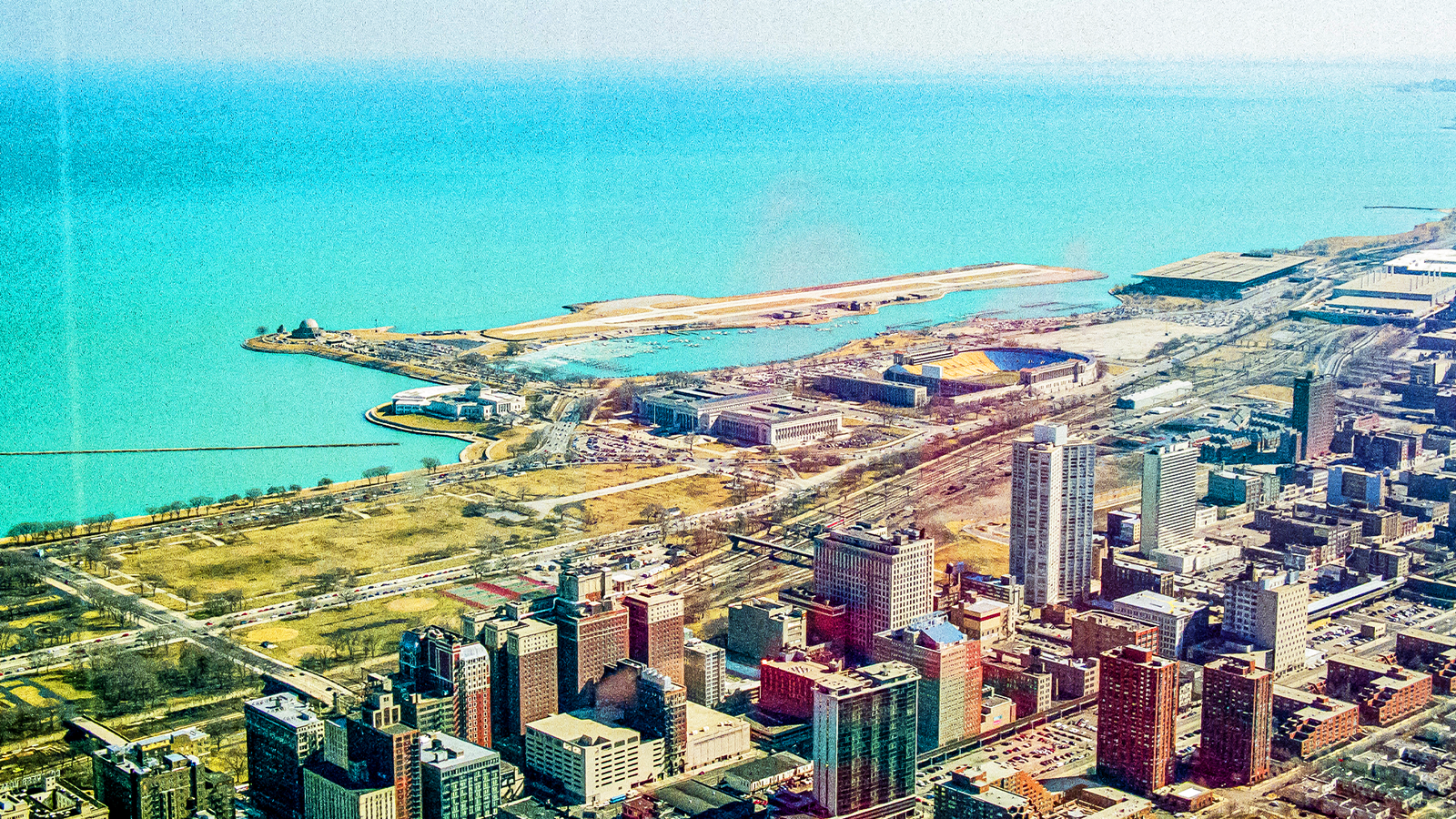
Published Oct 20, 2026, 12:01 PM EDT Aaron is an aviation enthusiast and world traveler with a deep interest in aerospace history and technology. He has traveled around the world numerous times, often incorporating visits to aviation museums and historic aircraft collections into his journeys. A native of New Zealand, he is an expert in aviation and maintains a broad interest in a variety of other subjects. Merrill C. Meigs Field Airport was a single-runway airport in Chicago on Northerly Island, an artificial peninsula in Lake Michigan. The airport operated between 1948 and 2003 and was built to serve general aviation after the Second World War. In the 1950s, it became the busiest single-strip airport in the United States and had an air traffic control tower in 1952 and a terminal in 1961. The airport offered unusually close access to a major American city center, although it didn't host any commercial regularly scheduled passenger flights. In 2003, Meigs saw its runway torn up in the middle of the night in a shocking but decisive unilateral move by the Chicago mayor to resolve a long-running squabble over the future of the airfield. Today, the old field is a nature park and hosts a large concert hall as well as an artificial beach. While the runway is long gone, the airport's buildings, the terminal and control tower remain. Let's revisit the destruction of Meigs Field. The History Of Meigs Field Credit: Sergey Kohl l Shutterstock Meigs Field occupied valuable lakefront land, land that Chicago's political leadership had sought to redevelop for public access to the waterfront. The airport became controversial between those who wanted to keep it as a uniquely convenient downtown airport for general aviation and those who wanted it to become parkland. Some wanted the airport to be incorporated into Chicago's lakefront parks and nature areas. Chicago Mayor Richard M Daley said as far back as 1994 that the land should be closed and the airport returned to parkland. He also supported the development of a new airport near Peotone. The number of flights at Meigs had also declined: in 1990, it handled around 61,000 takeoffs and landings, but by 2002, there were only 32,000 flights. The airport's lease expired in 1996, and Daley briefly closed the airport and padlocked the gates. However, then-Governor Jim Edgar intervened, and it reopened. The debate continued to simmer, but then took another turn after the 9/11 attacks in 2001. In late 2001, Chicago Mayor Richard M Daley reached an agreement with Governor George Ryan for the expansion of the primary O'Hare International Airport in return for Daley committing to allow Meigs to continue operating until at least 2006. The Effect Of 9/11 On Meigs Field Credit: Google Maps Following the 9/11 attacks, Daley thanked federal authorities for acceding to this request to reinstate a no-fly zone over greater downtown Chicago. However, the mayor also said the no-fly zone was only temporary and was "simply not enough to ensure an appropriate level of safety and security to the people of Chicago." He was also angry about what he saw as federal authorities being quicker to restrict airspace over Mickey and Minnie at Disney World and Disneyland than for Chicago. Daley was blocked in Congress from cementing the deal with the former governor into law by Sen. Peter Fitzgerald. Fitzgerald was a staunch opponent of the expansion of O'Hare. At the time, the Chicago Tribune reported that "a pugnacious and unapologetic Daley argued at a Monday news conference, left him free to move on Meigs." However, it wasn't just the post-9/11 security environment and the long-held desire to redevelop the Chicago waterfront. In February 2003, Daley had been reelected with almost 79% of the vote. This seemed to be a mandate that added weight to his position that Meigs should be shut down. The mayor said his next move was partly prompted by fear that homeland security was being too bureaucratic and slow. The Destruction Of Meigs Field Credit: Robin Guess l Shutterstock A secret meeting about the destruction of Meigs Field included city lawyers, mayoral chief of staff Sheila O’Grady, Cortez Trotter, the city’s emergency response chief, and Aviation Commissioner Thomas Walker. It did not include the FAA, Governor Rod Blagojevich, or virtually anyone else. The 9/11 attacks over a year earlier allowed Daley to frame the measure as an attempt to protect the Loop from possible terrorist acts launched by small aircraft. On the night of March 31, 2003, Daley sent construction crews into the airport without any advance notice to the public or aviation authorities. The crews then carved six large X-shaped trenches into its runway. Meigs Field History (Per Chicago Tribune) Date opened 1948 Role General Aviation Operations 61,000 by 1990, 32,000 by 2002 Closed 2003 Park opened 2015 The Chicago Tribune wrote that "Daley launched the surprise closing of Meigs Field at a secret meeting over the weekend where he huddled with top aides to solidify a strategy designed to strike before any opposition could be mustered." This surprise attack on the airport left 16 private aircraft stranded on the tarmac, although Daley said those could be moved by using a narrow taxiway left intact. Barring that, he said they could be dismantled and trucked out at the city's expense. In the end, they were flown out using the taxiway. The FAA and city established procedures that allowed the aircraft to depart under restrictions. The aircraft were progressively flown out over the next few days. The End Of The Line Credit: Hank Shiffman l Shutterstock The midnight strike on the airport was shocking, but it was generally accepted. The air traffic controller at Meigs, Mike Daffenberg, only found out the airport was shut as he drove to work in the morning. He said that "I felt I was laid off by the radio this morning," with the FAA and even many of Daley's opponents acknowledging that the mayor had the authority to shut the airport. The FAA was disappointed about the closure of the airport, saying it would increase the pressure on O'Hare and Midway. Plenty of people were incensed by the unilateral shutdown. John Carr, president of the National Air Traffic Controllers Association, said that "Mayor Daley bulldozed his way into aviation history this morning by destroying a national treasure." Carr also called it the "epitome of arrogance." People could express their anger, but this was the end of Meigs Field, and it would be transformed into a park. Courts eventually ruled that the city was within its rights to close the field. All the same, the FAA fined Chicago $33,000 for closing an airport with a chartered instrument approach without giving the required 30-day notice. At the time, this was the maximum fine allowed. The city eventually paid the fine and repaid $1 million in FAA Airport Improvement Program funds it had used to demolish the airfield and build the nature park. Northerly Park Since Meigs Field Credit: Carlos Yudica l Shutterstock Twenty years later, the Chicago Sun-Times wrote a piece looking back. By then, Meigs Field was long gone and had been transformed into Northerly Island Park, which had opened in 2015, an event Daley didn't attend. By the time the park opened, the mayor of the city was Mayor Rahm Emanuel, and Daley wasn't invited, despite him fighting for the park for so many years. Since opening, the park has struggled to become popular. The Park District, along with the Army Corps of Engineers, spent over $10 million to develop the 40-acre nature area on the island over the last two decades. Juanita Irizarry, executive director of the nonprofit advocacy group Friends of the Parks, said that the park's transformation plan was "never fully actualized" and that the space is incongruous. She said that "we don't think it's got the right set of components," adding that if you want to have a natural area, it shouldn't be next to "mind-numbingly loud concerts" with the Huntington Bank Pavilion so close. A plan was announced in 2010 to convert Northerly Island into an urban oasis of sorts, complete with scuba diving and campsites, although it lacked funding. Since then, ambitious redevelopment plans seem to have stalled. In 2026, the city allocated $600,000 for modest improvements, including a multi-use pavilion, additional pathways, an adaptive boat launch, fencing to protect sensitive habitat, and native plantings. Remnants Of Meigs Field At Northerly Island Today Credit: Marcus E Jones l Shutterstock The Chicago Sun-Times notes that "on a recent weekday afternoon, a few people biked or walked along a path at Northerly Island, but they were far outnumbered by geese and seagulls." It also says it's hard to imagine there ever was an airport there. Besides the overall airport-shaped island, there is one very clear reminder of the old airport. Visitors can still see the closed but standing air traffic control tower. Not only that, the Northerly Island Visitor Center is the former Meigs Field terminal building, first built in 1961 and designed by Chicago architects Consoer & Morgan. The terminal was repurposed as a visitor center, and it is still referred to as 'Terminal Building' by the Park District. The airport closure wasn't the only brush with death the building has experienced. Indeed, in 2023, the old terminal suffered a fire that closed it for 18 months before reopening again in April 2025 after restoration. The northern parts of the island now host the Huntington Bank Pavilion, the artificial 12th Street Beach, and the Adler Planetarium. The Adler Planetarium predates the closure of Meigs Airport. Northerly Island Park occupies the southern section of the old airport, including the terminal and control tower. Much of the old runway is now a lake or lagoon.
The Night Chicago Destroyed Meigs Field: The 2003 Runway Bulldozing Explained
Full Article
Original Source
Read the full article at Simpleflying →KhanList aggregates and links to publicly available news content. We do not host full articles from third-party sources. Always verify important information with original sources.