
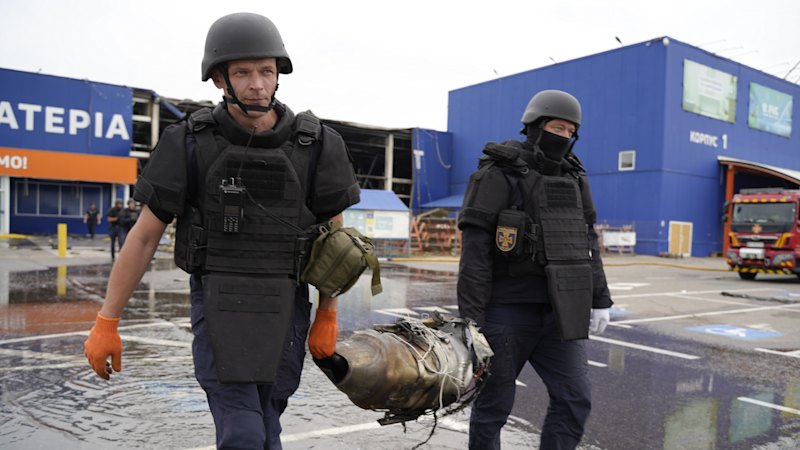
September 13, 2026 — 9:49amKyiv: The shocking new weapons in the war on Ukraine are deepening fears over civilian deaths when major cities seem defenceless against the speed and scale of the latest Russian attacks.Drones fitted with jet engines are radically changing the war, slamming into targets at speeds of about 600km/h and outrunning the interceptors designed to stop them.Ukraininan police officers carrying the wreckage of a Russian drone in Kharkiv last month. The strike that killed a 40-year-old man and injured five others was carried out by a Russian Geran-4 jet-powered drone equipped with a camera.Global Images Ukraine via Getty ImagesThe result is a new terror for Kyiv and other cities, according to the Ukrainian officers who defend the nation against relentless missile and drone attacks.“Kyiv is being terrorised day and night with the jet-powered drones from Russia,” said Colonel Skurativskyi, chief of the air defence directorate of Ukraine’s 7th Rapid Response Corps.Russia unleashed the new drones in massive numbers over the past month, setting off air raid alerts throughout the day and changing the tempo of a war once dominated by overnight missile strikes.Daily life continued on the streets of Kyiv in recent days, as many residents chose to stay out at a bar or cafe while checking their social media channels to gauge the scale of the danger, particularly if the attack was likely to be a ballistic missile rather than a drone.Men stand near a fire after a jet-powered drone struck an office building in the Podilskyi district of Kyiv on Friday (Ukrainian time).SOPA Images/LightRocket via Getty ImagesThe alert on Friday night, for instance, did not stop young people gathering in a park for drinks. The alert on Saturday morning did not deter an old man from walking his dog in the light rain on the streets near the city’s historic Saint Sophia cathedral.But the danger was real, and deadly, in other parts of the city and country. On Friday, Russian drones hit two petrol stations in Kyiv, killing two people and wounding six. A drone strike on an apartment building in Zaporizhzhia injured two civilians, including a young boy. An attack in Dnipro wounded a dozen people.On Saturday, a Russian strike on a grocery store in the town of Zvyahel, west of Kyiv, killed two people. In the southern city of Odesa, the local governor said 37 were injured in overnight strikes.Earlier drones, including the Shahed models designed in Iran and shared with Russia, came with propeller engines, enabling them to reach speeds of about 180km/h.Firefighters work near the scene of a fire after a jet-powered drone struck an office building in Kyiv’s Podilskyi district, on Friday (Ukrainian time).NurPhoto via Getty ImagesUkraine developed drones to counter these threats, although the country remains desperately short of the Patriot interceptors it needs to stop Russian missiles.Now the jet-powered drones are finding a way through Ukraine’s air defence – and forcing a debate over how quickly the armed forces can develop faster interceptors to destroy the flying bombs before they kill.Russia is intensifying the danger on a rapid scale, with the Ukrainian armed forces telling the BBC that jet-powered drone attacks rose from 350 in June to 1600 in July and 2800 in August.Skurativskyi expressed confidence on Saturday that Ukraine would find a way to counter the danger. Speaking to the Yalta European Strategy (YES) conference in Kyiv, he said the danger was not restricted to Ukraine alone.“Jet-powered drones are not just a problem for Ukraine but for the entire civilised world,” he said.“They [Russia] have this lethal tool, this kind of weaponry, that they can apply not just against us but against other countries as well.“The good news is that Ukrainian Armed Forces are on alert all the time.”Skurativskyi argued that other countries should be concerned about the new jet-powered design after Romania, Poland and Moldova experienced Russian drone incursions in recent weeks.German authorities named Russia as the source of an explosive drone at Leipzig airport that failed to detonate when it struck a transport aircraft on August 4.Behind the shift to the faster drone is a Russian deal to buy small jet engines from Chinese suppliers in massive volumes.The main supplier of the turbojet engines is said to be Telefly Telecommunications Equipment, based in the southern Chinese city of Shenzhen, according to The Wall Street Journal.The impact is felt across Ukraine because people know their armed forces lack the technology to stop jet-powered drones and do not have enough Patriot interceptors to bring down ballistic missiles.“Ukraine badly needs air defence,” admitted Yuriy Fedorenko, a commander of the Achilles drone unit in the Ukrainian Armed Forces and a member of the Kyiv City Council.Air defence officer Artem Skurativskyi (right), a colonel in the Armed Forces of Ukraine, speaks at the Yalta European Strategy conference in Kyiv on Saturday (Ukrainian time). Victor Pinchuk FoundationFedorenko told the YES conference that this danger intensified the need for international help, especially with the supply of missile interceptors.“Ukraine lives on the brink,” he said. “Please help us to survive.”Ukrainian President Volodymyr Zelensky, addressing the conference by video on Friday, said the country was working with European governments to develop air defence systems that could reach test mode as soon as December.Even so, the immediate need is the supply of more Patriot systems, given that it can require two interceptors to take down one ballistic missile.“Today, Russia produces 140 ballistic missiles per month. According to NATO standards, to down 140 missiles you use 280 anti-ballistic interceptors,” Zelensky posted on X.“But you will never get 280 Patriot missiles per month. Even getting 100 missiles is a huge challenge. And this is what I want – to have 100–120 interceptors for the difficult, cold months ahead.”But global stocks are low because of the Ukraine and Iran wars. Defence giant Lockheed-Martin produces about 600 Patriot interceptors per year and is scaling this up to 2000 over the next seven years.Ukrainian company Fire Point, which developed the successful Flamingo missile now striking targets deep inside Russia, is cautious about when it can produce a missile defence system to fill the gap.The company’s chief executive, Iryna Terekh, announced the Freyja project for a missile interception system with European partners in July, but it would take until next year to reach the test phase for the prototypes.“Hopefully, the first test interception will be conducted by the end of next year,” Terekh told the conference.For the people of Ukraine, the advent of new Russian weaponry brings more fear and suffering, but there is no easy solution to the shortage of Patriots, the time required to develop the Freyja and the immediate threat of the jet-powered drones.For now, the answer in Kyiv is to escalate missile and drone strikes on Russian facilities that help produce Russian weapons – such as chemical plants and warehouses. Ukraine also targets oil refineries, forcing a supply crisis at petrol stations.Kyrylo Budanov, the top aide to Zelensky and a key negotiator on potential peace deals, said the long-range strikes would continue to put pressure on Russia. The objective, he told the YES conference, was to ensure Russian President Vladimir Putin would eventually accept the need for a peace agreement.“Sooner or later, it will bring the desired effect,” said Budanov.Meanwhile, high-speed drones will menace Ukrainian skies. And the air raid alerts will continue to go off, day and night.Get a note directly from our foreign correspondents on what’s making headlines around the world. Sign up for our weekly What in the World newsletter.From our partners
The new terror stalking Kyiv day and night
Full Article
Original Source
Read the full article at Smh →KhanList aggregates and links to publicly available news content. We do not host full articles from third-party sources. Always verify important information with original sources.