
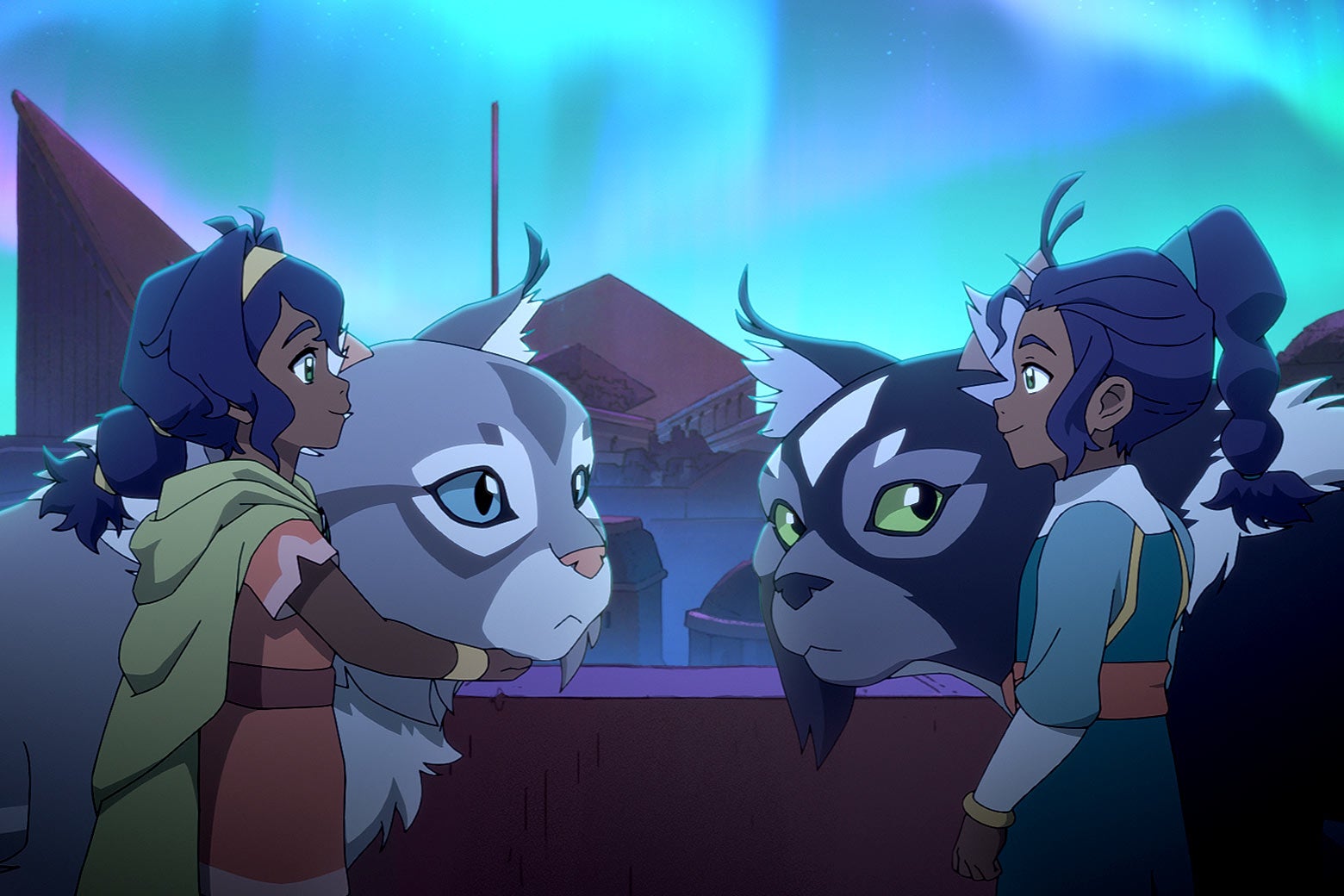
Television Avatar: Seven Havens is set 225 years after the events of The Legend of Korra. By Enter your email to receive alerts for this author. Sign in or create an account to better manage your email preferences. Unsubscribe from email alerts Are you sure you want to unsubscribe from email alerts for Nadira Goffe? Oct 09, 20265:45 AM Paramount+ This article contains spoilers for the first three episodes of Avatar: Seven Havens. It’s been a long time coming, but the beloved animated Nickelodeon series Avatar: The Last Airbender is back, (yes, again), this time with a new series, Avatar: Seven Havens. The original show—which aired from 2005–2008, followed by a sequel, The Legend of Korra, from 2012–2014—is set in a fictional world where people are gifted with the ability to control, or “bend,” nature’s four elements. Despite its popularity among its legions of dedicated fans, the Avatar: The Last Airbender (aka ATLA) franchise has struggled over the years. The Legend of Korra proved divisive for reasons both rational and irrational. ATLA creators Michael Dante DiMartino and Bryan Konietzko pulled out of a number of live-action adaptations of the IP, dissatisfied with the creative direction of the projects. When the series landed on Netflix during COVID lockdown, reinvigorating demand for more stories in the Avatar world, Nickelodeon finally established Avatar Studios, a new content division expressly designed to create new works in the world of ATLA. Avatar Studios promised a number of future releases, including films—the first of which, a sequel film about adult Avatar Aang taking place between the events of ATLA and Korra, was infamously leaked online—and more iterations of the series, with each new installment following a new Avatar. The long-awaited fruit of that journey, Seven Havens, has now debuted with its first three episodes on Paramount+ after its 2027 release date was abruptly moved up post-leak. So, after all that mess, one question remains: How is Avatar: Seven Havens? Is this highly anticipated sequel series as good as its predecessors, or should Avatar fans prepare themselves for diminishing returns? After screening six of the season’s 13 episodes, I can now report: It’s … certainly a series. Avatar: Seven Havens takes place 225 years after the events of Korra, and, in that time, society’s opinions on the Avatar—the “chosen one” who can bend all four elements, and who is reincarnated over and over again to keep the world in balance—have done a complete 180. In Korra and Aang’s eras, the Avatar was seen as society’s savior from ever-impending evil and doom. In Seven Havens, however, the legend of the Avatar has been tainted by Korra, who is known by all as the person to blame for what happened during an unexplained event called the Cataclysm, which shattered both the physical and spirit worlds. The Cataclysm led to society forming the seven different Havens, protected by a bending Brigade that trains young benders to volunteer as defenders of their home. Our story centers around Pavi (Saheli Khan), a 9-year-old girl and amputee who, when we first meet her, is unhoused and roaming the streets of Ellora with her pet cat-monkey, Geet (Dee Bradley Baker). Pavi, aware that she can bend all four elements, is pretty sure that she’s the Avatar, but is in denial about it, for fear of persecution. She’s in for a rude awakening when not only are her suspicions about being the Avatar confirmed, but the confirmation saddles her with twice as much trouble than she initially bargained for. By that I mean: She discovers that she has a long-lost twin sister, Nisha (Aishu Devan), who—it’s revealed in the first episode—is also the Avatar, making them the first-ever twin Avatars. They have no memory of each other, their parents, how they were separated, or how Pavi lost her leg. As the twins begin training in secret—hidden, protected, and overseen by a group that sees the hated Avatar as their misunderstood future salvation—they not only have to defeat an unknown evil, vaguely dubbed “the entity,” that begins to threaten Ellora, but they must also try to remember their forgotten past in order to do it. This is all well and good, but some key changes to the Avatar IP take the luster out of what made Seven Havens’ predecessors so good. For starters, the younger slant of the show complicates the watching experience. Though the twins and Aang are only three years apart in their respective series, the difference between the Avatars is noticeable. Pavi and Nisha have to deal with so much more, personally, than Aang or Korra did. Pavi has to contend with her disability and the fact that she’s years behind Nisha in training, while both girls also have to reckon with their forgotten past, a society that hates the Avatar, and what it means to be a sister and share the title of the Avatar. To have them dealing with so much, but at a younger age, at which they’re more prone to crying, speaking childishly, and throwing the occasional frustrated tantrum, can cheapen the gravity of what they go through, at times. And—I’m sorry, I’ll say it!—it can be annoying to watch, even as someone who loves kids and fully understands that these are normal kid behaviors. But all of this isn’t as disappointing as what so far appears to be a more fundamental change in the show: the politics. One of the most impressive things about the Avatar series is how the first two installments deal with harrowing elements of global politics that can be difficult to speak to children about. Aang’s series was explicitly about genocide, and Korra’s was about the struggles of a modernizing society, and how those wrinkles can breed unrest and even terrorism. Those are the mature themes that set ATLA and Korra apart from other animated series and made them so beloved to fans well into their teens, 20s, and 30s. So far, I can’t entirely tell you what the central political tenets are in Seven Havens. The show could try to pass commentary on many things, like a general sense of unlearning what you’ve been taught, but it’s hard to say how it will play out and how political the show will be. Still, there’s potential: In the very first episode, I was struck by an early scene of a mother who is reluctant to give up her young son, a bender, to the Brigade. Though she ultimately submits—and, to be fair, it wouldn’t be surprising if the Brigade weren’t all it promised to be—the opportunity to comment on the militarization of children and young adults could be a massive missed opportunity for Seven Havens if it doesn’t expand upon it. Despite these issues, Seven Havens is not an empty watch by any means. Being back in the world DiMartino and Konietzko created—albeit a barren, apocalypse-style version of it—still scratches the itch for people who, like me, are overly nostalgic for one of the most well-written programs of their youth. And the show has its humor, though neither Korra nor Seven Havens manages to be as funny as the original Avatar seasons. Plus, Seven Havens makes some fun updates fitting for a release in the era of the culture wars. For starters, everything is more queer-coded and feminized now, something that famously began with Korra, which ended with the start of a romance between two female characters. In Seven Havens, every young guy in the show has long hair and a dangly earring, and at least one same-sex duo seems to be more than friends. The show is more inclusive of characters of varying skin tones, and, with Pavi, even foregrounds disability representation. Where the original Avatar series nodded to a sort of fantasy pan-Asian world, Seven Havens makes more specific references to different Asian cultures, particularly through cuisine. In the first episode, for instance, one character bakes fresh kachoris, while another claims that his favorite dish is kimchi-jjigae. That’s a specificity that isn’t often seen on mainstream American shows, and it’s nice to ground Seven Havens in these details. Pavi and Nisha’s journey will unfold over two seasons and a total of 26 episodes, so there’s plenty of room for the series to grow and develop, hopefully in the right direction. My early forecast is that Seven Havens won’t be the refined Avatar offering we’re used to, but, at the end of the day, it will still be an iteration that ATLA fans will be grateful for—at the very least, because its existence means that there may be more Avatar works in the pipeline, with each one offering a taste of the world we fell in love with so many years ago. TV Fantasy Animation
The New Avatar: The Last Airbender Show Is Finally Here. How Does It Stack Up to Its Predecessors?
Full Article
Original Source
Read the full article at Slate →KhanList aggregates and links to publicly available news content. We do not host full articles from third-party sources. Always verify important information with original sources.