
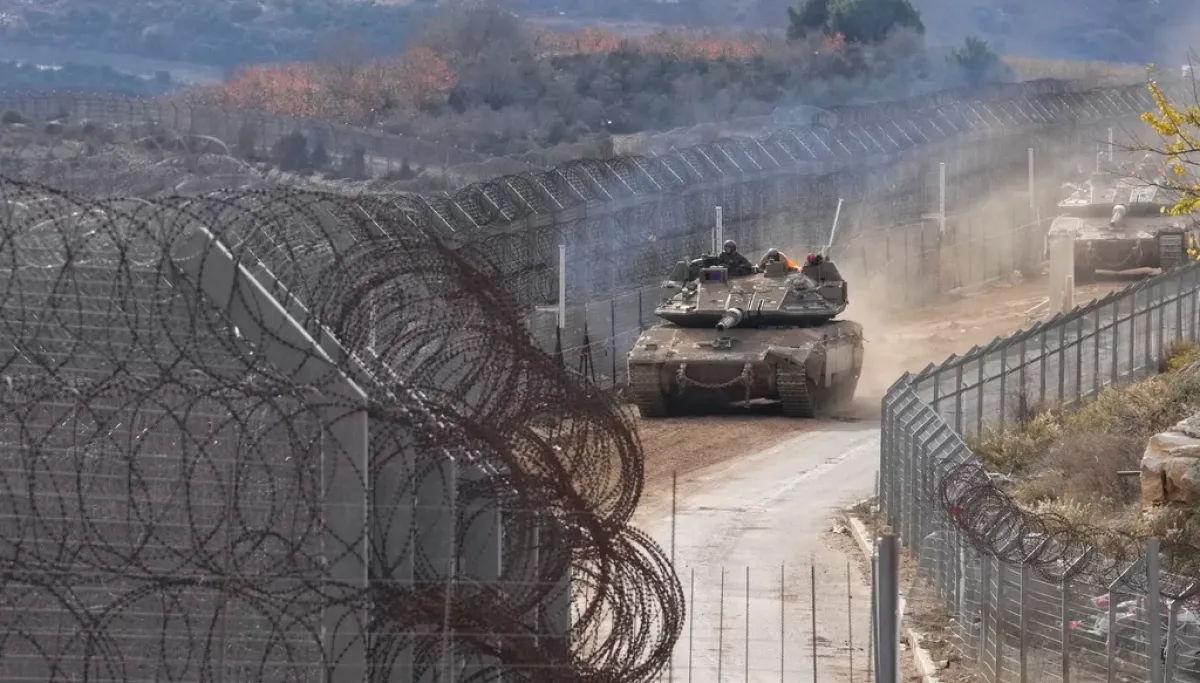
In Focus delivers deeper coverage of the political, cultural, and ideological issues shaping America. Published daily by senior writers and experts, these in-depth pieces go beyond the headlines to give readers the full picture. You can find our full list of In Focus pieces here.Over the weekend of Aug. 23, Hamas launched kites from Gaza, across the border, an area called the Gaza envelope, and into Kibbutz Nahal Oz. Terrorism by kites is how the arson terrorist attacks started in 2018, when Hamas used to launch kites carrying incendiary materials that would then burn the farm fields upon landing. Hamas terrorized the southern border farming communities through these kites until the Oct. 7, 2023, massacre, when it invaded and killed, burned, raped, and took civilian hostages. Members of these communities are still traumatized from that day — they are asking the Israeli military to deal seriously and immediately with this renewed threat.On a recent trip to Israel, I visited Kibbutz Nahal Oz, one of the kibbutzim terrorized by Hamas on Oct. 7. The leader who met with our group, a teacher in the community school who holds a master’s degree in Middle Eastern studies, walked us step-by-step through the horrifying events that unfolded that day and the effect it has had on their community. She said that, for many years, Palestinians from Gaza with work permits came into Israeli territory and worked together with them in these farming communities. She said they thought they could trust them, but not long before the attacks, they caught Palestinian workers taking pictures around the kibbutz. In hindsight, they realized that the way the attacks were executed meant Hamas terrorists had advanced intelligence on the location of the community armory, how many houses had dogs, the location of the guard station and the head of security, their schedules, and so on. Never, she said, did she think that her community would be betrayed by these people whom she had thought of as friends over the years. The savagery of the Hamas terrorists extended even to livestock — they set the cows on fire, and trapped the calves within a ring of hay bales that were set on fire.An Israeli army tank maneuvers near the “Alpha Line” that separates the Israeli-annexed Golan Heights from Syria on Wednesday, Dec. 11, 2024, in the town of Majdal Shams. (AP Photo/Matias Delacroix) A few days after this, our group was in Northern Israel atop Har Adir Observation Point and Memorial overlooking the Lebanon-Israel border, where we received a security briefing. Har Adir is a memorial to the soldiers who fell in the 2006 Lebanon War. The border communities in the north suffer from Hezbollah, just as the communities in the south suffer from Hamas terrorists. This Iran-backed terrorist group has embedded itself in Lebanon and uses southern Lebanon as its launch site.For years, Hezbollah has used its position to terrorize Israeli northern communities. It also uses Lebanese Christian villages from which to launch rockets, so that when Israel retaliates, Hezbollah can use the attack on Christian villages in its worldwide PR war against Israel. Because of a weakened Iran, the Israeli military has been able to slowly do what the Lebanese army and the United Nations Interim Force in Lebanon, which were tasked under Resolution 1701 in 2006 to remove weapons and destroy tunnels, would not do.Finally, on Sept. 3, the Israeli military cleared out the expansive Hezbollah base underground the Ali al Taher Ridge. How long this quasi-peace will last in the security zone before Hezbollah regroups and starts terrorizing the north again, nobody knows. But one thing is known: The Lebanese army is 40%-50% Shiite Muslim whose sympathies lie with Hezbollah, not with the Lebanese people, and certainly not with the Israeli communities across the border.The Israel-Syria border in the Golan Heights is yet another possible front for Turkish-backed terrorists. On our drive in Galilee, our guide pointed out the villages in the Golan. Before Israel took control of the Golan in 1967, our guide said the border communities suffered from Palestinian Fatah terrorist attacks, after Israel took the Golan Heights, Iran and Hezbollah used the Syrian controlled area to continue the harassment and terrorization of these communities.On March 25, 2019, President Donald Trump, by proclamation, recognized the Golan Heights as part of Israel, after which, our guide informed us, the border communities had a little reprieve. Unfortunately, foolish and subversive comments from U.S. Ambassador Tom Barrack that the Golan Heights are “occupied” by Israel can reignite the terrorization of the villages in the area.In the movie Golda, Prime Minister Golda Meir, played by actress Helen Mirren, picks up the phone to call Secretary of State Henry Kissinger to inform him of the surprise attack on Yom Kippur by Egypt and Syria. She begins with, “We’ve got trouble with the neighbors again.” That line has stood out to me because that word, neighbors, carries so much of the story of the people of Israel and those who surround them.DANGEROUS, RADICAL, AND WEIRD DEMOCRATS: TIM SCOTT’S MIDTERM CONVENTION WARNING TO VOTERSEven in 2026, Israel is willing to consider the surrounding Arab states their “neighbors.” I’m not naive enough to think that everyone around them could be content with an Israeli state, but it is telling that the attacks themselves in recent decades have almost exclusively been funded and stoked by Iran. The elimination of Iran as a political and financial actor could have calmed some of this down.Unfortunately, on the horizon is Turkey, the “new Iran,” forging a “ring of fire around Israel.” Only two months ago, Turkish Foreign Minister Hakan Fidan said Israel was a “burden that humanity can no longer bear.” I don’t think it is a stretch to say that Israel might have trouble with the neighbors again.
The never-ending terrorization of Israeli border communities
Full Article
Original Source
Read the full article at Washingtonexaminer →KhanList aggregates and links to publicly available news content. We do not host full articles from third-party sources. Always verify important information with original sources.