
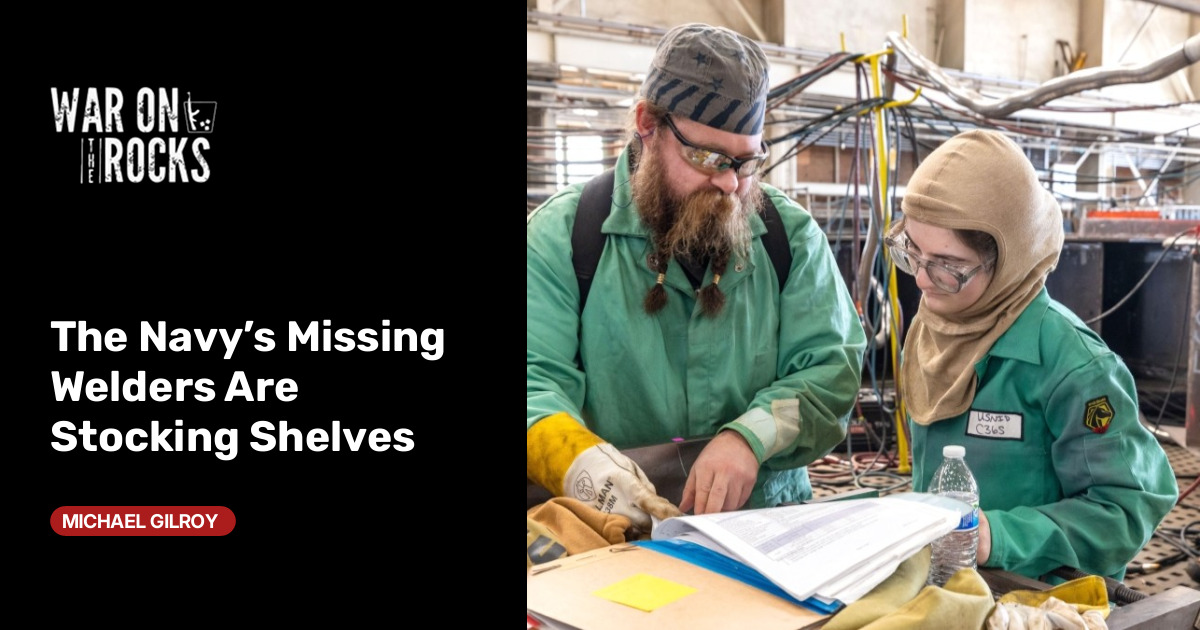
The U.S. Navy’s May 2026 shipbuilding plan, signed by Acting Secretary of the Navy Hung Cao, uses the word “innovative” eight times. The plan applies that word, among other things, to the Columbia-class submarine, an acquisition strategy for the medium landing ship, and new approaches to running the public shipyards. Elsewhere, the shipbuilding plan notes that recent increases in wages at Electric Boat and Newport News Shipbuilding got both yards to their required 2025 hiring rate and cut attrition by two to five percent.While added funding is a welcome salve to the Navy’s well-known problem of shipyard worker shortages, it is insufficient as a long-term solution, and hardly innovative. The yards are still 174,000 workers short. Recent wage increases only reached people already in shipyard jobs, not the larger pool who never applied and cannot afford unpaid months of training. What nobody has tried yet is recruiting a cashier at a mall forty miles away with the same money. Reaching that cashier or other would-be shipyard workers will require an intermediary that pays them during the intermediate training period between jobs, and no such broker yet exists.The Navy can close this gap by measuring programs on whether they reach new entrants, redirecting advertising money to pay trainees while they learn, and letting each shipbuilding region name one accountable intermediary to broker that training.Sign Up for Our NewsletterForty Miles from the YardThat the Navy needs shipyard workers is not in dispute. In April, the Government Accountability Office told a House panel that none of the seven yards building the Navy’s ships was positioned to meet its delivery goals, and it named the workforce as one of the two reasons, alongside the yards’ own infrastructure.To be sure, the pipeline the Navy and the Pentagon’s acquisition and sustainment office have built has made meaningful progress. The six regional Talent Pipeline Programs have placed more than 15,000 workers with more than 500 suppliers since 2021, and the Southeastern New England Defense Industry Alliance has trained more than 10,000 people for the shipbuilding base. Newport News’s Apprentice School has trained shipbuilders since 1919, about 200 a year.The primes, for their part, are acting as typical incumbents. Huntington Ingalls Industries announced in April 2025 that it would step back from hiring green shipbuilders and pay for experience instead, and by October, its chief executive was crediting a Navy-funded summer wage increase at Newport News with more experienced hires and lower attrition. In March 2025, Brett Seidle, then the Navy’s acting acquisition executive, told the Senate that first-year attrition across the yards runs 50 to 60 percent. For a yard with hulls to deliver, bidding for the experienced tradesman and abandoning the entry level is the rational move. The low end of the market is now up for grabs.Who Wants It?In May 2025, the Bureau of Labor Statistics counted 3.09 million cashiers earning a median pay of $33,180, 3.85 million fast-food and counter workers at $32,150, and 3.90 million retail salespersons at $37,310. The same survey put a welder’s median pay at $53,750, a machinist’s at $58,750, and an industrial machinery mechanic’s near $64,500. A cashier weighing an upward move into a new industry would likely look at the first-year wage, which at Newport News, the largest yard of the country’s largest shipbuilder, now starts near $57,000 for an entry-level welder after the raises the Navy funded last year.Thanks to raised wages, the pay at the end of the training program is no longer the problem, but getting there means quitting a job and going months without a paycheck. The $24,000 difference in pay may not be reachable for someone living paycheck-to-paycheck, if he or she has to skip shifts to attend daytime classes. What that worker could use is a three-and-a-half-hour class at five in the morning, so the paid shift is still waiting when the class lets out.Any community college could offer that class next term, and yet none do, because states pay community colleges by the head. Thirty-seven states fund their two-year colleges on a count of full-time-equivalent students, and a five o’clock section for a dozen working adults does not move that count.The Navy’s workforce money has the same blind spot. It pays for advertising, including about $100 million in one year on the submarine recruiting campaign. It also pays for classroom seats, 5,500 new ones in 2025 by the Navy’s own tally, and for placement pipelines, 15,000 workers placed through six regional programs the same year.Even the most generous of these efforts, which covers tuition, housing, and transportation for four months in Danville, leaves the student to cover everything else. Nothing in that list replaces the paycheck a working adult gives up to enroll.The Business Nobody RunsA product built around a paid shift and a wage while learning exists in pieces. Assembling them requires a regional “intermediary” that changes who is connected to whom and who carries the risk. In workforce development, that word usually means an apprenticeship sponsor, but other organizations could fill that role. A supplier association could do it, or a chamber of commerce, or a college that decided to change its business model, or an outfit that does not exist yet.On one side of this intermediary sit employers, chiefly the second- and third-tier suppliers too small to run an academy, and on the other sit working adults. What the intermediary runs between them is an eight-to-fifteen-week paid stand-up, on a shift schedule, that ends in a job with an agreed-upon wage. The harder work sits around the mechanics of that stand-up, from pooling the two welders one small shop needs with the eighteen the rest of the county needs, through screening the applicants and paying the worker from the first day, to carrying the risk when a placement falls through. No college is paid to do that work, and no second- or third-tier supplier is large enough to.The evidence that such a business can raise earnings is real but uneven. WorkAdvance was a test of four programs, each of which trained people for jobs in one industry and then placed them. MDRC (formerly Manpower Demonstration Research Corporation), in its ten-year results, found that one program increased participants’ earnings by 32 percent after a decade, while the other three showed no effect by year ten. Lawrence Katz and colleagues found that what made the difference in the sector programs that have worked was the work around the classroom, screening up front, and clearing the way into high-wage sectors. Registered apprentices averaged about $80,000 in their first year out.But the evidence above is about the wrong person. WorkAdvance and the other sector programs enrolled the unemployed or the young. The apprentices drew a wage only after the trade had hired them. The Employment Training Panel is the other nearby case: a company class for its current staff. Two years later, those sites had about 22 percent more employees than similar companies that got no money. That number is about the size of the company, not the worker’s pay, and those workers never left. No one has yet followed an adult who quits a $34,000 job. That is the trial the Navy should run this year.Half a Paycheck ShortWorkforce Pell, which went live on July 1, extends the Pell Grant to short training programs. Pell pays the tuition half of what a worker needs to transition to a shipbuilding career, but the other half, the paycheck during training, still has to be pieced together from sources that do not talk to one another. Part comes from employer payroll, and part could come from state programs such as North Carolina’s Incumbent Worker Training Grant, which reimburses employers for training workers already on the books. An intermediary is the only party that sits where both can be brought together.There are potential risks in paying students to study. Community colleges are already building eight-week programs to capture the new Workforce Pell dollars, so one question is whether an enrollment-funded college will pay its instructors to teach at early or odd hours to accommodate working students. The yards’ first-year attrition record is bad, although that number was set by nineteen-year-olds with no training and no dependents. A thirty-four-year-old with a mortgage who just added $24,000 to the household, however, is a different hire, and no one has recruited such workers into college training programs in any number.In addition, if shipyard pay fell behind other opportunities a few years into a new shipyard worker’s career, an intermediary could end up training people the yards cannot keep. Seidle told the House last year that a shipyard job once paid three or four times what comparable work paid and now pays 1.2 to 1.4 times as much. Only the Navy can mitigate this risk, and the recently announced raises mentioned earlier are a good start.The intermediary faces another big risk if and when many new hires quit, often in the first year. The Navy has already counted those quitters in its 174,000-worker shortage. An intermediary built to address this problem would have to pay a worker through training and stay in touch through the first year. The president of Newport News Shipbuilding has said that a shipbuilder who lasts the first year can double the entry wage within two.The Buyer Sets the TermsWhat the Department of the Navy could do about any of this is modest, but the Navy is the buyer, and the buyer gets to set the conditions. The first fix could be a reporting rule requiring every workforce effort the Navy funds, and every contractor or office it pays to recruit or train, to report the prior-year earnings of the people it places. State workforce agencies already hold quarterly wage records for nearly every worker, and the Navy need only ask for the year before enrollment as well as the year after. The Labor Department scores every workforce participant against those same records today, so the Navy would be asking for data that already had been collected. These figures would help the Navy ascertain who the program actually reached. A program whose placements earned $50,000 the year before enrollment poached welders from elsewhere. A program whose placements earned $33,000 the year before reached the more meaningful target, such as the cashier at the mall, or others making a career change from a lower-paying job.The second change is to pay the worker while he or she trains. Workforce Pell, as noted, already covers classroom costs. However, nothing covers the fifteen weeks of wages the worker gives up, so the Navy can offer a “wage bridge.” Fifteen weeks at forty hours and $18 an hour comes to about $11,000 a worker. For comparison, the Navy’s recruiting campaign for the submarine industrial base spent about $100 million in Fiscal Year 2023 to produce roughly 9,700 hires, about $10,000 a hire once the half who quit in the first year are counted. The Navy already spends a training paycheck on every recruit. It just spends it on advertising.This bridge money would come with the same strings Workforce Pell already attaches to tuition money. A program keeps its federal funding only if 70 percent of its students finish, 70 percent are placed in jobs, and their earnings exceed what the training cost. A wage bridge held to those same conditions would pay only for programs that produce shipbuilders.The third change would be to let each region name its own intermediary, hold it to placement and prior-year earnings, and let it serve the supplier tier as well as the yards. This is what a defense manufacturing region designation would give the Navy. A region is a yard, the suppliers that feed it, and the colleges, workforce boards, and civic institutions within commuting distance of both. The right intermediary would be whichever of those institutions already convenes the employers, or could. In southeastern New England, that might mean the Southeastern New England Defense Industry Alliance. In New Orleans, it might be a body like Greater New Orleans, Inc., the regional economic development organization. In San Diego, it could be the city itself. These are examples, but the Navy does not need to choose. It needs to name the region, set the conditions, and let the region pick the body that fits local conditions.For thirty years, the Navy’s training system for shipyard workers has refined a product for people already inclined to enroll. The Navy’s next thousand welders are not in that market. They are at the register in a mall forty miles away, and still nobody has made them an offer.Write for Cogs of WarMichael Gilroy is vice president for workforce development at the Center for Regional Economic Competitiveness in Arlington, Virginia, where he supports the Department of Defense’s manufacturing workforce programs. A retired Army officer and graduate of the Naval War College, he previously directed workforce programs at both the Departments of Labor and Defense.Image: Wendy Hallmark via Naval Sea Systems Command.
The Navy’s Missing Welders Are Stocking Shelves
Full Article
Original Source
Read the full article at Warontherocks →KhanList aggregates and links to publicly available news content. We do not host full articles from third-party sources. Always verify important information with original sources.