
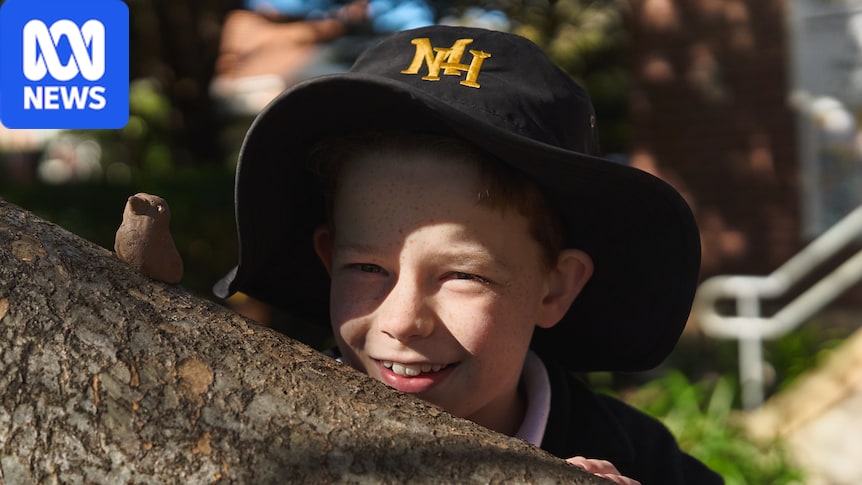
It is not every day that class takes place in the great outdoors, but one initiative is pushing the limits of what learning can look like. The Greater Sydney Parklands's Bush School program takes young children in urban areas out with education rangers to help foster a love for the natural world.Researchers, led by PhD candidate Alexandra Harper, followed a year 1 class from Middle Harbour Public School on Sydney's lower north shore in 2024.Some participants improved in their mathematics, the research found. (ABC News: Timothy Ailwood)The team observed the students as they spent two hours a week playing in the heart of Centennial Parklands.Now, evidence from a study has suggested nature play can help boost education, wellbeing and development. At Bush School, 25 children participated in immersive activities to learn about native animals and how to preserve the natural environment. The kids participated in Bush School two years ago. (Supplied: Jenni Osborn)They spent 2 hours outdoors weekly over 10 weeks. (Supplied: Jenni Osborn)The students were in year 1 at the time and are now in year 3. (Supplied: Jenni Osborn)"It's learning in, through, and about the environment in a natural setting," Tonia Gray from Western Sydney University's School of Education said. "For a lot of children, they're really switched on to that type of learning instead of computer screens."Over 10 weeks, the students explored their surroundings, crafting stick cubbies, painting with ochre, and writing poems dedicated to the trees.Tonia Gray was the PhD supervisor for the Bush School research project. (ABC News: Timothy Ailwood)A recent research paper reflecting on the time found students experienced more joy, autonomy and a deeper connection to nature; helping them flourish.Some even showed "significant improvement" in maths after taking part."It doesn't take away from time-compressed teaching, it actually adds to the learning environment ... it's like a catalyst for growth," Professor Gray said. "Learning differently is just as important as learning through the mainstream ways."From reserved, to 'at home' in natureReflecting back on Bush School, the cohort fondly remembered climbing trees, bush walking, and encountering items like seed pods."We saw lots of native wildlife including a water spider and a tawny frogmouth," participant Nate said, now in year 3. "I got way more confident in things like balancing ... and right now I'm feeling more confident rock parkouring."The students wrote a poem together about their new-found appreciation of trees. (ABC News: Timothy Ailwood)The students still bring up what they learnt in their outdoor adventures, even recreating games in the playground to share with their peers.Middle Harbour Public School assistant principal Jenni Osborn said the children came to see the outdoors as an "extension of their own classroom"."We were able to watch the kids go from being really reserved at first to ... becoming really at home in the environment," she said.Assistant principal Jenni Osborn says students now see the outdoors as an "extension" of class. (ABC News: Timothy Ailwood)Teachers reported at the time that the Bush School students were more "engaged" in their explicit lessons, Ms Osborn said.They also noted that despite being taken out of class, there was "no negative impact" on their curriculum learning, despite initial concerns from some parents. Ms Osborn said students applied what they learnt to real-world scenarios.After a Bush School session, the kids would reflect in their journals. (ABC News: Timothy Ailwood)The students would journal after each session, recount stories in literacy classes, and discuss challenges like how they got a DIY seesaw to balance in their maths lessons. "Indigenous cultures have done this for centuries, children learn better on the land than in a box," Professor Gray said."We need teachers to embrace it but we need teacher training institutions to upskill those educators to feel confident and capable to conduct outdoor lessons."'Enjoying school a lot more'Students participated in activities like making critters out of clay. (ABC News: Timothy Ailwood)The impacts have also been noticed at home. School parent Andrew said the experience was "invaluable" to his son, Archie, and that he observed a "stark difference" in his behaviour afterwards."We could see he really started to expand not just his knowledge of the environment, but also his writing, his drawing, because he was interested in what was going on," Andrew said. Teachers observed students were more engaged in class after Bush School. (ABC News: Timothy Ailwood)"He was more involved, he was really enjoying school a lot more."A lot of people don't have an understanding of the Australian bush, and it is unique, and I think it's really important we all start to understand the environment around us."Rachel said Bush School gave her daughter Evie more confidence and helped her appreciate nature more. "After each session they would bring it back to the classroom and talked to the other students about what they learnt and what they explored," she said. One parent said it was important for more people to become acquainted with the bush. (ABC News: Timothy Ailwood)Sej told the ABC that while jumping in mud may not be an activity "you'd associate with school", her son Hamish had "come into his own" in the couple of years since. "He's got a real mind for science, nature, and history. So I have seen that grow and develop," she said."Every school in New South Wales should have this as part and parcel of the experience for every child."
The nature program that helped a class 'significantly improve' in maths
Full Article
Original Source
Read the full article at Abc →KhanList aggregates and links to publicly available news content. We do not host full articles from third-party sources. Always verify important information with original sources.