
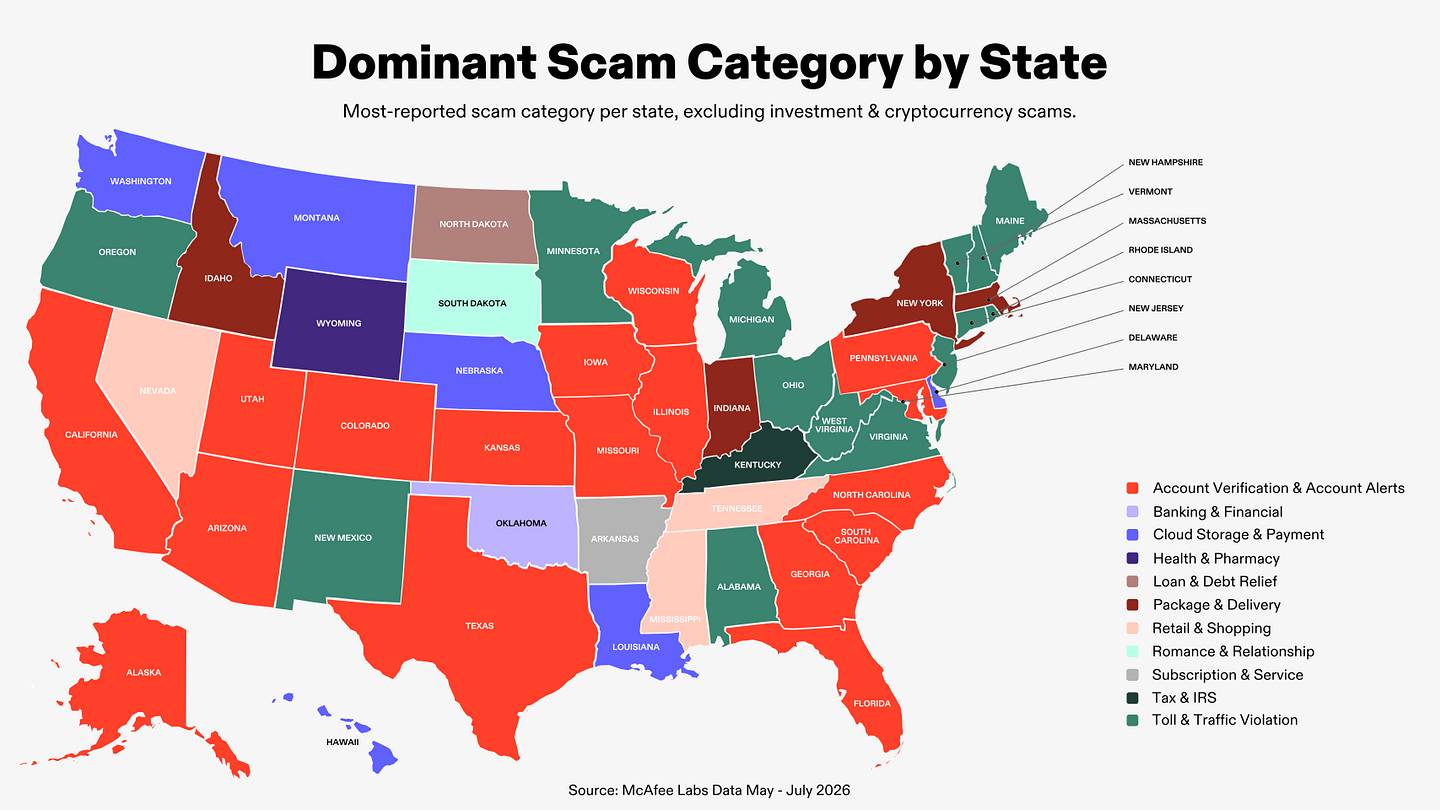
No one wants to get scammed. But unfortunately, in the era of convincing AI deepfakes and relentless digital advertising, it’s easier than ever to fall for something fake.To better understand which scams are bamboozling Americans the most, McAfee Labs surveyed 5,000 Americans across all 50 states. They also collected data about financial losses, concerns about AI, overall trust in digital content, and more, and analyzed all this alongside text-based scam activity from May to July 2026. The scams Americans are facing most frequently in all 50 statesInfographic-USA-Map-Dominant-Scam-Category-by-State-1 | McAfee LabsThe map above shows the study’s results for the most-reported scams in each state, excluding investment or cryptocurrency scams. Account verification and account alert-based scams were most common in 17 states, including Texas, California, and Pennsylvania.These phishing scams generally involve scammers impersonating legitimate companies in order to gain information or money. This might look like an email seemingly from your bank telling you to log in to prevent your savings account from being frozen, or a text message that seems like it’s from a legitimate site asking you to click a link and download a file. To protect yourself from these scams, always check and verify any email or text you receive. In particular, email verification scams are often sent from addresses that don’t match the domain of the company that the scammer is impersonating. For example, an email from PayPal will come only from an address ending in paypal.com, but a scam might come from a completely unrelated address or one that differs only slightly from the username you expect. Additionally, it can be a good idea to verify every URL you click, or type links into your browser instead of searching for them on Google, as scam sites often appear in Google search results. Password managers can also help avoid scam sites, since autofill won’t work on them. Meanwhile, states including Oregon, Maine, and Alabama most frequently reported toll and traffic violation scams. These scams often involve messages, emails, calls, or texts that claim that you have an unpaid toll or balance on your account. However, toll operators also rarely use text messages to collect tolls and will never use threatening or intimidating language to get you to pay. Additionally, scam texts often come from international numbers and may be sent to multiple numbers at once. Scammers also sometimes ask for payment via gift card or wire transfer, which is often a clear sign that something may be amiss.Other common cons included romance and relationship scams, which were most common in South Dakota, and cloud storage and payment scams, which dominated Washington, Montana, Delaware, and Louisiana. Meanwhile, investment and cryptocurrency scams were the most common text-based scams in 47 out of 50 states.More scam data from across AmericaInfographic on how scams are affecting Americans | McAfeeIn addition to collecting data about the most common scams across the U.S., the study also tracked Americans’ views on digital scams. In almost every state, over 50% of the people surveyed said that they spend more energy figuring out what’s real online than they used to. In every state, the vast majority also said they worried that artificial intelligence was making scams harder to spot. 88% of people surveyed nationally said they had encountered a scam in the past year, and Nevada had the highest percentage of people in any state who said they’d encountered one in the past year, at 95%. Furthermore, 82% of people nationwide said that worries about scams had altered their online behavior. 31% of those surveyed said they had lost money to a scam, and just 23% of those who lost money said they’d recovered all of it. Scams are definitely a risk, but it’s possible to avoid them with a little discernment about anything asking for personal information—especially if that request is coming from someone who wants you to believe that a major corporation would allow employees to use misspelled email addresses.
The Most Common Scams in Every State, Mapped
Full Article
Original Source
Read the full article at Mentalfloss →KhanList aggregates and links to publicly available news content. We do not host full articles from third-party sources. Always verify important information with original sources.