
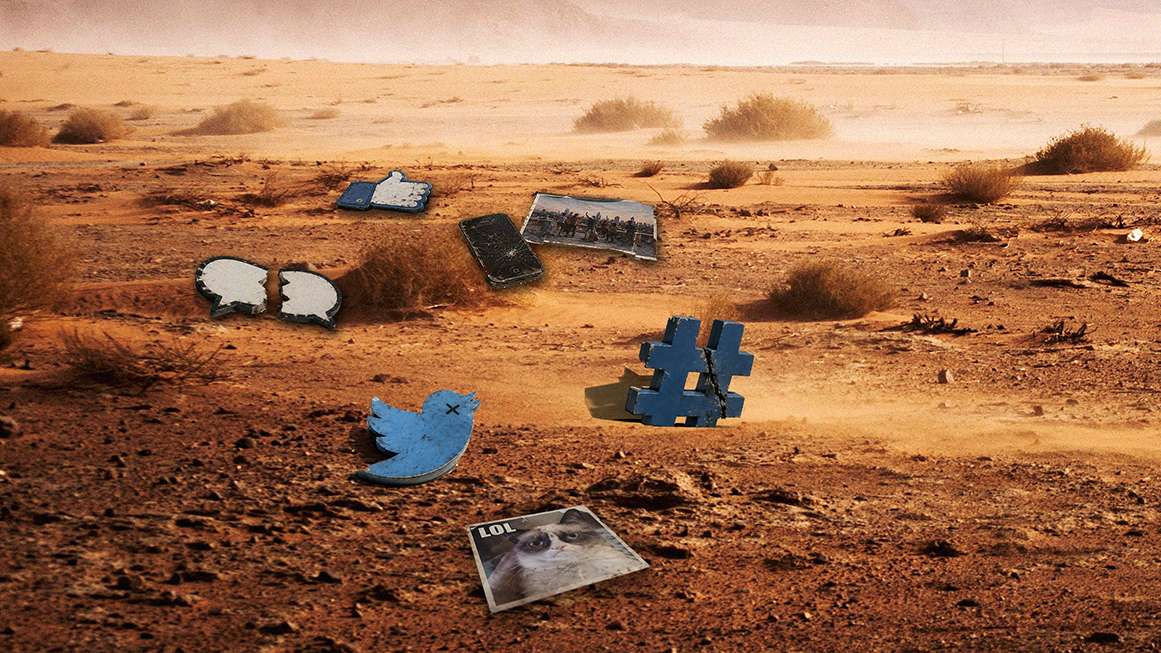
It's 2019, and Rep. Alexandria Ocasio-Cortez (D–N.Y.) is in a video. It shows her dancing on a rooftop with friends. Everyone on Twitter has an opinion about it, after an anonymous account suggested in a widely circulated post that it showed what a "clueless nitwit" she was. AOC is just starting her first term in Congress, Twitter is a hotbed of histrionics, and this video may actually be a secret time capsule, harkening back to the carefree early days of social media and the Millennial Internet. As the video went around, few people stopped to ask why AOC was dancing on this rooftop. But I knew as soon as I saw it. She was copying my friends. In March 2009, someone took old clips of Brat Pack actors dancing, set them to a song by the art-punk band Phoenix called "Lisztomania," and posted the video on the then-4-year-old platform YouTube. A group of friends in Brooklyn, my friends, decided to recreate the viral video on a graffiti-adorned Williamsburg waterfront rooftop, dancing the parts of Molly Ringwald and associated brats themselves and posting it with the title "brooklyn brat pack mashup." It soon became a viral meme. People all over the country, then all over the world, started creating and posting their own Brat Pack mashups, filmed from rooftops and other outdoor spaces in Houston, San Francisco, Scranton, Madrid, Moscow, Nairobi, Taipei, Amsterdam, and many more cities. Most were amateur efforts, filmed by friends for the fun of it. My friends' video eventually topped 550,000 views, but most had far fewer views. AOC's dancing video was part of the craze. Although it went viral in 2019, it was actually shot in 2010 when she was a student at Boston University. It was a silly online lark. Few people noticed it at the time. Only after she became a member of Congress, and the video became culture war fodder, did it hit a million views. Photo: Rep. Alexandria Ocasio-Cortez (D–N.Y.) dances in a 2010 video produced at Boston University while she was an undergraduate; YouTube When AOC, my friends, and everyone else made these videos, no one was monetizing this content. The point was simply participation. The goal was to have fun. We were young, and so was social media. A lot of early social media was like that. Cheesy. Collaborative. Pointless. People posted pictures of themselves "planking"—lying face down in weird locales, like the kitchen counter—just to be a part of a trend. They dumped ice water on their own heads and posted it, allegedly for Lou Gehrig's disease awareness but mostly just because it was the thing to do. They posted old photos on #ThrowbackThursday, lists of accounts they liked on #FollowFriday, and the results of whatever BuzzFeed personality quiz was new that week. There were wedding, party, and conference hashtags, so everyone at an event, or following along online, could catch all the pictures and updates. If you ran into friends, made new friends, or just saw someone you vaguely knew at an event, you absolutely had to take and post a selfie. Bloggers dove into this new medium with gusto, expending countless words responding directly to each other and dissecting each other's posts as if in some massive virtual writers workshop. Politicians either ignored or celebrated this new development. Some campaigns, most notably President Barack Obama's, seemed excited about using it to connect with young audiences who weren't reading mailers or watching cable news. This was the early Millennial Internet. It was driven by new technology (smartphones, social media), a new generational ethos (post everything), optimism, earnestness, venture capital, connection, and possibility. It was weird and beautiful, but also brief. By the mid-2010s, things had shifted. What would come to be known as "cancel culture" started setting in. We started talking about Twitter's "main character of the day." Social justice politics and MAGA rhetoric began drowning out mashup videos, funny animal memes, and bar bathroom selfies. Social media updates became "content" instead of just "my friends' posts." But remnants of the earlier internet remained. Even in the late 2010s, it still felt right to have a wedding hashtag and to post #Caturday pics. Happy #caturday morning from Gem pic.twitter.com/lVMmtR13oI — Elizabeth Nolan Brown (@ENBrown) June 1, 2019 This was the late Millennial Internet. We were more serious, and angrier. Politics intruded, as lawmakers called tech CEOs in for hearings. Yet social media still felt authentic. It was still a place for community and collaboration. Yes, professional influencers existed, but posting was still largely by and for amateurs. The Millennial Internet was friendly, personal, and above all, participatory. People talked to each other. It was sometimes performative, but very often real—an ongoing conversation among friends—and a place where genuine connections could be made. The Millennial Internet is now over. Social media as it once existed is dead. What remains isn't very social. It echoes traditional media and entertainment culture more than the freewheeling early social media years. It's become more like a broadcasting platform, a one-way, top-down system rather than a decentralized free-for-all. There are some upsides to this, of course. But we're losing a lot of internet vitality, usefulness, creativity, and fun in the process. Much of the blame for these changes has been pinned on corporate decisions involving algorithms, advertising, and content moderation. There are people who blame the COVID-19 pandemic, people who blame influencers, people who blame Elon Musk, or TikTok, or MAGA, or woke. There's at least some surface truth to these charges. But we can't overlook the role that politics has played in bringing about social media's demise. The real story of the Millennial Internet's decline is one of government meddling, bullying, and soft, or even overt, censorship. These same factors now threaten the remnants of social media's golden era. 'Decline, Fragmentation, and Enduring Polarization' One need only open the X app or visit facebook.com to see that social media isn't literally dead yet. Even on the most staid social media platforms, people are still flirting and fighting, sharing pet photos, and sounding off without reading the articles. But the data paint a picture of decline. An increasing number of people, particularly in younger (18- to 29-years-old) and older (65+) cohorts, use no social media at all, as the University of Amsterdam's Petter Törnberg showed in his March 2026 paper "Shifts in U.S. Social Media Use, 2020–2024: Decline, Fragmentation, and Enduring Polarization." Signs of social media's stagnation and decline are everywhere. In Pew Research Center surveys of American adults, the share who have ever used Facebook is up just three percentage points from 2016 through 2025 (from 68 percent to 71 percent). Twitter/X use peaked at 24 percent in 2018 and has decreased since. Snapchat use was also down from its 2018 peak. Pew Research Center Some evidence suggests the number of active users on many platforms is dwindling too. Törnberg's research found visits and posts on Facebook and Twitter/X went down almost 50 percent between 2020 and 2024. A June 2026 survey from the data removal service Incogni found more than half of respondents saying they post less these days than they did five years earlier. Even when people are logging in, their experience is fundamentally different from what it was a decade ago. An analysis of online habits commissioned in 2025 by the Financial Times found fewer people using social media for the sorts of social activities—keeping in touch with friends, meeting new people, creative expression—that once were the main draw of these platforms. A 2025 Morning Consult poll found users much more likely to use social media for entertainment (57 percent) once a day than for posting (33 percent). Among Gen Z respondents, it was 74 percent vs. 31 percent. The Millennial Internet, with its communal, conversational bent, may not be literally dead. But it is dying. And it's not entirely due to natural causes. 'An Aggressive Regulatory Effort' Social media's decline is "the result of an aggressive regulatory effort by the government to censor speech online," says tech journalist Taylor Lorenz, author of Extremely Online: The Untold Story of Fame, Influence, and Power on the Internet and creator of the Substack newsletter User Mag. "It was very, very hard before the internet and social media specifically to reach people at scale," Lorenz says, but social media "gave the public the ability to speak freely and connect freely. And very quickly, governments and people in power realized that that's a liability for their ability to maintain control." Tech CEOs didn't simply wake up one day and decide they needed to police content more aggressively. It came after years of politicians and bureaucrats insisting on it. Politicians began to change the way they saw social media in 2016, when Donald Trump was first elected president. Many in and around politics, especially Democrats and their supporters, including many in the media, couldn't understand that outcome. So they blamed social media: Russian bots, misinformation, tech companies. They wanted social platforms to stop the spread of erroneous or polarizing content. Social media companies, most notably Facebook, responded by downgrading political news and links to outside content across the board. Into the void came "influencers" accountable only to engagement metrics. The political class's demands for greater oversight of speech had backfired. Social platforms became no less volatile or polarizing, but they were less oriented around sharing and commenting on articles and other content coming from traditional media. With each new social or political problem that puzzled pundits and worried politicians, a consensus emerged that it was either Big Tech's fault or Big Tech's responsibility. Leaders of both parties began demanding crackdowns on what people could say online, mistaking suppression of speech for suppression of the social issues the speech alluded to. Sometimes their demands were direct, as with laws like 2018's Allow States and Victims to Fight Online Sex Trafficking Act (FOSTA). Ostensibly concerned with stopping prostitution ads and sex trafficking, FOSTA incentivized websites to suppress all sorts of sexual content. In its wake, social platforms started cracking down on not just sex work ads but a variety of content related to sex work or just sex generally. FOSTA—combined with government persecution of sex-worker-friendly websites such as Backpage and politicians' constant hype about websites allegedly facilitating "sexual exploitation"—all but assured that skittish social media companies would shift from spaces where people could have frank conversations about sex to spaces where adults now write sex as s*x or seggs to avoid running afoul of "safety" policies. In what's come to be known as "algospeak," people have had to find creative ways to talk about certain subjects without alarming the robot moderators that police social media. Porn is corn. Suicide is unaliving. Algospeak reflects how government pressure works in indirect ways, too. There's no federal law requiring platforms to crack down on suicide-related content. Yet lawmakers have repeatedly hauled tech CEOs into hearings and demanded they answer for teen suicides. They've blamed Big Tech platforms for the plights of teens who died doing risky stunts, developed eating disorders, or otherwise engaged in harmful behavior while simultaneously spending ample time online. Politicians also blamed social media for mass shootings and political violence, under the theory that perpetrators were radicalized by bigoted rhetoric or false stories, and demanded that platforms crack down on "hate speech" and "misinformation." Sometimes—as with the Biden administration during the COVID-19 pandemic or the Trump administration during anti-ICE protests—they have directly contacted tech executives about content that authorities deemed dangerous in some way. Encouraging platforms to suppress "hate," pro–eating disorder content, or fringe COVID theories might not sound so bad. But content moderation at scale is imprecise and difficult, and filters often catch people merely discussing sensitive topics, including discussing topics in ways that could be helpful to struggling young people. It's also hard for moderators, algorithmic or human, to detect sarcasm or hyperbole, leading to bans for people taken too literally. Decisions about what counts as hate, misinformation, or risky rhetoric are inherently political, forcing tech platforms to take sides in hot-button debates. As a result, we've seen accounts punished for being on the wrong side of issues that are evolving, such as the COVID-19 lab leak theory, or rooted in values more than in objective right and wrong, as with gender debates. Public pressure by politicians also worked at a more subtle and insidious level. It primed us to think that social media companies should be arbiters of truth and distortion, good and bad, permissible and impermissible, instead of just town squares where the smartest people you know might rub elbows with kooks, zealots, and some guy handing out flyers about satanic daycares. Social platforms didn't have to comply with all of the government's censorship guidelines. But at the same time the authorities were making these helpful "suggestions," they were threatening to use antitrust laws to break up Big Tech companies and even brought antitrust actions against some of them. They were also repeatedly threatening social platforms with the revocation of Section 230 speech protections. Section 230 is part of the 1996 Telecommunications Act that shields computer services from some legal liability for user speech. Without it, social media platforms basically could not exist. But since Section 230 means tech companies can't be formally blamed in court for many things people say online, censorial politicians tend to dislike it. Elected officials on both the left and the right have suggested revoking or revising Section 230, making protections contingent on creating an ideologically "neutral" space, or saying it doesn't apply to user speech about guns, drugs, or other sensitive topics. It's no wonder platforms started bluntly suppressing whatever politicians got nervous about. And the more content these platforms suppressed, the more the public expected them to stop any undesirable speech. 'Kids Are Different Because We Closed the Schools' In the trajectory of the Millennial Internet, the COVID-19 pandemic was a tipping point. With social distancing policies in effect and with schools and offices closed, social media platforms became the locus of social lives and cultural battles. Soon, people began to blame the platforms for social ills that might more plausibly be blamed on the unique circumstances of the pandemic: student test scores falling, people's alone time increasing, general mental health declining. "Kids are different because we closed the schools and they weren't socialized. It's not a mystery," says internet culture writer Katherine Dee, who initially came to prominence on Twitter as @default_friend and now pens the default.blog newsletter on Substack. "It's not like generations suddenly became dumber or less social out of nowhere because their parents have an iPhone." Yet explanations involving iPhones and social media have been stickier, no matter how flawed their premises. Primed by lockdown-era resentment of a screen-heavy life and by years of politicians' negative rhetoric about social media companies, many seem willing to blame social media for troubles ranging from teen suicide rates to families having fewer kids. Signs of this turn against phones and social media are everywhere. Phone-free bars have emerged. Some Chick-fil-A locations have introduced a "phone coop challenge" in which diners who keep their phones in a box while they eat can get free ice cream. "Luddite clubs" are popping up on high school and college campuses, and activists in New York City put on a weeklong "Summer of Ludd" festival. Tech discontent isn't just a niche pastime either, as evidenced by Jonathan Haidt's book The Anxious Generation, which blames technology for a range of teen woes and became a bestseller (and the subject of countless parent book clubs). Blaming Tech for Teen Troubles There's little concrete evidence to back up the idea that social media is triggering mass misery. Rather, studies that show small effects—such as a statistically insignificant difference in anxiety and depression levels between people who deactivated Instagram for six weeks and those who did not, or a slight decline in minutes spent reading books over the past few decades—are hyped as evidence that social media is poison, while studies linking it to mixed or positive outcomes and traits tend to be ignored. Studies where correlation but not causation is established are heralded as proof of social media's dangers, as if no one can imagine that heightened screen time among teens suffering from anxiety, depression, or social isolation might be a symptom of that distress, not a cause. This lack of evidence hasn't stopped conventional wisdom from coalescing around the idea that social media is making all of us, and especially teenagers, quite miserable. Politicians and mainstream media have so "villainized" and "stigmatized" social media that people feel ashamed of the habit, says Lorenz. She suggests that may help explain why people are cutting back. At the very least, data back up the idea that inundation with messages about social media "brain rot" may be influencing public opinion. In one 2025 Pew Research Center survey of teenagers, only 14 percent said social media is mostly negative for them personally, while 48 percent said it's mostly negative for their peers. The share deeming it negative for others was up 16 percentage points since 2022, coinciding with a period of intense political and cultural attention to how social media might be harming teens. Maybe "teens are being told social media harms people their age, so they're more likely to report that it does, even if they don't see it in themselves, personally," wrote psychologist Jacqueline Nesi in her Techno Sapiens Substack newsletter. Pew Research Center Politicians have capitalized on this free-floating dissatisfaction with social media to start pushing big changes. The most popular of these is age verification. Plan particulars vary. Some would ban minors from social media entirely; some would let 16- and 17-year-olds join but ban younger teens and children; some would allow minors with parental consent or special restrictions on their accounts. But all of these schemes would require social platforms to assess the age of every user, which would mean identifying adults and minors alike through means like collecting driver's licenses or doing facial scans. Age-verification laws have already passed in some U.S. states and in some countries abroad. Australia banned younger teenagers from social media in 2025, and France followed suit in 2026 (though that move has been struck down by the country's high court). The U.K. is planning to do it too, and the European Union is considering it. In the U.S., at least 11 states have passed laws that ban some minors from social media or require parental consent. Federal judges have blocked some of these, but others have suggested they might pass constitutional muster. One such ruling, from a federal appeals court in Louisiana, explicitly cited the fact that the U.S. Supreme Court OK'd a Texas law requiring age verification by porn websites, as if that now justifies any and all age-verification plans. Some of these schemes would quite literally mean the end of social media for teenagers. They would also end the anonymity that has been a central feature of most social media platforms since the beginning. This could chill speech that's controversial or politically dangerous—or dissuade some people from posting entirely. In a Carnegie Mellon University study in which participants were asked to watch movie clips and then take a short survey for the chance to win prizes, only 22 percent to 28 percent of people continued when asked to age verify with government-issued identification. Plans to ban minors from social media and regulate it in other ways have bipartisan support. As part of Project 2029, a group of Democrats proposed a nationwide ban for those under age 16. A bill by Sen. Ruben Gallego (D–Ariz.) would ban many minors from social media unless they got parental consent to be there. Other members of Congress have proposed requiring ID checks by app stores, by AI companies, and even at the device level. Adam Candeub, Trump's nominee to head the Justice Department's antitrust division, has advocated moving beyond "traditional economic thinking" and factoring in things like social media's potential to make us "less happy" when deciding when to use state power to break companies up. The Kids Online Safety Act (KOSA), a bill under consideration in the Senate, has earned widespread support from both Republicans and Democrats. It would impose on social platforms a "duty of care" to somehow protect minors from all manner of harms. (Related legislation that passed the House of Representatives, the KIDS Act, did not include this requirement.) But it would have a chilling effect on speech. KOSA "creates a 'papers please' social media regime where every single social media user will be forced to identify themselves before speaking on social media, undermining their constitutional right to read and speak anonymously, and enabling government retaliation against disfavored ideas and expression," said Ari Cohn, free speech counsel with the advocacy group TechFreedom, in a public statement. For decades, attempts to punish social platforms on speech-based grounds have failed, thanks to Section 230 and the First Amendment. But since 2022, we've seen more suits brought on "unfair trade practices" or "negligent product design" grounds. These plaintiffs argue that it's not social media content they object to; it's their "endless scroll" setup, or their algorithmic recommendations, or platforms' failure to warn people about their allegedly damaging or "addictive" nature. They gloss over why anyone would be susceptible to excessive use or other negative reactions if it weren't for the content. This line of attack has already had some success in court, most notably in New Mexico, where in August a state court ordered Meta, Facebook's parent company, to pay $567 million for violations of the state's Unfair Practices Act. Meta platforms "significantly interfere with public safety, public peace, and public comfort," wrote state Judge Bryan Biedscheid. (In an earlier phase of the same case, a jury fined Meta $375 million.) Meta and other social media companies also face a series of "social media addiction" cases in federal civil court, brought by thousands of plaintiffs, including hundreds of U.S. school districts and 29 states. In the first of these to be decided, a jury concluded that Meta and Google owe millions in damages to a now-20-year-old who blames YouTube and other platforms for her psychological issues. In August, Meta settled with the 29 states, admitting to no wrongdoing but agreeing to pay $16.68 billion and make major changes for minors' accounts, including imposing a two-hour-per-day time limit. Results like these could open social platforms to endless lawsuits, brought by anyone who blames social media for their problems or any state lawyer who can pin some teen's troubles on short-form video. They also make measures like identity verification and even tighter content crackdowns likely. Social media might seem stodgy and surveillance-friendly now. But it's poised to become worse. 'Just Passively Scrolling' People still communicate electronically, but they're increasingly using semiprivate forums, such as Discord, WhatsApp, and Signal, rather than the big, public platforms. It's a return of sorts to the days when chat rooms and message boards ruled the web. Some have migrated to newer, more niche-oriented public platforms, such as Bluesky or Truth Social, but only in modest numbers. Even Threads, Meta's Twitteresque platform launched in 2023, has humble reach, with just 8 percent of people surveyed by Pew Research Center last year saying they ever use it. On old Twitter, "the basic idea [was] that politics should be like everyone in the whole world screaming into the same open air insane asylum at the same time," says Ben Smith, who served as editor in chief of BuzzFeed in its heyday and has since founded the news website Semafor and authored the book Traffic: Genius, Rivalry, and Delusion in the Billion-Dollar Race To Go Viral. That idea, he says, was "an unusual historical thing" and "probably isn't coming back." Maybe that has its upsides. But at least the days of peak Twitter and Facebook felt manageable—you knew where to find people and where to reach people. Participating was easy: You just put up some photos or strung together a few lines of text. TikTok has been one of the few growth spots in social platform use this decade. But it's a much more passive medium. "While in principle anyone can upload a quick TikTok, that's still a much higher bar than firing off a reply tweet," says tech writer Julian Sanchez, who writes the Non-Content Substack newsletter. Among adult TikTok users, only 52 percent have ever posted a video, according to Pew. TikTok is "an experience almost more like Netflix than it is like Twitter," says Smith. "I just don't think TikTok is social media." Yet Facebook, Instagram, and YouTube have strived to emulate it, introducing brief, vertically oriented videos, referred to on YouTube as "Shorts" and on the Meta platforms as "Reels," which feature prominently on the user interface. Even for users who might like to avoid them, they're impossible to avoid, with strangers' Reels now forced into feed space where photos of friends' artisanal lattes, or calls to participate in the cause or meme of the day, may once have appeared. These days, your average social media user "is just passively scrolling," says Dee. She doesn't see that as necessarily a bad thing, likening it to the way people once put on the TV for background noise. But she thinks the Millennial Internet is "absolutely" over, and she thinks social media—at least "the way it existed when I was in my early 20s"—is over too. Even the idea of building a social media following—or tuning into social platforms to follow a select group of people and institutions you care about—may be growing obsolete, as platforms increasingly fill users' feeds not with content from those they follow but with whatever the algorithmic gatekeepers have deemed most relevant. 'Don't Be Weird About This' It's 2026, and AOC is in a video. It shows her injecting herself with fertility drugs in order to freeze her eggs. By posting this, AOC has made herself the main character in social media's hottest culture war of the moment: the one about when, whether, and how women should have kids. She also may have given us a secret decoder ring, illuminating just how far from the early days of social media we have come. AOC's TikTok-like vertical video was posted not on her Instagram's "main grid," permanently visible to all, but as a more ephemeral "story," where comments are typically private messages to the poster. It's part of a long series of videos where AOC talks directly to the camera—social media as soapbox, or reality TV, rather than an interactive and public affair. As AOC opens various medical accoutrements in her egg-freezing video, she jokes, "Maybe I should start an ASMR egg-freezing channel." (ASMR is, in essence, sounds that make your head tingly.) "I think they banned them on YouTube," she adds with a laugh. That's not exactly right. ASMR in general is still allowed. But YouTube did ban several popular ASMR content creators this year for supposedly violating its "sex and nudity policy" by linking to sexually oriented content on an external site. "It's our job to make sure that YouTube is a safe place for all," the platform's email to banned ASMR creators reportedly said. After years of government campaigning, social media is now brimming with "safety," which often means restrictions on speech. But it isn't social anymore. It isn't growing. It isn't cohesive. And it isn't cool. "In my age demographic…it's kind of cringe to be constantly online," says 26-year-old New York Post columnist and Cato Institute fellow Rikki Schlott. Her peers have a different etiquette around social media than my cohort did in our 20s. Schlott says when hanging out, "Without fail, everyone has their phone face down at a dinner table and it doesn't come up unless you say, like, 'Oh, I have to check this,' specifically." Many millennials are now disillusioned too. "Social media got fundamentally less interesting," wrote Kate Lindsay of the Embedded Substack newsletter in a January post titled "Social media dies in 2026." Rather than "the advent of social media [being] a line on a graph that only goes up," we might actually remember the extremely online era "not as a beginning, but a blip." This might be somewhat natural: Technology is dynamic, young people age, generational tastes shift. But the internet also changed, in part because of politicians like AOC. "Don't be weird about this, even though I know you will be," Ocasio-Cortez says in her fertility meds video, pointing at the camera. It's a challenge we might give to politicians addressing social media, too. AOC, reportedly considering running for the 2028 Democratic presidential nomination, is fluent in social media. Like Trump, she has mastered using it for political gain while supporting policies that further government influence and control over it. AOC called social media a "public health risk to everybody" and has said repeatedly that "we need to break up" tech companies. Trump has called for repealing Section 230, tried to ban TikTok (though he later reversed course on that), and implemented policies to scrutinize the social media accounts of visa applicants. These are exactly the kinds of moves and rhetoric that, multiplied across state and federal governments, have slowly poisoned the social web and ultimately sent it into its current death spiral. The Millennial Internet was imperfect. It was earnest, silly, weird, amateurish, and sometimes overtaken by mania and mob rule. But it was a virtual place, and a time, where the grasp of traditional gatekeepers slipped. For a while, people could connect, comment, and create without excessive censorship or supervision. We might remember its flaws and the ways it evolved into a more conventional, top-down broadcast medium. But we might also remember it as an era of unprecedented—and lost—freedom. This article originally appeared in print under the headline "Who Killed Social Media?."
The Millennial Internet Is Dead, and Politicians Killed It.
Full Article
Original Source
Read the full article at Reason →KhanList aggregates and links to publicly available news content. We do not host full articles from third-party sources. Always verify important information with original sources.