
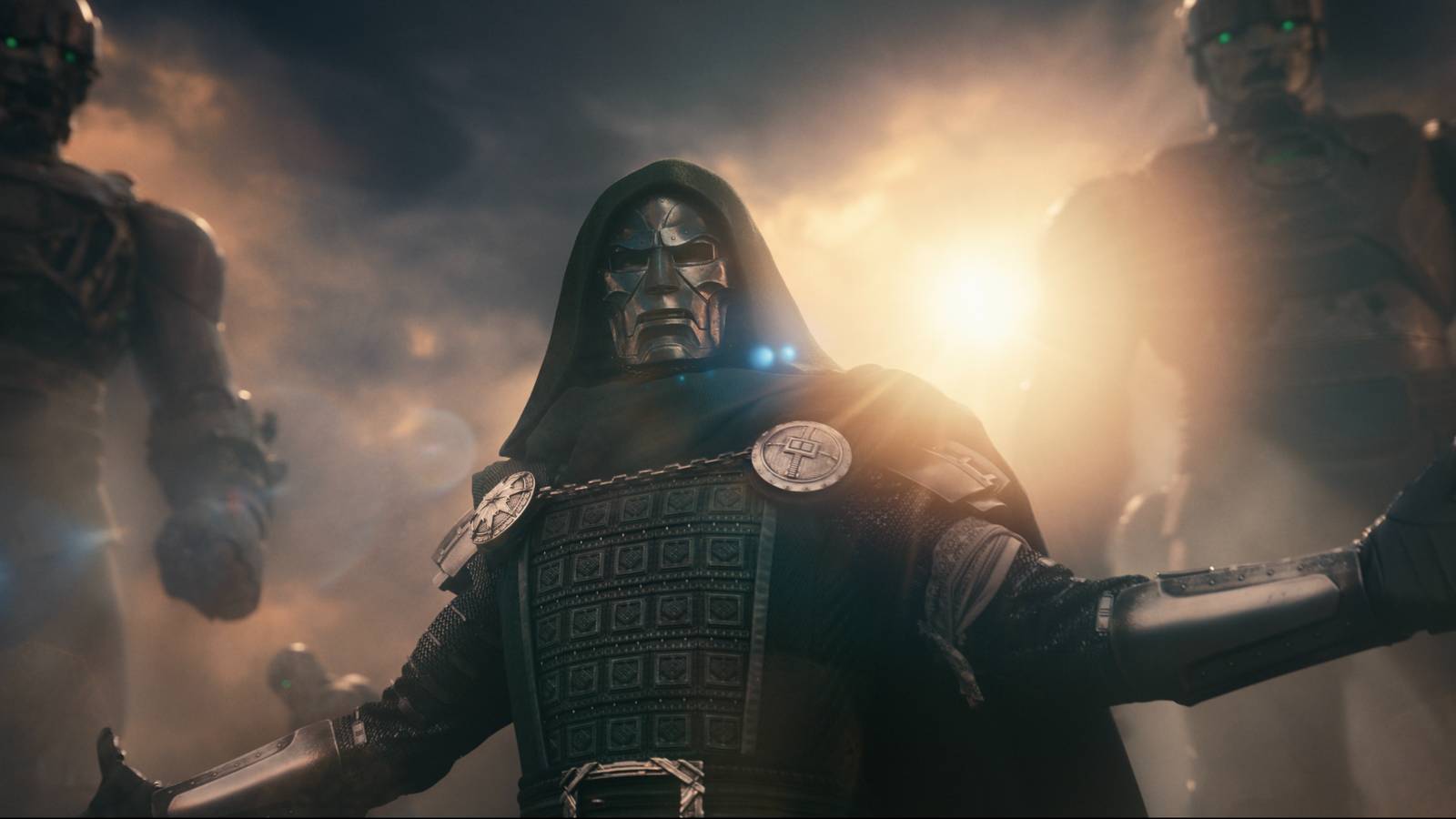
Published Sep 26, 2026, 2:05 PM EDT Once head of Screen Rant's Star Wars coverage and co-lead of Superheroes, Tom Bacon now works with the movies and books teams. He's a lifelong fan of the fantasy and sci-fi genres, and loves franchises such as Doctor Who and Marvel. You can find him on Twitter @TomABacon, on LinkedIn @tabacon, or on Muckrack under tombacon. Tom has a wide range of interests, and he continues to serve his university as a volunteer chaplain. He's heavily involved with his local church, and anyone who checks him out on Twitter will swiftly learn he's into British politics too. The MCU's Multiverse Saga is building to a climax in this year's Avengers: Doomsday and next year's Avengers: Secret Wars. The last three phases of the MCU have been pretty sprawling, with the shared universe expanding into a range of Marvel TV shows on Disney+. The sheer scale means not every story has had a multiversal angle, though, and not every story is really essential if you want to be familiar with the full story of the Multiverse Saga ahead of Doomsday. The multiverse has also served as an opportunity for Marvel to expand into a range of animated TV shows, all of which are said to be set in alternate timelines or feature time travel. That said, few of these feel important enough to be essential viewing; as good as X-Men '97 may be, Marvel is unlikely to incorporate it into Doomsday and Secret Wars. Given that's the case, here's the full timeline of the MCU's Multiverse Saga, explaining the role each plays in the ongoing story. Avengers: Endgame (& Endgame Encore) A Must-Watch Before Avengers: Doomsday Introduces time travel and branching timelines to the MCU. Avengers: Endgame introduced time travel into the MCU, albeit so inconsistently that the film's writers and directors openly disagreed over how it works. The surviving Avengers sought to undo Thanos' snap by traveling back in time and retrieving the Infinity Stones before their destruction, but in doing so apparently created new branched timelines. According to the Ancient One, the Infinity Stones are fundamental to the multiverse itself: "The Infinity Stones create what you experience as the flow of time. Remove one stone and that flow splits. [She flicks the Time Stone projection away and Shows black stream indicating a point of divergence] Now, this may benefit your reality, but my new one…not so much. In this new branched Reality, without our chief weapon against the forces of darkness, our world will be overrun. Millions will suffer." The Avengers prevented multiversal catastrophe by returning the Infinity Stones when they were done, essentially sealing off the new branches. Then, in an odd twist, Steve Rogers chose to remain in te past and enjoy his happily ever after with his beloved Peggy Carter, and nobody seemed able to agree what that meant in terms of time travel. Avengers: Doomsday features Steve Rogers' return, so is likely to finally address this. Avengers: Endgame Encore features additional footage intended to bridge the gap between Endgame and Doomsday, too. The Russo brothers have insisted viewers should be able to go straight from Endgame Encore to Doomsday with minimal confusion. Loki Seasons 1 & 2 Another Must-Watch Before Avengers: Doomsday Image via Everett Collection The birth of the MCU's multiverse and basic time travel rules explained. Ends by establishing Loki's importance to the multiverse. Loki is essentially the foundation of the Multiverse Saga, although the MCU's overarching narrative has changed a lot so some details may not quite line up. This spins straight out of Endgame, revealing the Avengers' time travel mission left one branching timeline spinning out of control due to a Loki variant who'd escaped. This Loki was captured by the Time Variance Authority, who had been tasked by a being named He Who Remains to prune branching timeline and prevent the multiverse forming. A variant of Kang the Conqueror, He Who Remains revealed that the multiverse is inherently unstable because its mere existence inevitably leads to a multiversal war and ultimate annihilation. He was the last survivor of the latest multiversal conflict, and he created the TVA to prevent the same kind of crisis happening again. He Who Remains ultimately failed, of course, and Loki wound up working with the TVA to preserve the multiverse rather than destroy it. By the end of Loki Season 2, Loki himself had become the loom around which the multiverse wove itself. What If Seasons 1, 2, & 3 Image via Disney+ Explores different timelines in the multiverse, with season 1 introducing the new key concept of absolute points in time. An animated series spinning out of the main MCU timeline, What If,.? showcases different universe and timelines where events played out a little differently. It's unlikely to be particularly significant, but several concepts and characters may well be revisited (two timelines have already had an influence on live-action). The most important episode is probably in season 1, What If...Doctor Strange Lost His Heart Instead of His Hands? This introduces absolute fixed points in time that cannot be changed, cornerstones of the MCU timeline. Shang-Chi & the Legend of the Ten Rings Introduces a cosmic weapon that appears to be rooted in the multiverse. Shang-Chi & the Legend of the Ten Rings introduced the real Mandarin, Xu Wenwu, who had discovered the Ten Rings — a group of ten hung gar rings charged with powerful energy — back in the Middle Ages. Shang-Chi's post-credits scene revealed the Ten Rings had sent a signal across the multiverse, one Bruce Banner couldn't interpret. It clearly linked this movie in with the overarching narrative of the Multiverse Saga, although it remains to be seen whether this remains after some of Marvel's course-corrections. Spider-Man: No Way Home Sets the pattern for the multiverse, bringing back pre-MCU stars to reprise their roles. Features a near-cataclysmic multiverse event. Surprisingly, Spider-Man: No Way Home was probably one of the most important movies in the Multiverse Saga. A botched memory spell from Doctor Strange almost caused a major multiversal incident as people from other universes were dragged into Earth-616. In the end, Tom Holland's Spider-Man teamed up with Tobey Maguire and Andrew Garfield's versions of Peter Parker. In the end, Spider-Man had to make a heartbreaking sacrifice to save his entire world; he pushed Doctor Strange to erase all memories of Peter Parker's existence. Spider-Man: No Way Home doesn't appear to have any direct consequence on the MCU timeline, although it certainly left Spider-Man's personal life a mess. But it foreshadows what has now become the defining approach for the Multiverse Saga; the use of the multiverse as a plot device to bring back pre-MCU Marvel stars. Doctor Strange in the Multiverse of Madness A Definite Must-Watch Before Avengers: Doomsday Introduces the concept of incursions, where universes collide. Sets Doctor Strange up on a quest to prevent an incursion. Introduces America Chavez, a teenager who can jump through realities. Now we move to one of the most important movies in the Multiverse Saga; Doctor Strange in the Multiverse of Madness. This sent Doctor Strange on a multiversal jaunt with America Chavez, a teenage girl with the power to create portals across the multiverse. Crucially, this established the idea of incursions; that realities should not cross, for fear of risking a multiversal event that destroys one or both timelines. At least one alternate Earth, Earth-838, established a group known as the Illuminati to protect their world from potential incursions. The Doctor Strange sequel's post-credits revealed Strange had unwittingly caused an incursion during his multiversal journey, and he disappeared into the multiverse with a powerful sorceress named Clea to try to put this right. Meanwhile, America Chavez wound up training at Kamar-Taj under Wong. It's reasonable to assume her multiverse-jumping powers will figure into this story somehow. Ant-Man & the Wasp: Quantumania Develops Kang and the Council of Kangs, key multiversal villains who may still be relevant in some way. We've already alluded to Marvel making some pretty major course-corrections while working on the Multiverse Saga. Ant-Man & the Wasp: Quantumania should have been essential, because it introduced another variant of Jonathan Majors' Kang the Conqueror (and an entire Council of Kangs) as major villains. But the film failed to perform, and Disney dropped Jonathan Majors after his conviction for domestic assault. Marvel subsequently announced Robert Downey Jr.'s Doctor Doom as the new villain of the Multiverse Saga, replacing Kang. The Marvels Ends with Monica Rambeau transported to an X-Men timeline. The Marvels united Captain Marvel, Ms. Marvel, and Monica Rambeau when a Kree warlord attempted to use the power of ancient Quantum Bands to restore Hala to its former glory. The heroes triumphed, but Monica Rambeau was lost in a multiversal tear; the post-credits scene revealed she emerged in an X-Men timeline, one where her mother was still alive and gained the powers of Captain Marvel instead of Carol Danvers. Given Doctor Strange in the Multiverse of Madness' warnings about incursions, her presence could be dangerously destabilizing. Deadpool & Wolverine The Final Must-Watch Before Avengers: Doomsday Introduces "anchor beings," essential to a timeline's stability. Sets up a relationship between Deadpool and Wolverine and the TVA. Deadpool & Wolverine revisited the Fox X-Men timelines courtesy of the TVA, introducing a new concept called "anchor beings" to the MCU. According to the TVA, an anchor being is so important to a timeline that their death results in its gradual destruction; Logan was the anchor being of his timeline, and Deadpool was tasked with finding a Wolverine variant to stabilize it. Deadpool and this Wolverine variant succeeded, bringing with them a number of survivors from defunct timelines. Deadpool & Wolverine is one of only a few Multiverse Saga movies to center itself on the concept. Anchor beings add an interesting new wrinkle, because they show a mechanism by which someone could destroy an entire universe to prevent an incursion; simply target that timeline's anchor being. Thunderbolts* Post-credits scene leads directly into Avengers: Doomsday. Thunderbolts* is an Earth-bound adventure that brings together a mismatched group of would-be heroes as the Thunderbolts and, later, the "New Avengers." We already know this group will play a major role in Avengers: Doomsday, and Thunderbolts*' post-credits scene directly launches some of the plot. The Fantastic Four: First Steps Introduces a new timeline, Earth-828, and gives a glimpse of Doctor Doom in the post-credits scene. The Fantastic Four: First Steps is set on an entirely different Earth in the multiverse (Earth-828), one where the Fantastic Four are the world's only heroes. The movie tells the story of their battle against Galactus, and its post-credits scene is direct setup for Avengers: Doomsday; Doctor Doom pays a house call, showing particular interest in Reed and Sue's son, Franklin. In the comics, Franklin has cosmic power and becomes key to restoring the multiverse in the 2015 Secret Wars comic book event. Release Date December 18, 2026 Runtime 165 Minutes Director Anthony Russo, Joe Russo Cast Reed Richards / Mr. Fantastic Vanessa Kirby Sue Storm / Invisible Woman Writers Stephen McFeely, Michael Waldron, Chris McKenna, Erik Sommers Producers Anthony Russo, Joe Russo, Kevin Feige, Louis D'Esposito, Jonathan Schwartz Prequel(s) Spider-Man: Brand New Day Sequel(s) Avengers: Secret Wars Franchise(s) Marvel Cinematic Universe, The Avengers, Fantastic Four, Black Panther, Thor, X-Men
The MCU's Multiverse Saga Timeline Fully Explained Ahead of Avengers: Doomsday
Full Article
Original Source
Read the full article at Screenrant →KhanList aggregates and links to publicly available news content. We do not host full articles from third-party sources. Always verify important information with original sources.