
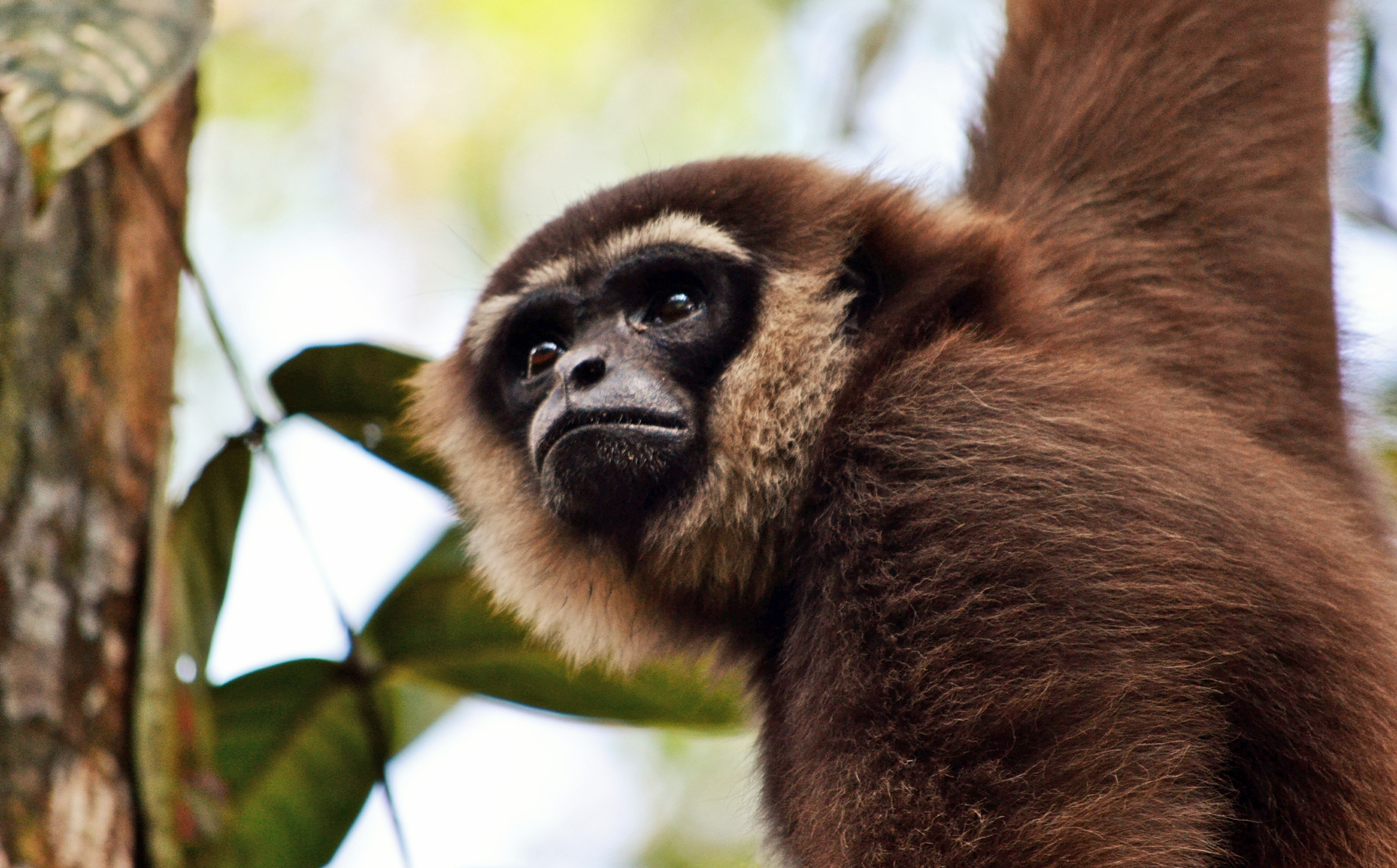
A recent review of research on the short- and long-term impacts of El Niño-driven fires raises concerns about the impacts of such events on primates in Southeast Asia.Habitat loss caused by droughts and fire are linked to changes in the diets, behavior and physical conditions of primates, with changes observed even decades after fires end.The study highlights the urgent need for more research on the topic, noting that researchers identified only 15 papers, which focused on just seven of the region’s 105 primate species. As Indonesia’s El-Niño driven fires spark a race to save endangered orangutans and other wildlife, a recent review paper, published in the journal Oryx, is raising concerns about both the short- and long-term impacts on primates of such climatic events in Southeast Asia. “Primates might survive a fire, but that doesn’t necessarily tell us whether they’re going to have enough food or suitable habitat, or what’s happening with their health and ability to reproduce in the months and years ahead,” said Elizabeth Barrow, lead author of the paper and conservation research director at the Gunung Palung Orangutan Conservation Program (GPOCP), Indonesia. With 94% of Southeast Asia’s primates threatened with extinction, the impact of El Niño is a poorly understood but significant threat to populations, according to the researchers. “From my perspective, this is a huge conservation issue for primates in Southeast Asia,” Barrow said. Habitat loss and degradation caused by drought and fire are linked to several concerning impacts. They can drive changes in diet, behavior and the physical condition of primates, the review found. Primate populations can become crowded as forest areas shrink, while others may be displaced, suffer localized extirpations, or increased infant mortality. In total, however, the review identified only 15 papers on the impacts of El Niño-linked drought, fire and smoke on primates. Research was limited to just seven of 105 primate species, and entirely focused on Indonesia, leaving major knowledge gaps. “Although there are very few papers, the effects on primates are quite clear,” Barrow said. “They are predominantly negative.” A fire in West Kalimantan in 2026. Research suggests some species can recover from fires but it’s unclear how repeated exposure to such events can impact primates in the long-term. Image courtesy of the Gunung Palung Orangutan Conservation Program. A long view From the handful of long-term studies conducted, there are encouraging signs that primates can recover from the impacts of El Niño, given time, Barrow said. “But they also show these long-term impacts and that there’s a lot we still don’t know.” Susan Lappan, a professor at the Appalachian State University, U.S., was part of a team that tracked siamang gibbons (Symphalangus syndactylus) after widespread fires during the 1997-98 El Niño. Those particular populations began returning to burned areas after 18 years but still avoided heavily damaged forest patches. Though forests had recovered by then, their composition shifted. “The effects on habitats continued to affect animal ranging behavior for well over 10 years after a fire,” said Lappan, who was not involved in the Oryx paper. “The data that we don’t have so far is what happens 20, 30 or 40 years post fire, or, I think even more critically, after multiple fire cycles.” Another major concern is the potential long-term impact on reproduction. Lappan and her team’s research also found that siamangs living next to burnt areas had much higher infant mortality, and therefore reduced reproductive success, for several years after the event. She said she believes that a combination of fire and drought resulted in a long-term reduction in habitat quality that made offspring more vulnerable. She added that it’s also possible that stress or exposure to toxins, or both, may also have contributed to the problem. “That has a net effect on the population by making it more difficult for smaller and more isolated populations to recover in the long term,” she said. An orangutan displaced by forest fires in West Kalimantan. Image by Erik Sulidra. Such “subtle effects” may be overlooked because of the dramatic nature of fires or smoke. “But they may actually turn out to be the more important and impactful processes for the entire ecosystem,” Lappan said. Another study conducted a decade after the 1997 fires in the Kutai National Park, East Kalimantan, Indonesia, suggests Miller’s grizzled langur (Presbytis canicrus) was extirpated from the area as surveys failed to find them. Research in the Mega Rice Project area, also in East Kalimantan, found a dramatic increase in orangutan population density as they became crowded in patches of forest fragments that were isolated by previous fires. Studies of the long-term health impacts of El Niño-linked drought, fire, smoke and haze on primates are lacking. But short-term exposure to wildfire smoke is known to cause behavioral changes and weight loss, to increase the risk of diseases, and to affect the calls of primates. “I think it is reasonable to infer that an animal that has inhaled enough smoke to be showing these behavioral impacts is very likely to have more negative health consequences as well,” Lappan said. “It’s really concerning.” Fire burning in the Gunung Palung National Park during the 2026 El Niño. Image by Wahyu Susanto. From evidence to action Susan Cheyne, co-director of the nonprofit conservation and research organization Borneo Nature Foundation, said she sees the review paper as a call to action for both researchers and conservationists. “We need to start now to try and understand what’s happening with the potential impacts on behavior, reproduction, population growth and density,” she told Mongabay in an interview. Some gibbon populations monitored by the Borneo Nature Foundation are experiencing their second strong El Niño in little more than a decade, she said. “They’ve had to deal with multiple less-severe fire events throughout their lives,” she said. “Now, is that going to cause an impact on life expectancy?” Barrow of GCOCP, who agrees that further research is required to fill in knowledge gaps, said she believes that urgent steps are also needed to make forests across Southeast Asia more resilient in the face of climate change and possibly intensifying El Niño events. That includes rewetting drained peat forests and halting forest fragmentation and degradation. “We need to try to reverse some of the damage that we’ve caused, and that is not an easy thing to do,” Barrow said. “We can try to increase the resilience of the primate habitats themselves, and I think that needs to be the number one focus moving forward.” Banner image: A gibbon in Tanjung Puting National Park. Research on gibbons shows they do return to burned areas after more than a decade as forests recover, but there may also be lasting effects. Image by Elizabeth Barrow. El Niño’s hidden toll on trees emerges years later in Papua New Guinea rainforest Citation: Barrow, E. J., & Erb, W. M. (2026). A systematic review of the impacts of El Niño-driven drought, fire and smoke on non-human primates in Southeast Asia. Oryx, 1-11. doi:10.1017/s0030605325102445 Setiawan, A., Nugroho, T. S., Djuwantoko, & Pudyatmoko, S. (2009). A survey of Miller’s grizzled surili, Presbytis hosei canicrus, in East Kalimantan, Indonesia. Primate Conservation, 24(1):139-143. doi:10.1896/052.024.0112 Cattau, M. E., Husson, S., & Vheyne, S. M. (2014). Population status of the Bornean orang-utan Pongo pygmaeus in a vanishing forest in Indonesia: the former Mega Rice Project. Oryx, 49(3):473-480. doi:10.1017/S003060531300104X Credits Topics
The long reach of El Niño impacts on Southeast Asia’s primates
Full Article
Original Source
Read the full article at News →KhanList aggregates and links to publicly available news content. We do not host full articles from third-party sources. Always verify important information with original sources.