
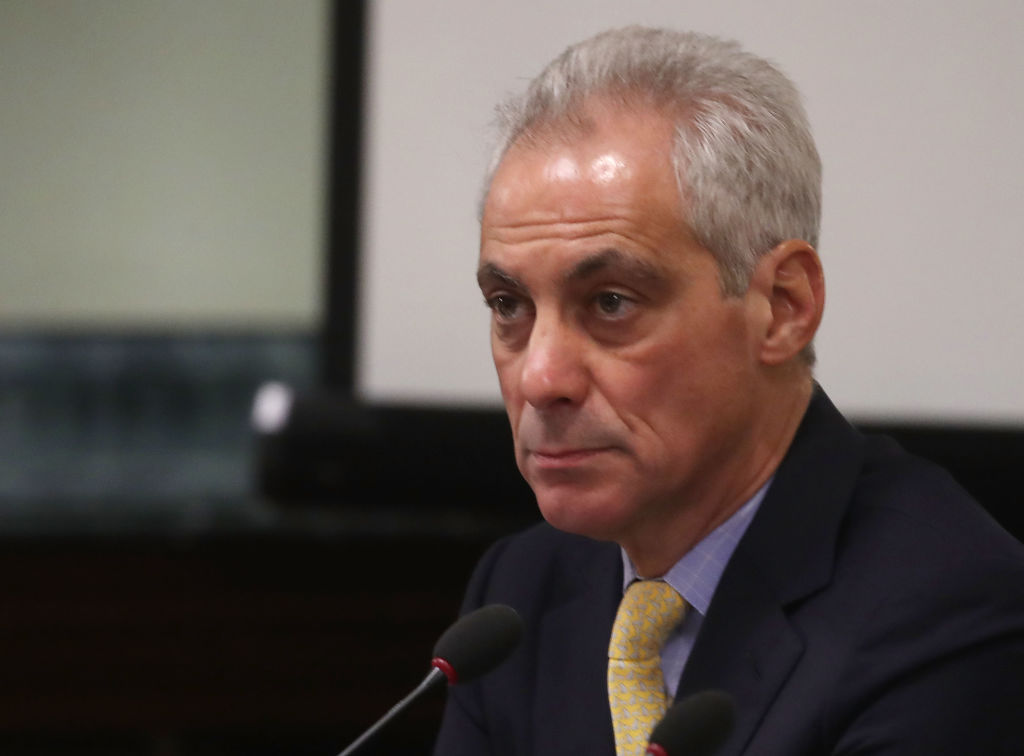
Between the Israeli genocide in Gaza and the calamitous stalemate of Donald Trump’s war in Iran, the American foreign policy consensus has been coming apart. Popular support for the United States’ violent foreign policy has reached an unprecedented nadir, as Americans increasingly recognize the downsides of maintaining a global empire.In particular, US military largesse has come at the cost of spending on domestic needs, and voters are increasingly unhappy about this trade-off. According to polling by ReThink Media and the Costs of War Project at Brown University, 59 percent of respondents found the Trump administration’s proposed 2027 Pentagon budget of $1.5 trillion to be excessive.This new epoch has ruptured elite unanimity over how the United States should proceed with its Atlas-like standing in the world. On the Right, Trump’s Iran war has curdled support from key MAGA acolytes like Tucker Carlson and Marjorie Taylor Greene. Meanwhile, socialists like Zohran Mamdani have helped mobilize the intense unpopularity of Israel’s decimation of Gaza into a movement that threatens to undo the Democratic Party’s long-standing fidelity to Tel Aviv.Yet centrist Democrats, despite waning influence, maintain a garrote around foreign policy and fiercely resist the dialing back of US imperial ambitions. As the 2028 presidential primary approaches, this faction may yet exert strong influence over whatever Democratic administration might assume office.What makes the center’s foreign policy so stifling is a commitment to an outdated vision of American supremacy. Prominent figures who represent this ideology include Michigan Sen. Elissa Slotkin, Joe Biden’s national security advisor, Jake Sullivan, and former Obama chief of staff and disgraced Chicago mayor — and potential presidential candidate — Rahm Emanuel. They are all wedded to the idea that technocratic efficiency in the service of US imperial power, not any kind of democratic accountability, should continue to dominate American foreign policy. Their play is to rebrand the politics of empire as a pugilistic, muscular force for liberal internationalism that will, under the banner of great-power competition, reignite the moderate wing of the Democratic Party. Socialists must be prepared to confront the embattled center’s noxious, reheated Cold War narratives — especially because centrists will no doubt weaponize them against the insurgent Left.These anachronistic Cold Warriors view politics as eternal struggle characterized by a conflict between “free-market” democrats and rigid authoritarians. The reason for the center’s fixation on these outdated schemas isn’t difficult to grasp: US victory in the Cold War was the pinnacle of the liberal international project. The end of the Soviet Union was supposed to illustrate once and for all that Western-style capitalism was superior to any alternative. But even as the foundations of American preeminence have deteriorated, the establishment is not ready to relinquish the idea that we should perpetually remain the “indispensable nation.”This obsession appears periodically in their rhetoric: “As a Cold War kid, I’m thankful it was [Ronald] Reagan and not Trump in office in the 1980s. Trump would have lost us the Cold War,” Slotkin said in her response to the president’s March 2025 address to Congress. “Donald Trump’s actions suggest that, in his heart, he doesn’t believe we are an exceptional nation. He clearly doesn’t think we should lead the world.”The collapsing of complexity is key to the center’s perspective. See, for example, Sullivan’s projection of the Russian invasion of Ukraine through a similar lens: “As a child of the eighties and ‘Rocky’ and ‘Red Dawn,’ I believe in freedom fighters, and I believe in righteous causes, and I believe the Ukrainians have one,” Sullivan told the New Yorker in 2023. “There are very few conflicts that I have seen — maybe none — in the post–Cold War era . . . where there’s such a clear good guy and bad guy.” This reductive framework turns the horrific war into a made-in-Hollywood Manichaean struggle rather than a crisis that might be addressed through actual diplomacy.Emanuel took such thinking a step further in a 2025 Wall Street Journal op-ed with the subhead “Can Americans stop fighting each other long enough to appreciate the threat from China?” As Trump’s second term battered American confidence in the country’s intrinsic goodness, Emanuel argued that the United States could move forward if we set aside our petty grievances and focus on the existential threat emerging from the East.In this understanding of geopolitical brinksmanship, America becomes the shining city on the hill when it’s engaged in a metaphysical battle. A refrain sung by liberals during the Cold War was that our rivalry with the Soviet Union was not only a moral struggle, but that the fight against communism was a spur to domestic progress. After World War II, issues such as civil rights were embraced by the original Cold Warriors like President Harry Truman in large part because racial inequality was often highlighted in Soviet propaganda. Anti-black racism had to be resolved not simply because it was flagrantly unjust, but also because it was useful to the enemy. When Truman became the first president in history to address the NAACP, he asserted that the United States must “put our own house in order” if it was to overcome the supposed Soviet threat.We can see a modern-day analog of this thinking in how the center approaches China. But unlike with the Soviet Union, in which the rivalry was seen as a catalyst for progressive social change, centrists view our competition with China as an opportunity to usher in a new era of prosperity for the middle class — while eschewing the ambitious redistributive measures being advocated by socialists like Mamdani and fellow travelers like Abdul El-Sayed.Take Emanuel’s proposal to tax online betting and prediction markets like Polymarket and Kalshi and use the billions procured to reverse cuts to the National Institutes of Health, the National Science Foundation, and the Defense Advanced Research Projects Agency, all under the auspices of better competing with China. “I want to bet on America, not bet against America, and that’s what we’re doing right now,” he said in a recent appearance on Real Time with Bill Maher. “And plow all the money into doubling up on research, so we don’t lose this race on fusion, nuclear energy, quantum computing, life sciences, to the Chinese, which we are now losing.”Slotkin has sounded a similar note. In a 2025 speech at the Council on Foreign Relations, she insisted that failing to invest in future technologies would make American families vulnerable not only to financial hardship but also to cyberterror attacks engineered by Xi Jinping. “We need economic security to be a national security priority. We need to get our ass in gear on the tech arms race, particularly on AI, and we need to protect Americans at home from these [Chinese] threats.”Sullivan, to his credit, once acknowledged that explicitly endorsing the concept of a second Cold War is unappealing to the contemporary middle class. In a Carnegie Endowment paper he coauthored right before Biden’s 2020 victory, Sullivan and his fellow wonks say that winning the middle-class vote means doing away with notions of “cosmic struggle” with China. Nevertheless, the paper advocates for a foreign policy that would maintain American dominance through reaping the benefits of “business dynamism and trade openness . . . while massively increasing public investment to enhance U.S. competitiveness, resilience, and equitable economic growth.”Still, the Carnegie paper expresses a kind of neo–Cold War logic: while acknowledging that Americans are concerned about imperial overreach, the report nonetheless claims they want a strong national defense, in part due to its invigorating effects on the economy. (Despite the fact that military spending is an ineffective means of creating jobs compared to public investments in health care or education.) So, Sullivan and company argue, a dramatic reduction in Pentagon spending would be unwise. “Instead of slashing the defense budget, a more prudent course would be to reduce defense spending gradually and predictably over the longer term, while shifting some resources toward a broader conception of national defense,” the report asserts.Here the long tail of the Cold War becomes even more pronounced. The center left draws substantial portions of its capital, both literal and political, from the defense industry. Although 56 percent of US voters want to reduce defense spending, the technocratic center refuses to pivot. That is not only because they are still convinced of our empire’s value to the world but also because, largely due to the Cold War, the political economy of the United States remains intimately intertwined with defense spending. Adopting less militaristic stances would not only be detrimental to their reelection campaigns — defense lobbyists are some of the most generous campaign contributors — but would undermine their push for a new military-tech spending spree.This is why attempts by progressives like Rep. Ro Khanna to push the Democratic Party toward an explicit rejection of interventionism were met with dismissal by senior Democrats. When Politico interviewed lawmakers during the 2025 North Atlantic Treaty Organization summit, New Hampshire Sen. Jeanne Shaheen forcefully rejected Khanna’s suggestion. “I think Ro Khanna is wrong. The fact is, foreign policy isn’t that easy. You can’t just say I’m against all conflicts because they’re all going to be against America’s interest or against global interest,” Shaheen, who has taken substantial campaign donations from the defense industry, said.Yet the influence of legalized corruption is only part of the explanation of the center’s intransigence here. The resurgence of the Cold Warrior archetype increasingly looks like a prelude to a larger impending fracture within the Democratic Party. Moderates are hoping to invoke the refined art of anti-communism to discipline the rising socialists in the party like Mamdani, Melat Kiros, and Claire Valdez.After the triumphs by Kiros, Valdez, and other left-wing candidates in this past summer’s Democratic primaries, perennial neoconservative scrivener David Brooks penned a column in The Atlantic encouraging establishment Democrats to retake the party — much like they did following the end of World War II. In Brooks’s telling of events, President Truman and his allies’ purge of every shade of red from the Democratic Party and its allied trade unions paved the way for modern liberalism’s golden era. (Though historian Manning Marable has persuasively argued that this purge dramatically set back progress on civil rights.) This intraparty clash “taught [Democratic centrists] how to organize, how to push back against a foe that did not believe in democratic niceties. It made them tougher.”According to Brooks, the Democratic Socialists of America (DSA) — which he claims is in league with the governments of Cuba and Venezuela as well as Hamas — are analogous to the Communists who were once critical to the New Deal coalition. (In a similar vein, British Trotskyist turned born-again centrist Paul Mason recently called on elected socialists to condemn the DSA “Leninists” in their midst.) If Brooks’s perspective is indicative, the center views the struggle over foreign policy as not simply a matter of electoral strategy but as an existential fight for hegemony within the party.But there’s a paradox in the resurgence of the Cold Warrior: the original Cold War was inherently ideological, and the current geopolitical vacuum its ending has created is deeply postmodern. For now, there are no grand disputes over the direction of history, and the attempt to make an enemy out of China is unjustified, dangerous, and counterproductive when it comes to addressing global challenges like climate change.The socialist left needs to offer an alternative narrative about, and vision of, foreign policy. That might include an account of what demilitarization will look like; an argument as to why and how we should divest from egregious human rights violators like Israel and Saudi Arabia; a plan for cooperating with other global powers to rebuild a world ravaged by austerity and ecological collapse; and a case for aid to hemispheric allies in Latin America that are reckoning with the rise of new reactionary governments. That sort of vision offers a way beyond the fruitless Cold War fantasies indulged by centrists like Emanuel and Slotkin.
The Left Needs an Answer to the Center’s New Cold War Program
Full Article
Original Source
Read the full article at Jacobin →KhanList aggregates and links to publicly available news content. We do not host full articles from third-party sources. Always verify important information with original sources.