
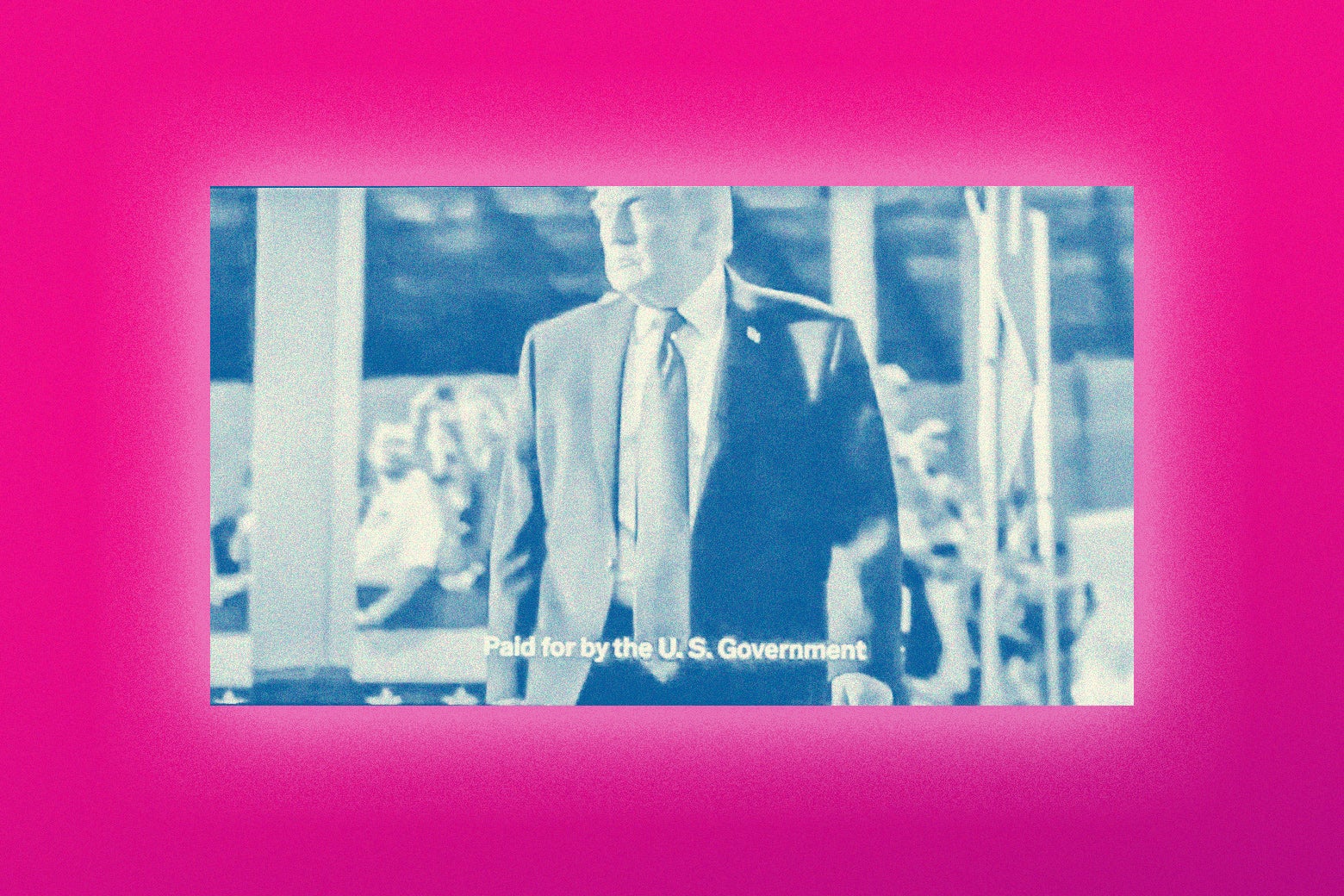
The Slatest Remember the Hatch Act? Neither do we. Photo illustration by Slate. Photo by the U.S. Government. This story is adapted from the Slatest newsletter. You can sign up here to get it in your inbox every day. For weeks, the country has braced for Donald Trump’s next move to help his party win the midterm elections. Would the president find a workaround to restrict mail voting? Would he try to declare martial law? Trump’s latest gambit turns out to be both less inventive and similarly norm-breaking: a TV ad apparently paid for by U.S. taxpayers. The ad is part of a long history of this administration trying to use federal resources to boost GOP candidates in defiance of the long-standing, bipartisan view that governing and politicking should remain as separate as possible. Let’s dive in. Wait, say more about this ad! It’s a lot. The ad (which you can watch here) opens with audio of Trump pledging to “defeat communism, socialism, and Marxism in America” and ends with Ultimate Fighting Championship CEO Dana White praising him as “the toughest, most resilient person that I’ve ever met.” In between, rapid-fire images of American flags, military aircraft, and the president looking tough flit across the screen, punctuated by red block letters of Trump victories (“LARGEST TAX CUTS IN HISTORY,” “REIGNITING AMERICAN MANUFACTURING,” etc.). The whole 30-second shebang is set to the JMSN song “Love Me.” As unsubtle as all of that is, the real doozy drops in the final seconds, when a disclaimer appears stating that the commercial was “Paid for by the U.S. Government.” It has reportedly aired on Newsmax and Fox News so far. In a statement to the New York Times on Thursday, the White House called the ad an “educational and unapologetically patriotic” public service announcement. Uh-huh, sure. And this isn’t the first time this administration has blurred the line between governing and campaigning, right? No sir. As Republicans confront the possibility of a calamitous midterm, several Trump Cabinet secretaries have hit the campaign trail. Bucking the post-Watergate norm that the nation’s top law-enforcement official is supposed to avoid the appearance of partisan bias, Attorney General Todd Blanche has appeared on stage at events for Republican candidates in North Carolina and New York. Last month, Secretary of Defense Pete Hegseth flew to Iowa on a taxpayer-funded military aircraft to attend a fundraiser for Rep. Zach Nunn, an endangered Republican. “We need guys like this man right here having our back in Congress,” Hegseth said. Other high-ranking Trump officials—including Health and Human Services Secretary Robert F. Kennedy Jr. and Treasury Secretary Scott Bessent—spoke at Trump’s midterm rally this month. Last week, Trump posted videos of himself endorsing a series of Republican candidates from the Oval Office itself. Surely there are laws to prevent this kind of thing? Enter the Hatch Act. Passed in 1939, the law bars federal employees from tapping official resources for political acts. It’s true that the president and vice president are exempt. But as the Washington Post explains, Congress has for decades included language in government funding bills banning the use of federal funds for “publicity or propaganda purposes,” including boosting political candidates or parties. Sending Cabinet officials to rallies, filming endorsements from the White House, and spending public money on a Trump-touting TV ad could violate both provisions. “This may be felony criminal theft and conversion of government property for political campaign purposes,” Rep. Jamie Raskin, a Maryland Democrat, said today of the ad, which he called a Hatch Act violation. OK, but couldn’t one argue that everything the president and his top officials do is political in some way? It’s a fair question, and past administrations of both parties have certainly found ways to duck the spirit of the law. When a president running for reelection visits a swing state to announce a new government initiative, are the federal employees who help write his speech involved in governing or campaign work? The Hatch Act also has some loopholes. The Pentagon says Hegseth visited Iowa in his “personal capacity” and that traveling aboard a military aircraft is a security necessity. The Justice Department says Blanche’s campaign “appearances are reviewed and cleared by the Department’s ethics officials” and that he reimburses travel expenses “in accordance with federal law, regulations, and policies.” So does the Hatch Act just not have any teeth? Historically, violations have rarely been punished. Government watchdogs concluded that Secretary of State Mike Pompeo, chief of staff Mark Meadows, and other top officials ran afoul of the Hatch Act during Trump’s first term. Under Joe Biden, press secretary Karine Jean-Pierre and Energy Secretary Jennifer Granholm faced similar accusations. None suffered meaningful consequences. So what’s the bigger lesson here? Trump and his entourage evidently believe that a Republican-controlled Congress will never punish them, so they don’t have to comply with the spirit of any of these rules.Stretching the law is one thing; acting like it doesn’t exist is an escalation driven by a (perhaps justified) sense of impunity. Even if Democrats win back Congress this fall, it’s unlikely to be by a margin large enough to impeach, convict, and remove the president or his top officials. Still, Trump could pay in another way. Significant majorities of Americans already think government corruption has become endemic and many seem to blame Trump for it. If voters decide they don’t like Cabinet officials who treat their jobs like extensions of a political movement and presidents who treat the White House like a campaign backdrop, Trump’s efforts to rescue his party may fail. And if they do, future presidents tempted to follow his example may conclude that bending the rules just isn’t worth it. Tolga Akdoğan OK, let’s shift gears from midterm mischief to evening entertainment. My colleagues recommend that you: Appreciate a music legend’s legacy: Dolly Parton got her start in Nashville as a country star, but she cemented her status as a global icon by courting pop fans. On a new episode of Hit Parade, host Chris Molanphy explains how Dolly blazed a trail for today’s country/pop crossover musicians like “Choosin’ Texas” singer Ella Langley. Savor a celebrity rumor that was too good to be true: For a moment this week, it seemed like Channing Tatum was using a burner Instagram account to leave snarky comments on his ex’s posts. But—spoiler alert—the account isn’t his. Heather Schwedel breaks down this titillating gossip. Search for a song’s deeper meaning: Taylor Swift is expected to drop her new single, “Patient Zero,” at midnight on Friday, so let’s count down the hours with some speculation. Anna Gibbs suggests that the song could be a riff on the loaded history of this term. Contemplate some steamy movie scenes: Prime Video’s new movie The Love Hypothesis is an academic romance based on Star Wars fan fiction. Slate’s Rebecca Onion and Nadira Goffe tackle the most important question: How hot are the sex scenes? With that, enjoy the rest of your night! We’ll be back in your inbox tomorrow. Donald Trump 2026 Midterms
The Latest Sign Donald Trump Is Feeling Scared About the Midterms
Full Article
Original Source
Read the full article at Slate →KhanList aggregates and links to publicly available news content. We do not host full articles from third-party sources. Always verify important information with original sources.