
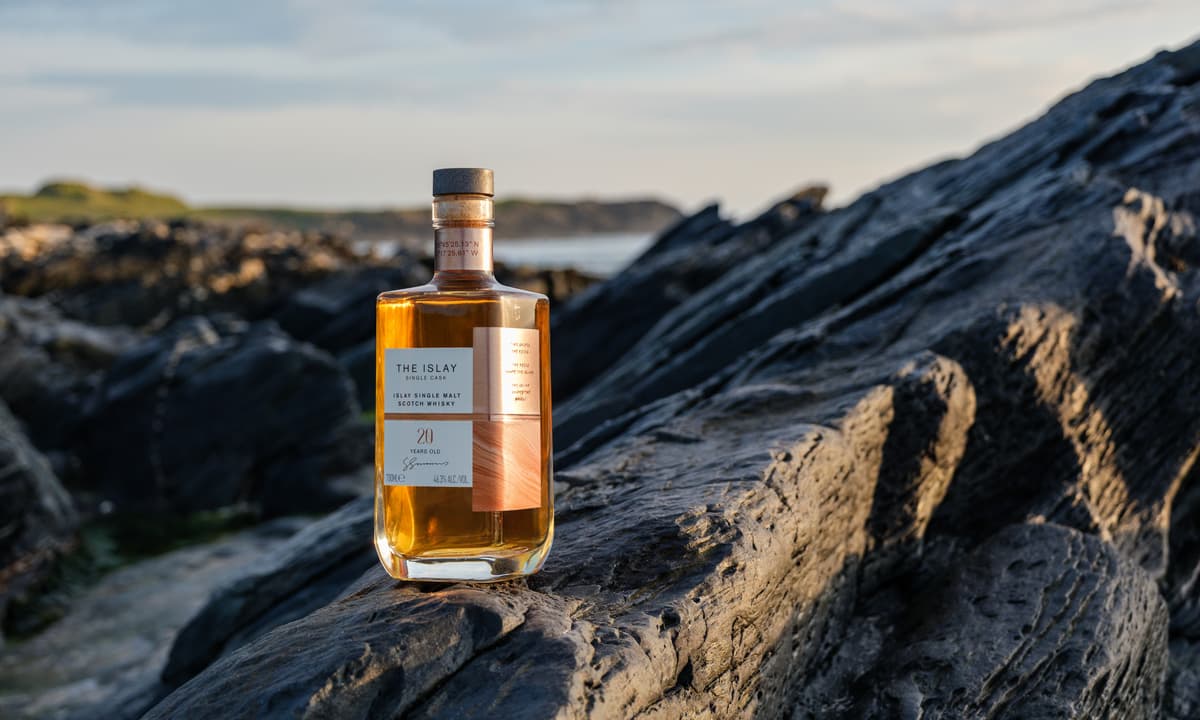
Coral Harker grew up in the circus. Not metaphorically, as some advertising executives might claim, but among the travelling productions of the Gandey family, where horses, aerialists and the occasional clown were everyday business. Her subsequent career in luxury branding might therefore seem an exercise in professional continuity, albeit with fewer trapezes and considerably more expensive bottles.Her latest production, The Islay, is a whisky collection in three acts, conceived with Master of Malt and featuring an unlikely supporting cast: a former Ezra Pound scholar, several million years of geological upheaval and three distilleries whose identities the producers would rather not discuss.At a launch dinner in London Fields, three single-cask malts aged 16, 20 and 30 years made their entrance. The rocks had names. The distilleries did not. Whether this represented a celebration of Islay unencumbered by individual reputations or an unusually elaborate means of avoiding the question everybody wanted answered was initially unclear.The IslayPRESS HANDOUTThe Greatest Show on Earth (and Islay)Harker’s father, Phillip Gandey, became Britain’s youngest circus director at 17, following his father’s death in 1973. He performed as a clown and Wild West character, while his wife Carol worked with horses and dogs and appeared as ringmistress. Their daughters inherited different parts of the family business. Hayley became an aerial performer and artistic director; Mariska a foot juggler and ringmistress. Coral pursued marketing, brand strategy and, eventually, luxury spirits.There is something pleasing about a woman raised among spectacular feats of physical improbability finding professional satisfaction in persuading people to admire a cardboard box. At the launch dinner, one guest suggested that Harker should, in future, sniff and lick the rocks informing her designs. She said she would entertain the idea.Studio Minerva, founded in 2014 by Daniela Nunzi-Mihranian and now led by her alongside managing director Coral Harker, shares its name with the Roman goddess of wisdom, craftsmanship and warfare, who also patronised writers and performers. A suitable deity for an enterprise bringing together a circus dynasty, a literary scholar and expensive Scotch. Minerva herself, one suspects, might have encouraged the geological experimentation.Nunzi-Mihranian’s career has taken her through Design Bridge, Interbrand and Jones Knowles Ritchie, where she helped dress Penhaligon’s gin-inspired Juniper Sling fragrance in an oversized box with a metal bow tie. She also co-founded Cartografie with Kae Shibata, a former Ritz pastry chef. The luxury chocolate venture makes much of the geographical origins of its cocoa. There is an appealing contradiction here. With chocolate, provenance is painstakingly mapped; with whisky, the distilleries initially disappear. Apparently, luxury can be as much about withholding information as supplying it.Minerva’s clients have included Laphroaig, Don Papa and Porte Noire. Making other people’s products desirable was familiar territory. Creating its own required a partner with rather more mature Scotch than the average branding agency’s drinks cabinet.Chance encounters at industry events usually conclude with an exchange of business cards and promises neither party intends to keep. Harker’s meeting with Master of Malt proved rather more productive. She recalled an immediate rapport, its sourcing and bottling expertise complementing Minerva’s design experience. Within approximately a year, The Islay was on sale.Instead of another excursion through distillery folklore, with its familiar procession of illicit stills, heroic founders and atmospheric warehouses, Minerva turned to the island’s geology. Basalt, aged 16 years, costs £99; Red Sandstone, 20 years, £149.95; and Quartzite, 30 years, £499.95. Each is a single malt from a different Islay distillery, bottled at 46.3% ABV.For those understandably reluctant to commit to a full bottle on geological evidence alone, £50 buys a tasting set containing three wax-sealed 30ml samples, one of each expression.Volcanic formation, sedimentation and metamorphosis offer fertile territory for a designer. They are less useful as explanations of flavour. A handsome piece of quartzite no more guarantees an exceptional cask than an attractive postcode guarantees a good restaurant.Harker’s intention was to celebrate the entire island rather than another procession of distillery personalities. Sensible, particularly for an independent bottler whose own distillery exists only in the imagination.The distillery identities are initially concealed, although clues exist for those inclined towards forensic drinking. A seven-character code on each bottle permits investigation of its cask details. To disclose the distilleries here would be rather like revealing the murderer before the first corpse has cooled.Scotch has spent generations persuading us that provenance is paramount. Now comes a whisky suggesting that perhaps we have become rather too interested in the name above the door. Can anonymity make a more convincing argument for authenticity than disclosure?Coral Harker and Dr Sam SimmonsPRESS HANDOUTThe Fossil RecordDr Samuel J. Simmons, Master of Malt’s Head of Whisky, studied Ezra Pound for his doctorate at Edinburgh, where whisky began exercising an attraction beyond literature. He helped devise what The Islay calls a ‘continuous single cask’ collection, an apparent contradiction more interesting than the terminology suggests.A conventional single-cask release ends when the bottles run out. Here, the expression survives, but the whisky changes. The next Basalt will remain 16 years old, bottled at 46.3%, although it will come from another cask, possibly even another distillery.Pound’s celebrated modernist injunction was ‘Make it new’. Simmons appears to have taken him at his word, although in whisky novelty has the considerable inconvenience of needing to be sixteen years old.There is no blending of successive casks to manufacture an immutable house style. Each release remains the product of one cask, with its particulars available to investigate. The drinker is invited to follow the evolution of a name rather than purchase the same liquid indefinitely.Simmons offered a comparison with fossils. Both preserve evidence of circumstances which cannot be recreated precisely. A cask records its own circumstances of distillation, maturation and time. Once emptied, that particular combination belongs to history, although with luck somebody will have kept a bottle.His longer ambition is to assemble an evolving encyclopaedia of Islay whisky, documenting differences between casks, years and distilleries. An archive which can be drunk, though presumably not without frustrating future historians.It is a compelling notion, and one which survives removal of the packaging. There is, however, an awkward question. If every successive cask tastes different, what exactly is the returning customer buying?The answer lies less with the designer than with Simmons. His selections must be recognisably related without becoming interchangeable. Too much consistency defeats the purpose of single-cask whisky; too little risks turning Basalt, Red Sandstone and Quartzite into names on expensive boxes.The inaugural whiskies were distilled and matured on Islay, without finishing, added colour or chill filtration. Reduction to 46.3% takes approximately two weeks. It is encouraging to encounter an enterprise which has not attempted to improve mature whisky by dispatching it on an unnecessarily complicated tour of miscellaneous wine casks.There was even discussion of playing rock music to maturing casks. The Islay’s whiskies have apparently been spared this indignity. After thirty years in a warehouse, the last thing a delicate malt requires is somebody else’s taste in guitar solos.Minerva’s presentation employs tactile surfaces, geological references and a glossed silhouette of the bottle on its box. The effect rewards handling rather than shouting for attention across a shop floor. Harker, whose childhood was spent among people paid to command an audience, understands that spectacle need not always involve somebody swinging from the ceiling.The Highland Laddie at ROCOLO StudiosPRESS HANDOUTThirty Years Without an EncoreThe launch took place at Rocola Studios, where chef Sam Pullan of The Highland Laddie offered a Scottish menu which occasionally took liberties with tradition.A Basalt and Drambuie highball began proceedings, apparently on the principle that one form of Scotch was insufficiently Scottish.Torched mackerel, cured then dressed with whisky caramel, seaweed and broth made from roasted salmon bones, combined sweetness, smoke and a considerable quantity of the sea. The neat spirit told a clearer story than its appearance in the sauce, although nobody could accuse the kitchen of failing to embrace the evening’s subject.Peppered venison came with root-vegetable terrine, a whisky-soaked devil on horseback and a game faggot, an excellent British preparation whose name travels rather less comfortably across the Atlantic than the dish itself.Dessert brought miniature fondant fancies: beetroot and beef, apple with caramelised white chocolate, and dark chocolate. Their familiar appearance made the savoury version a particularly effective ambush. Somewhere, Mr Kipling might have been reaching for his solicitor.Basalt, at 16, is the most forthright. Peach and mango emerge through woody smoke, while maritime salinity prevents the fruit from becoming cloying. There is the suggestion of an extinguished coal fire, followed by melon and something distinctly stony. Sixteen years in wood have done little to discourage its enthusiasm. Its peat remains assertive without overwhelming the more delicate fruit beneath.Red Sandstone, at 20, is the more intriguing proposition. Ashen smoke, almost recalling a recently extinguished ashtray, meets tropical fruit, bubble gum and gummy bears. It sounds like the contents of a particularly delinquent sweetshop, although creamy vanilla wafers, white chocolate and oak bring the whisky back towards adulthood. The finish is composed, with smoke lingering rather than imposing itself. Of the three, it makes perhaps the strongest case for judging what is in the glass rather than speculating about the distillery.Quartzite, at 30, tells a subtler story. As Simmons explained, decades in wood can soften Islay peat, allowing less obvious characteristics to emerge. Here come papaya, grapefruit and flowers, accompanied by darker suggestions of tar, cherries and ripe peach. The palate is generous but surprisingly delicate, with tropical fruit, treacle, vanilla and mature oak preceding a long, savoury suggestion of smoke. The peat has not disappeared. It has simply ceased to be the most interesting person in the room.At £499.95, Quartzite occupies peculiar territory. Thirty-year-old Islay whisky bearing a celebrated distillery name can cost considerably more. Remove the name and one source of prestige disappears, although the liquid remains precisely as old, and no cheaper to produce.Would you pay £499.95 for a whisky whose distillery is initially concealed, or does the name on the label still do some of the drinking for you? An illustrious name guarantees neither quality nor value; anonymity should not automatically be mistaken for a bargain. Ultimately, the glass must justify the price. Cardboard, however handsome, can only do so much.The Islay marks the beginning of a longer association between Studio Minerva and Master of Malt. Its real examination will come with subsequent casks, when returning customers discover whether the latest performance lives up to the one they remember.Harker should recognise the predicament. A circus performance is never precisely repeatable, however familiar its programme, performers or costumes. Each evening exists for its audience and then disappears. Here, the bottles and geological identities provide the recurring programme; the casks supply the performances.Whether the audience returns for the next act will be the real test. After all, the greatest trick in whisky is not persuading somebody to buy an expensive bottle once. It is making them want to discover what happens when that bottle no longer exists.
The Islay: The Greatest Show on Earth, Bottled
Full Article
Original Source
Read the full article at Standard →KhanList aggregates and links to publicly available news content. We do not host full articles from third-party sources. Always verify important information with original sources.