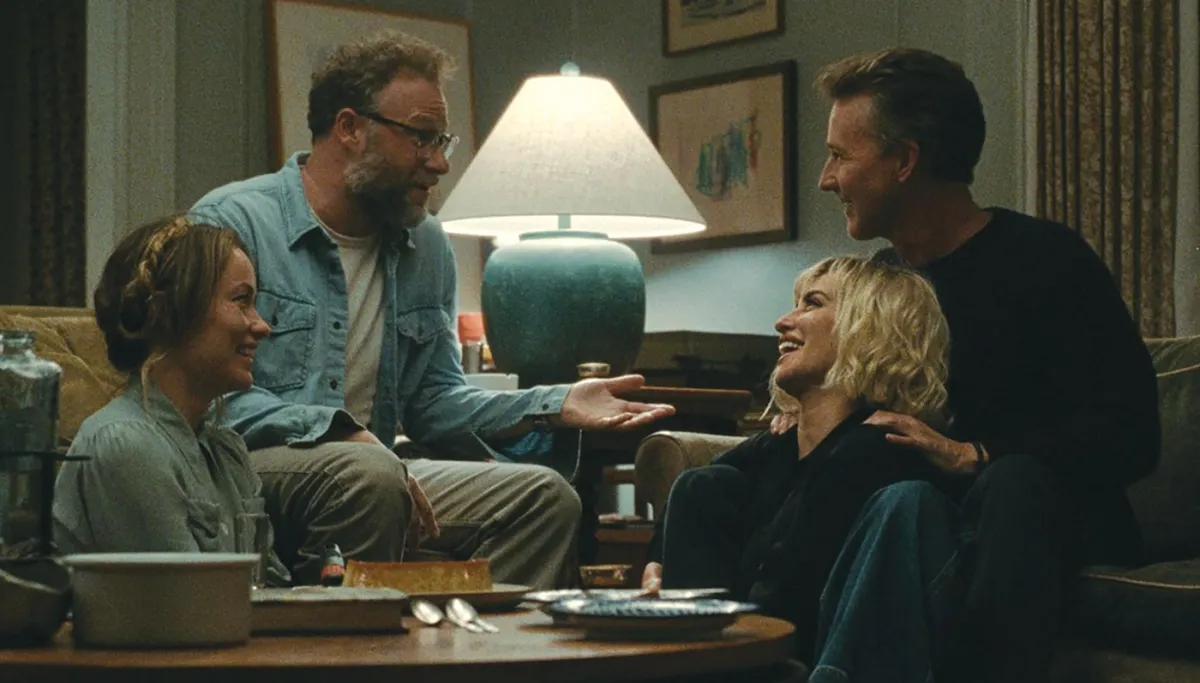
“One should always be in love,” reads the quote by Oscar Wilde that opens the rancid new comedy-drama The Invite. “That is the reason one should never marry.”Of course, works of art about unhappy marriages have been produced since time immemorial, but many earlier entrants existed within societies that still regarded healthy, contented marriages as the norm. For example, in Edward Albee’s 1962 play (and the 1966 film by Mike Nichols) Who’s Afraid of Virginia Woolf?, the splenetic antagonism of the middle-aged academic couple George and Martha was shocking because it was not assumed to be a natural state of affairs. Their marriage, weighed down by deception and vengefulness, was clearly an anomaly. Yet countless contemporary movies, from Sam Mendes’s American Beauty (1999) to Noah Baumbach’s Marriage Story (2019), take marital decay as a given and assume that, far from being shocked by it, many viewers will relate to it. Sadly, that assumption is probably correct, but it doesn’t make the movies worthwhile. With The Invite — a remake of a 2020 Spanish-language film that has happily escaped my notice — director and costar Olivia Wilde makes further, creepier assumptions: that some audiences have become so desensitized to aberrant behavior that they will not only accept the central couple, Joe (Seth Rogen) and Angela (Wilde), and their expressions of hostility and indifference but will tolerate other once-transgressive behavior, such as casual marijuana use among characters coded as non-losers, open marriages, and even so-called “sex parties,” all of which are plot points in this profoundly bad movie.Penelope Cruz and Olivia Wilde in “The Invite.” (Courtesy of A24) Who’s Afraid of Virginia Woolf? had the decency to locate George and Martha on the spectrum of marital plausibility — yes, they are miserable with and toward each other, but not irretrievably or irrationally so — but The Invite imagines Joe and Angela as being so fatigued and so wanton as to consider the abandonment of their vows on a whim. That the film (spoiler alert) suggests an eleventh-hour rapprochement is an entirely unpersuasive concession to conventional mores that Wilde (the director-actress, not the poet-playwright) plainly does not believe in.Another distinction between Virginia Woolf and The Invite: George and Martha, played in the film by Richard Burton and Elizabeth Taylor, are somewhat companionable even in their unpleasantness. But Joe and Angela are irredeemably insufferable. Are we supposed to laugh when Joe, who teaches at a San Francisco music conservatory, is so disinterested in a class rehearsal that he walks out before it is over? Are we meant to chuckle when Angela, greeting her husband upon his arrival home, barks, hatefully, “Shoes off, please”? These two live in the lap of luxury — their impeccably furnished apartment is weakly accounted for when it is revealed that Joe has inherited it — but they use it mainly as a site to squabble and spar.The reasons given are lame in the extreme: there is talk of Joe having been made sad by the dissolution of his mid-2000s band, and feminist-approved insights into the allegedly dull home life of Angela, who nonetheless seems to have access to unlimited funds to buy rugs, fancy cheeses, and new clothes. Grow up, people — show some appreciation for the fruits of American capitalism. That they share a daughter gives neither pause about excoriating one another.Those purchases, incidentally, are prompted by the “invite,” an evening of anticipated schmoozing with Joe and Angela’s upstairs neighbors, retired fireman Hawk (Edward Norton) and sex therapist Pina (Penelope Cruz). As inexplicable as Joe and Angela’s determined unhappiness is Angela’s drive to impress Hawk and Pina. Her strange concern with how she is perceived by them — she literally bought a new rug for the evening — is called out by Joe. This is the only stretch of the film that seems tethered to reality. “’Hawk’ is it — like the bird?” Joe jokingly says of his neighbor’s absurd nickname, but his periodic bursts of common sense are outweighed by the fact that the visitors, as in Virginia Woolf, are never asked to leave.THE NEW ‘SUPERGIRL’ IS A CHEERLESS COMIC BOOK MOVIE Then, in one of the raunchiest plot developments in a mainstream movie in memory, Hawk and Pina make it known that they have opened up their apartment for orgies, a revelation that would cause reasonable hosts to give them the heave-ho but which positively fascinates Joe and Angela. The couple further reveals that the main reason for their visit is to invite Joe and Angela to join their lewd arrangement — which, unbelievably, Joe and Angela agree to do. Here we have the endpoint of our culture of open-mindedness. Wilde maneuvers the film toward an endless series of monologues as Hawk shares the tragic reason for his present lifestyle, while Pina, putting on her therapist’s hat, offers spontaneous counseling for Joe and Angela. Much of what has preceded this has been played for comedy — of a very sick sort — but the denouement, as far as I can see, is meant to be taken at least semi-seriously since it is followed by dramatic scenes of Joe and Angela seeming to part ways before tentatively rekindling … something.Is The Invite suggesting that the institution of marriage is in such shabby shape that only the shock therapy of having insane and amoral neighbors can save it? What’s worse, the film is never even slightly involving except for those scenes in which Joe, speaking for any normal people in the audience, sneers at his neighbors’ outlandish lifestyle. No sane person would argue that this film is as remotely entertaining or edifying as those films that present more virtuous visions of male-female relationships, from Leo McCarey’s The Awful Truth (1937) to John Ford’s The Quiet Man (1952) to Roberto Rossellini’s Voyage to Italy (1954), the last of which honestly portrayed a splintering marriage bandaged by spiritual revelation. To mention those movies alongside the likes of The Invite is to measure how far we have fallen.Peter Tonguette is the Life & Arts editor of the Washington Examiner magazine.
‘The Invite’ with Olivia Wilde and Seth Rogen is full of awful, immoral assumptions
Full Article
📰 Original Source
Read full article at Washingtonexaminer →KhanList aggregates and links to publicly available news content. We do not host full articles from third-party sources. Always verify important information with original sources.