
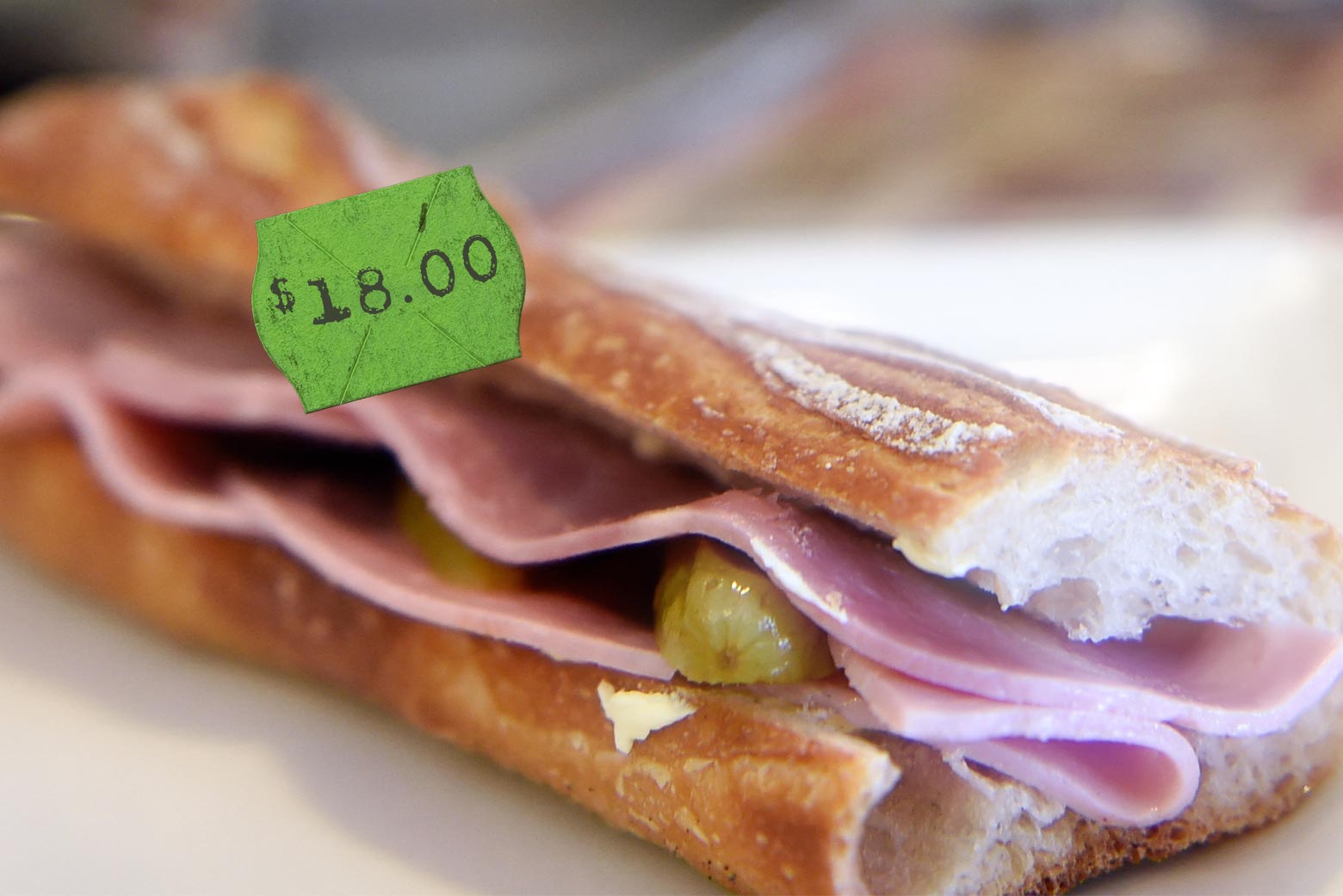
Food In Defense of the $18 Ham Sandwich The internet’s most recent expensive-food-item uproar—over a glitzy jambon-beurre—offers us the opportunity to ponder: How much should it really cost? Photo illustration by Slate. Photos by Loic Venance/AFP via Getty Images and Anjar G/Adobe Stock. Sign up for the Slatest to get the most insightful analysis, criticism, and advice out there, delivered to your inbox daily. One of my favorite media tropes is the old “Look at how expensive this sandwich, pastry, or egg is!” I think it started with avocado toast. Some Australians got all bent out of shape around 2016 over a $22 example—but in Australian dollars, so in real money what could it cost, $10?—and we’ve never heard the end of it. San Francisco, ever the disappointment, was a couple of years ahead of the trend but didn’t even include avocado on its fancy toasts. Philadelphia got more upset than usual in 2022 over cheeseburger inflation. In Chicago, corned beef on rye made the news—turns out Chicagoans will occasionally eat something other than hot dogs doused with pickles (good), peppers (great), and what appears to be minced Army men (unnecessary). L.A., perpetually beyond parody, had a $19 carton of strawberries strawberry. This fall, New Yorkers are aflutter over a $64 loaf of rye bread, which either is well worth it or … tastes like bread. I’ve had about half a dozen people ask me, “Have you heard about the $64 bread?!” as though it’s a party to some sordid prostitution scandal. A $19 strawberry is plainly ridiculous. The $64 rye seems crazy, but apparently the baker is some auteur of the grain. So who knows? A little closer to earth, the most recent example of surprisingly expensive food-item outrage came our way earlier this month, when the New Yorker’s Helen Rosner gave Richaud Vall’s $18 ham-and-butter sandwich—technically a version of the French stalwart jambon-beurre—a glowing review: “The best jambon-beurre in the city,” she wrote. More skeptical individuals have noted that “$18 is cheaper than a flight to Paris.” This seems like a prime opportunity to ask: How extraordinary is a ham sandwich pushing $20? Is there any way it isn’t an overhyped rip-off? I’ll start by saying that it is a delicious sandwich. I went one afternoon and stood in a very long line while elderly New Yorkers subjected the cashier to French they hadn’t practiced in 50 years. Once inside the shop, I saw the frenetic Frenchman himself turning out sandwiches at a hell of a clip, his arms moving so fast he looked like a cartoon octopus. Eventually, “Sandwich for Lawrence of Arabia!” was my cue (evidently), and I had lunch in a park while some pigeons came to terms with the fact that I planned to eat the entire baguette myself. It was a very good sandwich, but again, was it an $18 sandwich? I, one of the world’s most cromulent economists, intend to convince you that it was, or at least that no one is getting pickpocketed for buying it. Richaud’s does use expensive ingredients, but the cost of the sandwich itself is maybe as low as $6 (assuming reasonable quantities of the ingredients and a typical 25 percent wholesale discount). The remaining $12 isn’t profit, though. Many of those dollars are siphoned elsewhere: A lot of labor goes into the process, there’s rent for the space, and the startup costs for a business (even a small sandwich shop) are enormous, especially in New York. First, let’s think about labor. The shop makes bread, so, assuming he can’t do everything himself, Vall needs to employ qualified bakers. He also needs someone working the counter. His daily labor bill is probably in the ballpark of $700, higher if he isn’t himself working the full 64 hours a week the store is open. (This assumes 16 baker hours per day from $18–27/hour and 13 counter hours per day from $17–22/hour, plus FICA.) Next, rent is expensive, at least partly because putting up a new building in NYC is a medieval ordeal administered by joyless community board members. For this storefront (about half of a roughly 1,000-square-foot commercial space), a reasonable rent figure is $345 per operating day (Richaud’s is open six days a week). So far, a $12 margin means selling 87 sandwiches a day to cover labor and rent, but it’s not quite as simple as that. Opening a restaurant, even a small sandwich shop, is expensive anywhere, and very expensive in New York. Costs here vary a lot, but a reasonable estimate is $500,000. A proprietor can either use savings for this or take out a small business loan. For our calculations, the distinction doesn’t really matter: The owner either has to pay interest on a loan or has to earn a worthwhile return on his savings. Let’s assume it’s a loan. Currently, loans can be had at a 10 percent interest rate because they’re federally guaranteed. (No private bankers in their right mind would offer a rate that low without a guarantee because restaurants are very risky.) That implies $50,000 a year in interest for the startup money, adding about $160 per operating day to the shop’s costs, for a running total of $1,205. And so we’re up to 100 sandwiches a day. Now, suppose our zany French protagonist would also like to earn some money himself. The current median hourly wage works out to $30.80. In my little thought experiment, I have him working 64 hours a week all year, which gives us a salary of about $102,500 (in line with the median NYC teacher’s base salary). This adds approximately $330 to the required margin, putting us at $1,535, or 128 sandwiches. That means one sandwich about every five and a half minutes, 10 or 11 hours a day, six days a week, all year. And that’s the (borderline humanly impossible) requirement for doing just all right. It’s not “Now I can open a restaurant empire” money. What’s more, that’s a rosy picture. I left out the electric bill, the gas bill, insurance, spoilage, and the dozens of other expenses that crop up in the course of running a business. So how does the typical small sandwich shop or restaurant make it? Well, often they don’t: The median lifespan of a small business is under five years. For the ones that do make it, it’s not the expensive signature dish that’s helping turn a profit. Items like coffee and pastries are high margin and don’t have to be made to order. They help make the math a little less implausible. In particular to Richaud’s, there’s also a wholesale business selling bread to hotels and restaurants. Finally, there’s scale, which is why a successful restaurant often expands to a second or third storefront, as with a place like Court Street Grocers. Another, often underappreciated aspect of this is that we had a burst of inflation during the pandemic years, and it has remained elevated since. (Blame a virus, overly stimulative fiscal policy, or an idiot for that, whichever you prefer.) Today’s $18 sandwich is 2019’s $14 sandwich. Most of us don’t have experience with inflation this high and find it a little shocking. But in real terms, the price isn’t changing. With all of that said, is there any public policy that could help control the price of our precious sandwiches? Well, yes and no. Remember that much of the cost is labor. Part of the reason a jambon-beurre is cheaper in Paris (say, famously 6 euros when sold as a takeaway side business for which a full restaurant covers the fixed costs, or 13.5 euros in a sandwich shop at a scale of 350 sandwiches a day) is that Americans are significantly richer than the French. This is true whether you look at median disposable income or income after government services are accounted for. (Here’s a much more famous economist—oxymoron?—to explain it.) Insofar as that means the typical worker has good living standards, it’s not exactly a bad thing. What about rent, then? New York could certainly stand to make it possible to build things without years of delays—there is some movement in that direction—but as long as people want to be here, rent is never going to be cheap per se. But we really could do something about the cost of starting a business; it doesn’t have to be a king’s ransom, and even marginal changes (like fixed timelines for issuing permits or eliminating duplicative permit requirements) would help. Ultimately, though, an ironic side effect of living in a rich country—whether it feels that way or not!—is that small-shop prices can be eye-watering and fair at the same time. It’s perfectly reasonable to care about the cost of living, and some personal thrift is laudable (within reason—don’t be annoying). But sometimes a sandwich really does cost $18. Economics Food New York City Restaurants
The Internet Is in an Uproar Over a Haughty Ham Sandwich. We’ve Got the Story of What Really Went Down.
Full Article
Original Source
Read the full article at Slate →KhanList aggregates and links to publicly available news content. We do not host full articles from third-party sources. Always verify important information with original sources.