
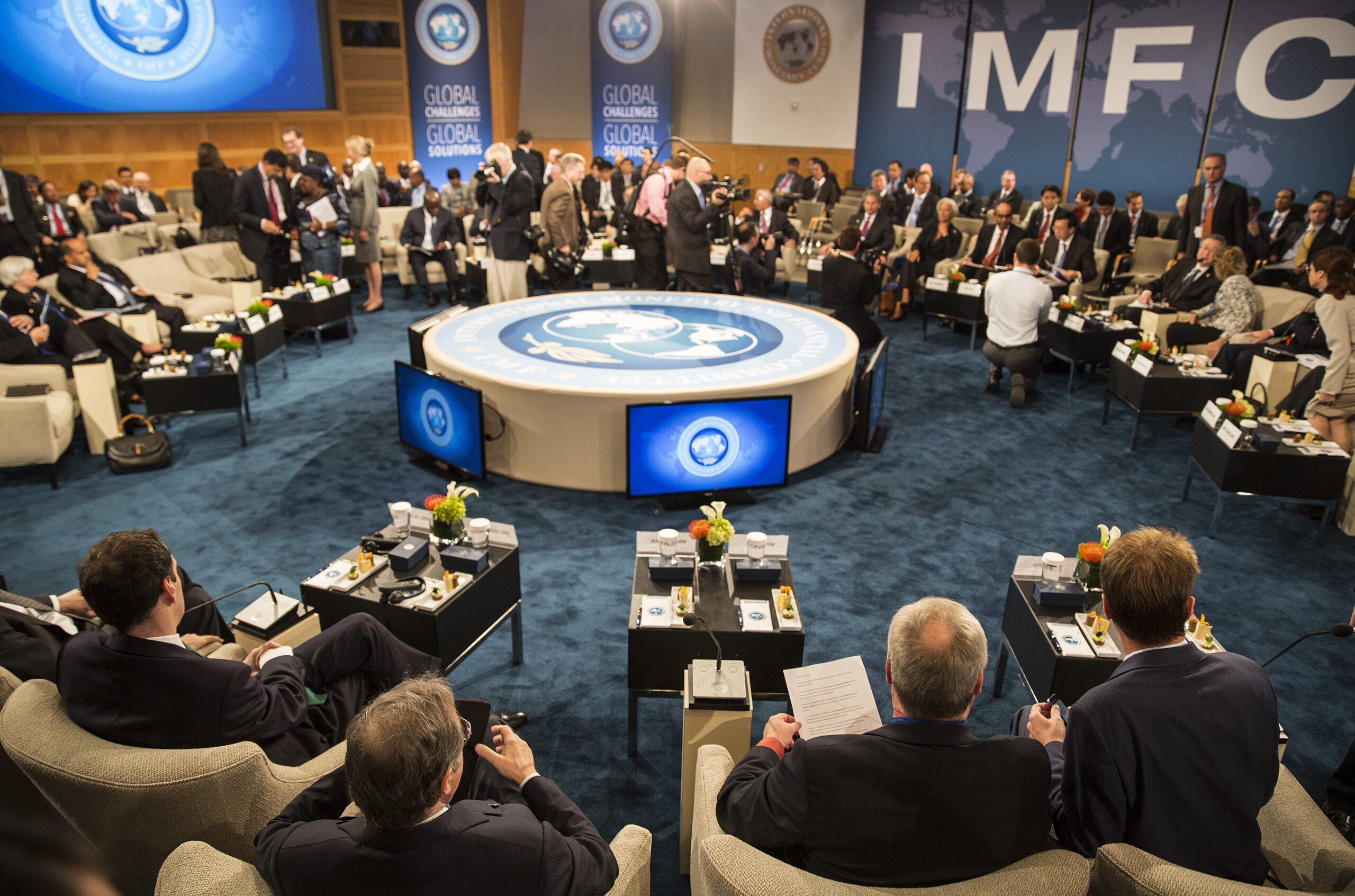
When finance ministers and central bank governors descend on Bangkok next month for the IMF-World Bank Annual Meetings, they’ll do so against the backdrop of overlapping crises, growing global imbalances, and heightened geopolitical tensions. The Iran war has been driving up energy prices and, thus, inflation. The war in Ukraine and the threat of Russian hybrid attacks continue to sow uncertainty in Europe while contributing to higher food prices that have severe consequences for poorer developing countries. Meanwhile, political polarization has been undermining the capacity to pursue economic reforms in advanced economies, and economic tensions have increased as global trade imbalances show no sign of narrowing. Although the International Monetary Fund (IMF) estimates that global growth will still hover at or above 3 percent this year and next, financial valuations are stretched and risks from artificial intelligence have moved to center stage. At the same time, the willingness of major powers to cooperate in a multilateral setting is fading, making it easier for a future shock to turn into a full-blown crisis. For the Bangkok meetings, that leaves a fundamental question: can the IMF continue to perform its most basic function? Can it call out member countries—privately and, if necessary, publicly—for policies that threaten global stability and advocate for remedies that minimize collective risks? Or is the Fund increasingly constrained by the very political and economic tensions it is supposed to help manage? A mandate under pressure The IMF was created to facilitate an open and stable international monetary system. Its Articles of Agreement call on members to avoid competitive exchange-rate depreciation and other policies that prevent effective balance of payments adjustment, while giving the Fund responsibility for firm surveillance over members’ exchange rate policies. The IMF’s mandate is to “promote international monetary cooperation through a permanent institution which provides the machinery for consultation and collaboration on international monetary problems.” That mandate gives IMF management and staff an important voice in the forthcoming meetings. The managing director’s curtain-raiser, the presentation of the World Economic Outlook, and a range of seminars give the institution a platform to present its views directly to the global public. The final communique traditionally plays a lesser role, unlike at the Group of Twenty, where China’s objections to specific language prevented an agreement on a final draft earlier this year. The IMF has unparalleled analytical capacity to underpin its policy advice. Its staff have access to finance ministries, central banks, financial institutions, and data that are unavailable to other organizations. Its annual consultations with major economies provide the Fund with a unique perspective on economic policymaking, and the institution is constantly refining its analytical tools and approach to engaging with its shareholders. But producing good technical work is different from delivering a clear institutional judgment. Recent Article IV consultations have been more forthright in presenting IMF economists’ views of major shareholders. Still, these reports tend to be quietly published on the Fund’s website—and they don’t receive the wide attention that accompanies its flagship products with their more general content. In Bangkok, the IMF therefore faces an important institutional test. Its management should resist the temptation to couch its advice in the language of multilateral consensus. It owes its global membership a clear explanation of how the policies of China, the United States, and Europe interact to weaken global growth and raise financial risks elsewhere. So what should the Fund say? The Fund cannot ignore Chinese excess capacity First, China presents the most consequential challenge. Its industrial policy seeks objectives far beyond conventional support for emerging industries. State-directed credit, fiscal subsidies, preferential access to land and energy, regulatory advantages, and government procurement are being used to establish Chinese leadership in sectors Beijing considers strategically important. These policies have helped China become a world leader in electric vehicles, batteries, solar equipment, and other advanced technologies. They have also created production capacity that domestic demand cannot absorb. China’s external surplus reached 3.8 percent of GDP in 2025, compared with an IMF norm of just above 0.5 percent of GDP that would be justified by economic fundamentals and appropriate policies. The global consequences are increasingly visible as producers elsewhere fail to compete against Chinese firms benefiting from state support. The policy shift needed to change course is laid out clearly in the IMF’s latest Article IV report. China should allow its exchange rate to appreciate meaningfully while redirecting fiscal resources from industrial support and traditional infrastructure toward pensions, health care, unemployment insurance, and household transfers. It should also level the playing field between private and state-owned enterprises and reduce restrictions on foreign direct investment. Western deficits are part of the problem China is not solely responsible for growing global imbalances, however. US and European fiscal deficits are also among the principal drivers of widening current account gaps. An evenhanded assessment must be equally direct about Western policy priorities. The United States is running an excessively expansionary fiscal policy at close to full employment. The Congressional Budget Office projects the federal deficit to rise to almost 7 percent of GDP over the next ten years, while publicly held debt is projected to reach 120 percent of GDP over that period. These are unusual deficits for an economy that’s not in recession. They support domestic demand, attract foreign capital, and contribute to the external deficit. At the same time, however, they also increase financing needs and put upward pressure on global borrowing costs. Because Treasury securities anchor the international financial system, doubts about Washington’s fiscal management could have severe consequences extending well beyond American taxpayers. Tariffs do not resolve this problem. The IMF estimates that higher US tariffs may reduce the trade deficit modestly and raise revenue, but also threaten to raise prices, reduce output, erode supply chain efficiency, and ultimately weaken productivity. They cannot substitute for fiscal consolidation because the external deficit ultimately reflects the gap between national saving and investment. This also implies that protecting selected industries while allowing public debt to rise leaves the underlying imbalance largely intact. Europe needs to adjust course as well. Several large countries face high debt, weak productivity growth, aging populations, and rising defense costs. Stronger growth would help manage these costs, yet the European Union still lacks a fully integrated capital market capable of channeling its substantial savings toward productive investment. It requires deeper capital-market integration, stronger cross-border financial oversight, and more effective coordination in areas where national policies generate European spillovers. At the same time, protectionist responses to Chinese competition risk raising costs without addressing Europe’s structural weaknesses. A moment of truth Although protectionist pressures are clearly on the rise, and two major military conflicts evoke unsettling memories of the 1930s, today’s circumstances differ profoundly from the Great Depression. Still, the underlying dynamic is familiar: domestic problems lead governments to shift adjustment costs abroad through trade restrictions, capital controls, subsidies, and currency policies. This could foster the re-emergence of a trade-policy logic in which tariffs serve simultaneously as a protective tool, fiscal instrument, and geopolitical signal. Retaliation then narrows the scope for cooperation, while lower growth and higher inflation add to economic and political insecurity. The IMF was designed to interrupt that sequence. Its immediate task in Bangkok should be to offer an integrated assessment of the policies driving global imbalances, demonstrating leadership in its core area of expertise by naming the countries responsible and setting out the domestic reforms required of each. The Fund cannot compel its largest members to change course. But if the IMF cannot speak clearly when their policies threaten the global financial stability it is meant to protect, its surveillance mandate will have little practical meaning. The Bangkok meetings will show whether the Fund is prepared to use the authority it still possesses. Martin Mühleisen is a nonresident senior fellow at the Atlantic Council’s GeoEconomics Center and a former International Monetary Fund (IMF) official with decades-long experience in economic crisis management and financial diplomacy. Image: A view of the International Monetary and Financial Committee before its meeting at the World Bank-IMF Annual Meetings in Washington. Source: REUTERS/Joshua Roberts.
The IMF’s big test in Bangkok
Full Article
Original Source
Read the full article at Atlanticcouncil →KhanList aggregates and links to publicly available news content. We do not host full articles from third-party sources. Always verify important information with original sources.